Live in NJ Work in NY: Tax Guide
It’s a tale as old as time for many in the tri-state area: you’ve found your dream job in the bustling heart of New York City, or perhaps even in one of its vibrant surrounding counties, but your home and heart belong across the Hudson River in New Jersey. This seemingly simple arrangement of living in one state and working in another can quickly turn into a head-scratching, nail-biting, annual tax season nightmare. The good news is, you're not alone in feeling utterly bewildered by the state income tax implications of being an NJ resident working in NY. This comprehensive guide is here to untangle that complex web, providing clear, empathetic, and realistic insights into how your state taxes work, why they work that way, and what you need to do to stay compliant without losing your mind (or more of your paycheck than necessary!).
The Unique Tax Challenge of NJ-NY Commuters
If you live in New Jersey and commute into New York for work, you're navigating one of the most complex state tax scenarios in the country. It often feels like you're caught in a financial tug-of-war between two powerful states, each vying for a piece of your hard-earned income. This isn't just a minor inconvenience; it can significantly impact your take-home pay and requires careful attention to detail to avoid penalties.
Why This Situation is So Tricky
The core of the problem lies in the fundamental principles of state taxation. Generally, states assert the right to tax income earned within their borders, regardless of where the earner resides. Simultaneously, a state typically expects its residents to pay tax on all their income, no matter where it was generated. For New Jersey residents employed in New York, these two principles collide head-on. New York, with its historically higher tax rates and its massive economic engine, naturally wants to tax the income earned by anyone working within its geographic confines. New Jersey, on the other hand, wants to tax its residents on their worldwide income, as is typical for most states.
This clash leads to a pervasive feeling of "double taxation." Many commuters look at their pay stubs, see New York taxes withheld, and then dread filing their New Jersey return, fearing they'll have to pay again on the same income. This frustration is completely valid, as the system seems designed to tax you twice. While the tax codes have mechanisms to prevent true double taxation, the process itself is anything but straightforward and often leaves individuals feeling overwhelmed and exploited.
Understanding New York's "Convenience of the Employer" Rule
New York State has a particular set of rules that can further complicate matters, especially in our modern world of remote and hybrid work. While technically referred to as the "convenience of the employer" rule, it primarily impacts New York residents who work remotely from outside the state. For non-residents like those living in New Jersey, the situation is slightly different but still important to grasp.
Historically, if you physically worked in New York, your income was considered New York-source income and was taxable by New York. End of story. However, with the rise of remote work, questions arose about income earned by non-residents working for New York companies from their home states. For non-residents, if you physically perform work duties from your home in New Jersey, that income is generally not considered New York-source income and shouldn't be taxed by New York, even if your employer is based there. This holds true unless your employer requires you to work remotely from your home state because they do not provide you with an office in New York. If the employer does provide an office in New York, and you choose to work from home in New Jersey for your own convenience, New York State may still consider that income to be New York-source income and therefore taxable. This specific interpretation for non-residents is a point of frequent confusion and audit risk, particularly if your employer is not meticulous with their withholding or you're not tracking your workdays diligently. You can dive deeper into the nuances of this rule by exploring our guide on New York Convenience Rule & Remote Work.
Navigating New York's Income Tax for Non-Residents
As a New Jersey resident working in New York, you are considered a "non-resident" for New York State tax purposes. This doesn't mean you get a pass on New York taxes; quite the opposite. It means New York will tax the income you earn within its borders, but only that income.
Who is a Non-Resident for New York Tax Purposes?
For New York tax purposes, you are generally considered a non-resident if your domicile (your true home, the place you intend to return to) is not in New York State, and you did not spend more than 183 days in New York State during the tax year while maintaining a permanent place of abode there. Since your domicile is in New Jersey and you're just commuting for work, you firmly fall into the non-resident category. Understanding the specific definitions for different residency statuses is crucial, and you can learn more about Resident vs Nonresident vs Part-Year Resident in our other articles.
How New York Taxes Your Earned Income
New York State and, if applicable, New York City, will tax the income you earn while physically performing services within their respective jurisdictions. This includes your salary, wages, and commissions from your New York-based job. When you receive your paycheck, you’ll notice that your employer has already withheld New York State income tax, and possibly New York City income tax, directly from your earnings.
The rationale is straightforward: since you are utilizing New York's infrastructure, public services, and benefiting from its economic opportunities while you work, the state (and city) claims the right to tax that income. Your W-2 will clearly show the New York State (and possibly New York City) wages and the corresponding taxes withheld. This is your first step in understanding your tax obligations in this scenario. For example, if you earn $100,000 annually and physically work five days a week in New York, New York will tax all $100,000 as New York-source income. Even if you only spend two days a week physically in New York, a proportionate amount of your income would be considered New York-source.
New York State and NYC Income Taxes for NJ Commuters
Beyond just New York State, many New Jersey residents commute into New York City itself. If your workplace is located within any of the five boroughs – Manhattan, Brooklyn, Queens, The Bronx, or Staten Island – you're not just subject to New York State income tax, but also to New York City’s local income tax. This is an additional layer of taxation that many commuters, especially those new to the area, might not initially anticipate.
New York City’s income tax rates are progressive and apply to residents and certain non-residents with New York City-source income. For a New Jersey resident working in New York City, this means a portion of their income will be subject to this local tax, effectively increasing their overall tax burden from New York. This city tax is also typically withheld directly from your paycheck by your employer. If you're looking for a comprehensive breakdown of these rates, our article on NYC Income Tax Explained (2026 Rates) is a great resource.
Consider someone like Maria, who lives in Jersey City but works as a marketing manager in an office in Midtown Manhattan. Her employer is legally obligated to withhold both New York State income tax and New York City income tax from her wages, treating her earned income as fully sourced to New York. Maria will then receive a W-2 that reflects these withholdings, which she'll use when filing her New York non-resident income tax return.
New Jersey's Approach to Income Earned Out-of-State
While New York is busy taxing your income earned within its borders, New Jersey, your home state, also has a claim on your earnings. This is where the concept of the "credit for taxes paid to another state" becomes your best friend.
New Jersey's Resident Tax Liability
As a bona fide resident of New Jersey, the state expects you to pay tax on all of your income, regardless of where it was earned. This is a common practice among states and aligns with the principle that residents benefit from their home state's services, infrastructure, and amenities. Your domicile in New Jersey means that your entire income, whether from your New York job, a side hustle in New Jersey, or investment income, is considered New Jersey taxable income. For a deep dive into what defines your official tax home, check out our guide on State Tax Residency Rules Explained.
This is precisely why the initial feeling of "double taxation" is so strong. You've already paid New York, and now New Jersey is looking at that same income. Without a specific mechanism to address this, you truly would be taxed twice on the same dollars.
The Credit for Taxes Paid to Another State
Thankfully, New Jersey provides a mechanism to prevent this true double taxation: the credit for taxes paid to another state. This is the cornerstone of tax filing for NJ residents working in NY. Here's how it works:
When you file your New Jersey resident income tax return (Form NJ-1040), you will calculate your total tax liability to New Jersey based on all your income, including the income you earned in New York. Then, New Jersey allows you to take a credit for the income taxes you paid to New York on that same income. The credit essentially reduces your New Jersey tax bill dollar-for-dollar by the amount of income tax you paid to New York on your New York-sourced income.
It's critical to understand the limitation: the credit cannot exceed the amount of tax New Jersey would have imposed on that specific income. In simpler terms, you won't get a refund from New Jersey for taxes you paid to New York if New York's tax rate was higher than New Jersey's on that income. You effectively end up paying the higher of the two states' tax rates on the income earned in New York. So, while it feels like you're filing two returns, you're not paying 100% to each state on the same dollar. You're simply reconciling what's owed. For a more detailed breakdown of this crucial credit, our article on Credit for Taxes Paid to Another State is an invaluable resource.
Filing Your New Jersey Resident Return
To properly claim this credit, you'll file Form NJ-1040, New Jersey Resident Income Tax Return. On this form, you’ll report all your income, including the wages earned in New York. You'll then calculate your New Jersey tax liability. Schedule NJ-COJ (Credit for Taxes Paid to Other Jurisdictions) is the form you'll use to calculate and claim your credit for taxes paid to New York.
It’s absolutely vital to accurately report your New York-source income and the New York taxes paid on it. Errors here can lead to underpayment, penalties, or delays in processing your return. Many tax software programs like TurboTax are designed to walk you through this process, making the calculation of the credit relatively seamless. However, even with software, understanding the underlying principles ensures you're inputting the correct information. Keep all your W-2s and New York tax return forms handy when preparing your New Jersey return.
The Absence of Reciprocity: Why NJ-NY is Different
One of the most common questions from commuters is, "Why can't I just pay taxes to my home state like my friend who lives in Pennsylvania and works in Ohio?" The answer lies in the specific agreements (or lack thereof) between states.
What are State Tax Reciprocity Agreements?
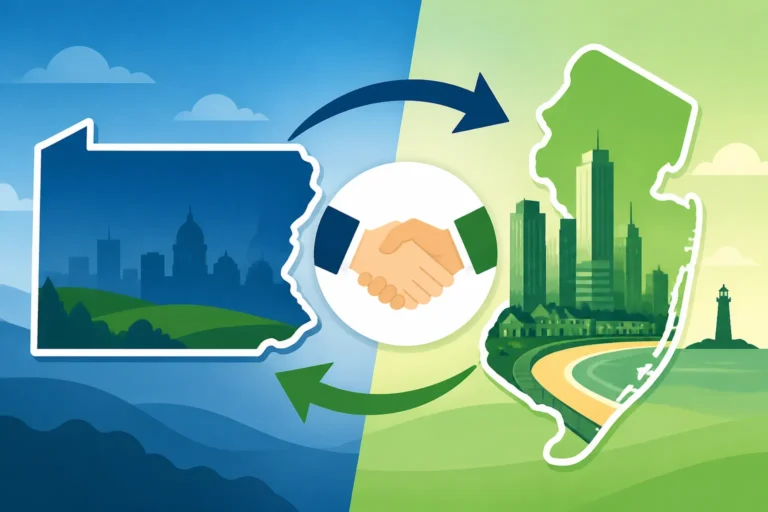
State tax reciprocity agreements are special arrangements between two states that simplify tax filing for residents who commute across state lines for work. Under a reciprocity agreement, an individual typically only pays state income tax to their home state, even if they earn income in the other state that has the agreement. The employer in the work state usually withholds taxes for the employee's home state, or the employee can claim an exemption from withholding in the work state. This streamlines the process significantly, as it largely eliminates the need to file non-resident tax returns in the state where income was earned. For example, if you live in Pennsylvania and work in New Jersey, you'd only pay tax to Pennsylvania because these two states have a reciprocity agreement. Our comprehensive guide on State Reciprocity Agreements Explained provides a full overview of these beneficial arrangements.
Why New Jersey and New York Don't Have Reciprocity
Here's the critical point for NJ-NY commuters: New Jersey and New York do not have a reciprocity agreement. This is not an oversight; it's a deliberate choice rooted in revenue generation and state fiscal policies. New York is a high-tax state that generates substantial revenue from commuters who work within its borders, particularly from high-earning individuals in New York City. Giving up this tax revenue through a reciprocity agreement would represent a significant financial loss for New York.
Conversely, New Jersey also benefits from taxing its residents on all their income, though it does offer the credit to prevent double taxation. The lack of reciprocity means that the "default" rule applies: New York taxes what you earn there, and New Jersey taxes you as a resident on all your income, with the credit mechanism in place to reconcile the two. This is precisely why commuters face the complexity of filing two state returns every year. You can delve into the specific implications of this absence of agreement by reading our detailed article on NJ-NY Commuter Taxes (No Reciprocity).
The Impact on Your Paycheck and Withholding
Because there's no reciprocity, your New York employer is legally required to withhold New York State income tax (and New York City income tax, if applicable) from your paychecks. They must treat your income as New York-source income, and they cannot simply opt to withhold New Jersey taxes instead. This means that a significant portion of your income tax liability for your New York-earned wages is remitted directly to New York throughout the year.
The consequence of this is that you must then account for this in your New Jersey tax planning. If your employer is withholding for New York, and you're also having New Jersey taxes withheld at a rate that assumes no credit, you could easily be over-withholding for New Jersey. While an overpayment means a larger refund, it also means you've given the state an interest-free loan throughout the year. Conversely, if you reduce your New Jersey withholding too much without fully understanding your final liability, you could face an underpayment penalty come tax time. This delicate balance requires careful attention to your W-4 forms for both federal and state purposes.
Practical Strategies for NJ-NY Commuters
Dealing with the NJ-NY tax labyrinth can be daunting, but with a few practical strategies, you can minimize stress and ensure you're compliant without overpaying.
Adjusting Your Withholding
This is arguably one of the most proactive steps you can take to manage your cash flow throughout the year. Since your New York employer is automatically withholding New York State and possibly New York City income taxes, you need to ensure your New Jersey withholding reflects this.
- New York Withholding (Form IT-2104): Your employer will typically have you complete a New York Form IT-2104, Employee's Withholding Certificate. Since you're a non-resident, your goal here is generally to ensure sufficient New York tax is withheld based on your income earned in New York. You likely won't make significant adjustments here unless you have specific deductions or credits impacting only your New York liability.
- New Jersey Withholding (Form NJ-W4): This is where you can make a significant difference. While you'll owe New Jersey tax on your entire income, the credit for taxes paid to New York means you won't pay both in full. You can adjust your New Jersey Form NJ-W4 to account for the credit you anticipate receiving. The goal is to avoid overpaying New Jersey throughout the year, as you'll already be paying New York. Many people find they can claim more allowances on their NJ-W4 or even request specific additional amounts not to be withheld, to better balance their payments. However, extreme caution is advised. If you reduce your New Jersey withholding too much and New York's tax on your income ends up being less than New Jersey's, you could owe a substantial amount to New Jersey at tax time or even face an underpayment penalty.
- Estimated Payments to New Jersey: For some, especially those with variable income or high earnings, adjusting withholding alone might not be enough. In such cases, making quarterly estimated tax payments directly to New Jersey (using Form NJ-1040ES) can be a smart move. This ensures you're meeting your New Jersey tax obligations evenly throughout the year and avoid a large bill and potential penalties when you file.
Utilizing Tax Software and Professional Help
Given the complexity of filing in two non-reciprocal states, leveraging the right tools and expertise is invaluable.
- Tax Software: Modern tax preparation software, such as TurboTax, H&R Block, or TaxAct, is designed to handle multi-state filing scenarios precisely like this. These programs guide you through reporting your income to both New York and New Jersey, automatically calculating the credit for taxes paid to other states. They streamline the process by first completing your non-resident New York return, then using that information to calculate the credit on your resident New Jersey return. This significantly reduces the chances of errors that could occur with manual calculations. Many commuters find TurboTax particularly user-friendly for navigating these specific forms. If you're wondering which platform is best for your situation, our article on Best Tax Software for Multiple States can offer guidance.
- Professional Tax Preparers: For individuals with higher incomes, complex financial situations, or simply a desire for peace of mind, consulting a tax professional who specializes in multi-state taxation is highly recommended. A qualified CPA or enrolled agent can ensure all deductions and credits are properly claimed, verify correct income sourcing, and advise on optimal withholding strategies. Services like SmartAsset can help connect you with local tax professionals who have expertise in these specific cross-state filing issues. They can also help you understand the nuances of working from home periodically while commuting, which can have different tax implications.
- Keeping Meticulous Records: Regardless of whether you use software or a professional, you are your own best advocate by maintaining excellent records. Keep all W-2s, pay stubs, and any other income statements. If you split your work time between New Jersey and New York, keep a detailed log of the days you physically worked in each state. This becomes crucial if you ever need to justify your income sourcing during an audit, or if you want to ensure you're not overpaying New York on income earned while working in New Jersey. For more on managing your tax records when you live in one state and work in another, check out our guide on Working in One State, Living in Another: Tax Guide.
A Quick Glance at NJ-NY Filing
Here's a simplified table to help visualize the main filing requirements:
| Aspect | New York (Non-Resident) | New Jersey (Resident) |
|---|---|---|
| Form Used | IT-203 (Nonresident and Part-Year Resident Income Tax Return) | NJ-1040 (Resident Income Tax Return) |
| Income Taxed | Only income earned within New York State (and NYC, if applicable) | All income, regardless of where earned |
| Withholding | Employer withholds NYS (and NYC) tax | Employer withholds NJ tax (adjust via NJ-W4) |
| Key Mechanism | No specific credit for non-residents, you just pay tax on NY-source income | Credit for Taxes Paid to Another State (NY) |
| Purpose of Filing | Report NY-source income and NY taxes paid | Report all income, claim credit for NY taxes |
| Reciprocity | None with New Jersey | None with New York |
| Potential Outcome | NY tax liability, possibly refund or balance due | NJ tax liability reduced by NY credit, possibly refund or balance due |
Understanding Common Pitfalls and Misconceptions
The NJ-NY tax situation is ripe for misunderstandings, and falling for common pitfalls can lead to unnecessary stress, penalties, or even an audit.
The Myth of "Double Taxation"
Let's put this one to rest once and for all. While it absolutely feels like you're paying taxes twice, the mechanism of the credit for taxes paid to another state prevents true double taxation. You are not paying 100% of your income tax to New York and then another 100% to New Jersey on the same dollar. Instead, New Jersey allows you to subtract the taxes you've paid to New York from your New Jersey tax liability on that shared income.
The practical outcome is that you end up paying the higher of the two states' effective tax rates on the income earned in New York. If New York's rate on your income is higher, you'll effectively pay that rate, and your New Jersey credit will reduce your NJ liability on that income to zero. If New Jersey's rate is higher, you'll pay the New York portion first, then pay the difference to New Jersey. The system is designed to avoid confiscating 200% of your tax dollars, but it certainly doesn't simplify the process. Understanding this mechanism is key to managing your tax expectations and avoiding unnecessary worry. Our article on How to Avoid Double Taxation Between States delves into this in more detail.
Misclassifying Residency or Income
One of the most dangerous mistakes an NJ-NY commuter can make is incorrectly classifying their residency status or misrepresenting the source of their income. This can trigger serious consequences from both states.
- Incorrectly claiming non-residency in New Jersey: If you are truly a New Jersey resident but try to file as a non-resident to avoid paying New Jersey taxes, you're exposing yourself to significant audit risk. New Jersey will expect its residents to file a resident return and report all income.
- Incorrectly claiming New York residency: Some individuals might consider claiming New York residency to simplify filing, but this comes with a host of other implications, including being subject to New York taxes on your entire worldwide income, not just what you earn there. Changing your domicile is a serious legal and tax undertaking, requiring substantial proof of intent and actions (e.g., changing driver's license, voter registration, bank accounts, etc.). Simply working in New York does not make you a New York resident.
- Misrepresenting income sourcing: As discussed earlier, if you primarily work remotely from your New Jersey home for a New York employer, but for your convenience, correctly sourcing that income can be tricky. Attempting to artificially shift income from New York to New Jersey to reduce your New York tax burden without legitimate justification (like actual physical workdays in NJ where no NY office was available) can lead to penalties if discovered. New York's tax authority, the Department of Taxation and Finance, is known for its rigorous residency audits, particularly for those trying to reduce their New York tax liability. You can read more about what triggers these audits in our New York Residency Audit Explained guide.
These situations can lead to audits, back taxes, penalties, and interest, making an already complex situation even more stressful and costly. When in doubt, always err on the side of caution or seek professional advice.
Remote Work Considerations for NJ Residents Working for NY Companies
The COVID-19 pandemic threw a huge wrench into the traditional "live in NJ, work in NY" model, as many commuters suddenly found themselves working exclusively from their New Jersey homes. This created significant confusion.
As a general rule, for non-residents, income is sourced to the state where the work is physically performed. So, if an NJ resident is working remotely from their home in New Jersey for a New York-based company, that income should generally be considered New Jersey-source income, not New York-source income. This means New York should not tax that income.
However, there's a caveat. New York's infamous "convenience of the employer" rule, while primarily targeted at New York residents who choose to work remotely, can create some gray areas for non-residents. If a New Jersey resident works remotely for a New York employer, and the employer requires them to work from New Jersey because there is no available office space for them in New York, then the income is clearly New Jersey-source. But if the employer does provide office space in New York, and the employee chooses to work from home in New Jersey for their own convenience, New York might argue that the income is still New York-source and thus taxable by New York.
This particular interpretation is highly contentious and has been challenged. Many tax professionals advise that for non-residents, actual physical presence should dictate sourcing. However, to avoid issues, it’s prudent to:
- Communicate with your employer: Ensure they are properly withholding taxes based on where you are physically performing your work.
- Track your workdays: Maintain a detailed log of which days you worked in New Jersey versus New York.
- Consult a tax professional: If you have a hybrid work arrangement or primarily work remotely from New Jersey for a New York employer, get expert advice to ensure you're reporting income correctly to both states.
Navigating the tax implications of living in New Jersey and working in New York requires diligence, understanding, and often, professional guidance. By understanding the rules, utilizing available tools, and avoiding common misconceptions, you can manage your tax obligations effectively and confidently.
Disclaimer
Please note that tax laws are complex and subject to change. The information provided in this guide is for informational purposes only and does not constitute professional tax advice. Always consult with a qualified tax professional or financial advisor for advice tailored to your specific situation.