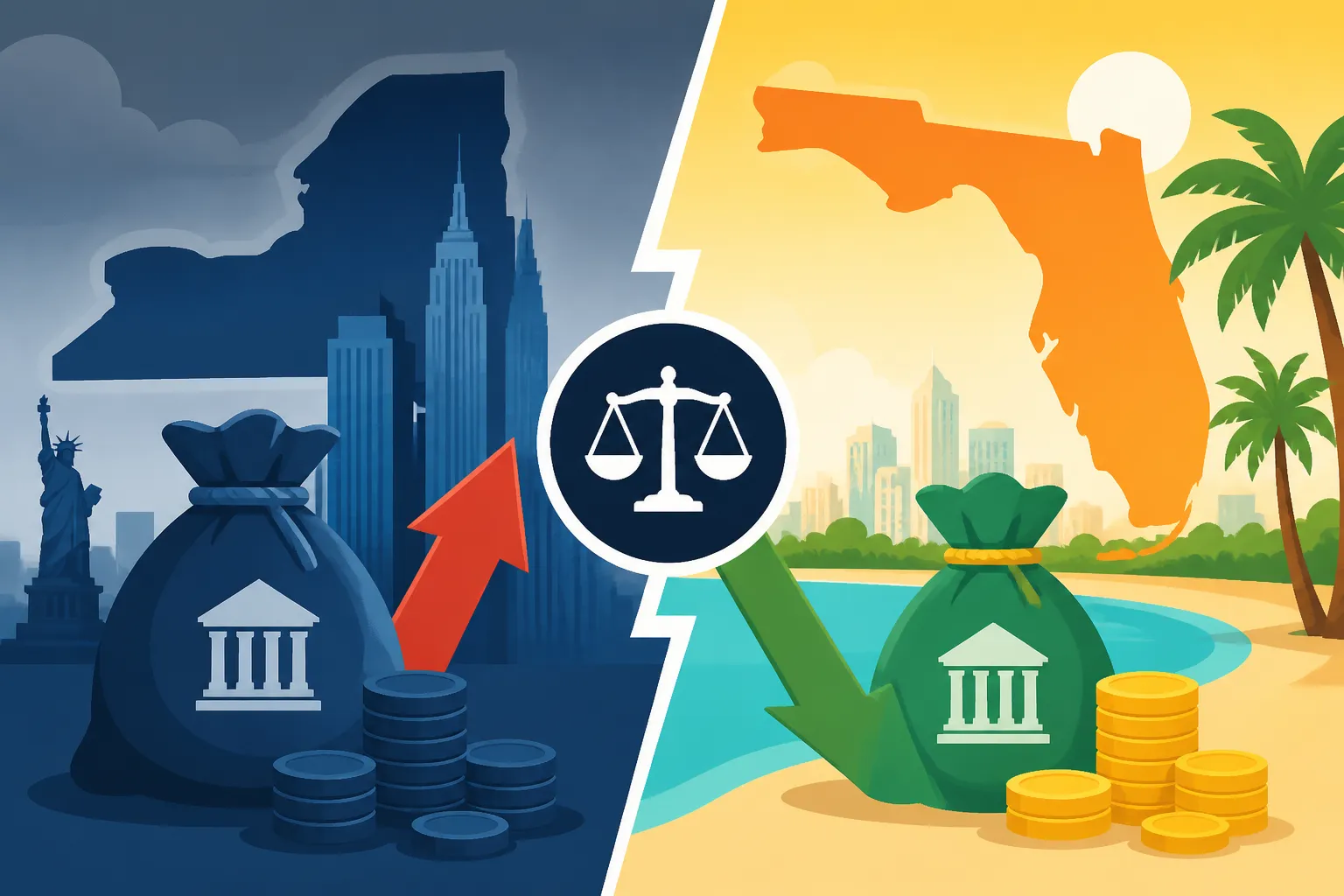
New York vs Florida Taxes Compared
Deciding where to call home, especially when you're thinking about a big move, often comes down to more than just the weather or job opportunities. For many, the sting of state income taxes, or the lack thereof, can be a massive deciding factor. It's a huge pain point for individuals and families alike, and trying to decipher which state will truly leave more money in your pocket can feel like navigating a maze. This guide is here to shed some much-needed light on the tax differences between New York and Florida, offering a clear, in-depth comparison to help you understand what each state truly offers your finances.
The Income Tax Divide: New York's Progressive System vs. Florida's Zero Tax
When you start comparing New York and Florida, the most glaring difference in their tax structures jumps out immediately: income tax. It's a fundamental distinction that impacts nearly every working individual and retiree in these states, shaping everything from your monthly paycheck to your overall financial planning.
New York's Progressive Income Tax Structure
Ah, New York. The Empire State is known for many things – bustling cities, stunning natural beauty, and yes, its progressive state income tax system. This means that as your income rises, so does the percentage you pay in state income tax. It's not a one-size-fits-all approach; instead, the state divides income into various brackets, with different rates applying to different portions of your earnings. This system is designed to place a higher tax burden on higher earners, a common characteristic of states that aim to fund robust public services through income taxation. For a deeper dive into how this all works, you might find our guide on New York Income Tax Brackets 2026 quite helpful.
For instance, someone earning $50,000 in New York will pay a much lower effective state income tax rate than someone earning $500,000. It’s not just the state, either. If you’re living and working in New York City, you’re also facing a local city income tax on top of your state taxes. This can significantly increase your overall tax obligation. Many residents, especially those in the five boroughs or surrounding high-cost-of-living areas like Westchester or Long Island, feel the squeeze. Imagine a nurse working in Manhattan making a good salary; they're not just paying federal and state taxes, but also a specific percentage to New York City, which can be a real shock if you're not prepared for it. Our detailed explanation of NYC Income Tax Explained (2026 Rates) covers this local impact thoroughly. The cumulative effect of these taxes means that a significant portion of your income goes towards supporting state and local services, from public transportation to schools and infrastructure.
Florida: The Sunshine State's Income Tax Freedom
Now, let let's pivot to the Sunshine State, Florida. This is where the tax landscape truly shifts. Florida is one of the few states in the U.S. that proudly boasts no state income tax. That’s right – zero, zip, nada. For many, this is the single most compelling reason to consider a move to Florida, especially if you're coming from a high-tax state like New York. This lack of a state income tax means that every dollar you earn from wages, salaries, business profits, or even most investment income isn't subject to an additional state-level deduction. It means more take-home pay for workers and potentially larger gains for investors.
This policy has made Florida a magnet for high-earners, entrepreneurs, and retirees looking to maximize their income and savings. Think about a successful tech entrepreneur in Miami, for example; they're certainly appreciating that extra percentage of their earnings staying in their pocket rather than going to state coffers. This also extends to capital gains and interest income, which, absent a state income tax, are also not taxed by Florida. While there are other taxes to consider, the absence of an income tax is a massive financial boon. If you're pondering a relocation, understanding this core difference is paramount, and it's a huge reason why many people ask, "Is Florida Tax Friendly for Workers?" The answer, from an income tax perspective, is a resounding yes. Florida is consistently listed among the States With No Income Tax (2026 Full List) because this policy is a cornerstone of its economic appeal.
Beyond Income: Property Taxes, Sales Taxes, and Other Levies
While state income tax often dominates the conversation, it's crucial to remember that it's just one piece of the puzzle. Both New York and Florida levy other significant taxes that can dramatically affect your overall financial burden. To get a true sense of which state is "cheaper" or "more tax-friendly," you need to look at the whole picture, from where you live to what you buy.
Property Tax Comparison: High Values, Varied Rates
Property taxes are a major consideration, especially for homeowners. Both New York and Florida have property taxes, but how they’re calculated and their overall impact can vary wildly. New York is notorious for some of the highest property tax rates in the nation, particularly in suburban areas surrounding Newileges of New York City. Areas like Westchester County, Nassau County, and Suffolk County on Long Island often see average effective property tax rates well over 2% of a home’s value, and sometimes significantly higher. This means if you own a home valued at $600,000 in one of these areas, you could easily be looking at annual property tax bills of $12,000 or more. Even within New York City, while the rates might look lower, the sky-high property values can still result in substantial tax bills.
Florida's property taxes, while not as low as some might hope given the no-income-tax reputation, are generally more moderate than New York's. The statewide average effective property tax rate often hovers around 0.9% to 1.0% of a home's value. However, this is an average, and rates can differ quite a bit from county to county. For example, a beachfront condo in Miami-Dade County might have a higher effective rate or a much higher assessment than a suburban home in Polk County. What’s more, Florida offers generous homestead exemptions, which can significantly reduce the taxable value of a primary residence for residents. This means if you own a home you live in, a portion of its value is exempt from taxation, effectively lowering your bill. For a homeowner in Orlando, this could save them hundreds or even thousands of dollars annually, a benefit not as widely available or as substantial in New York. A good resource like SmartAsset often provides tools to compare property tax burdens across different locales, which can be incredibly insightful.
Sales Tax: Similar Rates, Different Impacts
Sales taxes are another common revenue stream for states, impacting nearly every purchase you make. On the surface, the state sales tax rates in New York and Florida are quite similar. New York's statewide sales tax rate is 4%, but local sales taxes can push the combined rate much higher. For instance, in New York City, the combined state and local sales tax rate is 8.875%, one of the highest in the country. This means that a $100 purchase of clothing or electronics will cost you almost $109 at the register. Other counties across the state also have varying local sales tax rates, typically ranging from 7% to 8.875% total.
Florida has a statewide sales tax rate of 6%. However, like New York, many counties add their own discretionary sales surtaxes, which can raise the combined rate. For example, in Pinellas County (where St. Petersburg is located), the combined sales tax rate is 7%, while in Miami-Dade County, it's 7%. So, while the baseline state rate is higher in Florida, the overall combined rates in many areas aren't drastically different from some of New York's less urban areas. However, the sheer volume of purchases in a dense urban environment like NYC means people living there will likely feel the sales tax pinch more frequently and more intensely than someone living in a smaller Florida town, even if the rates are numerically close in some instances. It's about how much you're spending and where.
Other Taxes to Consider: Estate, Inheritance, and Intangible Taxes
Beyond income, property, and sales taxes, both states have other lesser-known levies that can affect your financial planning. New York is one of the few states that still imposes an estate tax. This means that if your estate exceeds a certain threshold (which changes periodically but is currently around $6.94 million for deaths occurring in 2024), a portion of your assets could be subject to state estate tax upon your passing. This is a significant consideration for wealthy individuals and families when planning their legacy.
Florida, on the other hand, does not have a state estate tax or an inheritance tax. This is another major draw for retirees and those with substantial assets, as it means their beneficiaries won't face an additional state tax bite on their inheritance. Florida also doesn't impose intangible personal property taxes on things like stocks, bonds, or other financial assets, a tax that some states have historically levied. These differences in estate and "wealth" taxes are critical for long-term financial planning, especially when considering your ultimate domicile. Understanding how to navigate these implications, particularly when contemplating a significant move, often requires a careful review of State Tax Residency Rules Explained.
The Full Picture: Cost of Living, Deductions, and Overall Tax Burden
Comparing state taxes isn't just about looking at individual rates; it's about evaluating the total financial picture. A lower tax rate in one area might be offset by higher costs in another, or vice versa. It’s a dynamic interplay that impacts your budget, your savings, and your quality of life. Thinking about where your dollar truly stretches the furthest requires a holistic view.
Cost of Living: More Than Just Taxes
This is where things get really interesting. While Florida proudly waves its no-income-tax banner, the cost of living in certain parts of the state can be surprisingly high, especially in popular coastal areas or major metropolitan hubs like Miami, Fort Lauderdale, or Naples. Housing costs, while generally lower than in high-demand areas of New York, have seen significant increases in recent years. Rent for a decent apartment in South Florida, for instance, can rival prices in some non-NYC parts of New York State.
New York, despite its higher taxes, also presents a vast spectrum of living costs. New York City is infamous for its astronomical housing prices, utility bills, and everyday expenses. However, upstate New York offers much more affordable housing and a lower cost of living overall. So, moving from, say, Buffalo, New York, to Tampa, Florida, might present a different financial equation than moving from Manhattan to Miami. It's truly a "Cost of Living vs Taxes by State" analysis. What you save in income tax in Florida might quickly get eaten up by higher homeowner's insurance (a significant concern in hurricane-prone regions), increased property values in desirable areas, or even just the cost of a daily cup of coffee in a tourist hotspot. SmartAsset, for example, often features detailed cost of living comparisons that highlight these regional nuances.
State-Specific Deductions and Credits
Even in a high-tax state like New York, there are various deductions and credits designed to ease the tax burden for residents. For example, New York offers deductions for things like college tuition expenses, certain retirement contributions, and specific itemized deductions that mirror federal ones. There are also a variety of state-specific tax credits, such as the Earned Income Tax Credit (EITC) and child care credits, that can provide significant relief for eligible families. Our resource on New York Tax Credits & Deductions Guide provides a comprehensive overview of these opportunities, which can genuinely reduce your taxable income and overall tax bill.
In Florida, because there's no state income tax, there are naturally fewer income-based deductions and credits available. The focus shifts instead to property tax exemptions, like the homestead exemption we discussed earlier, or sales tax exemptions on certain necessities. For instance, in Florida, groceries are exempt from sales tax, which is a small but welcome relief for daily budgets. While these are valuable, they don't offset income in the same way that deductions and credits do in states with income taxes. This contrast highlights that even if you don't pay income tax, your overall tax efficiency can still be impacted by available tax breaks.
Retirement Income: A Key Consideration
For many individuals eyeing a move for tax reasons, retirement income is a primary concern. And here, Florida shines brightly. As part of its no-income-tax policy, Florida does not tax most types of retirement income. This includes Social Security benefits, pension income, 401(k) withdrawals, and IRA distributions. This makes it an incredibly attractive destination for retirees who want to maximize their retirement savings and fixed incomes. The thought of your entire retirement payout remaining untouched by state taxes is a powerful motivator, leading many to specifically ask, "Does Florida Tax Retirement Income?"
New York, on the other hand, does tax most forms of retirement income, including pensions and traditional IRA/401(k) withdrawals, though it does offer some notable exclusions. For example, Social Security benefits are fully exempt from New York state income tax. Furthermore, New York offers a pension and annuity exclusion for individuals age 59 ½ or older, allowing you to exclude a certain amount of retirement income from state taxation. This can be a substantial benefit, though it doesn't equate to the complete exemption seen in Florida. For those living in New York and planning for retirement, understanding Does New York Tax Retirement Income? is crucial for accurate financial forecasting. The differences here can mean hundreds or thousands of dollars annually, significantly impacting a retiree’s lifestyle and financial security.
| Tax Category | New York | Florida |
|---|---|---|
| State Income Tax | Progressive (4% to 10.9%) + Local NYC Tax | None |
| Social Security Tax | None | None |
| Pension/401k/IRA Tax | Generally taxed, with some exclusions | None |
| State Sales Tax | 4% (plus local, often 7%-8.875% total) | 6% (plus local, often 6.5%-8% total) |
| Average Property Tax | High (often 1.5% – 3%+ effective rate) | Moderate (often 0.9% – 1.0% effective rate) |
| Estate Tax | Yes, for estates over certain thresholds | None |
| Inheritance Tax | None | None |
| Homestead Exemption | Limited or none at state level | Generous |
| Cost of Living | Varies greatly (NYC very high, Upstate lower) | Varies (coastal cities high, interior lower) |
Ultimately, the decision between New York and Florida, from a purely tax perspective, isn't as simple as "Florida has no income tax, so it's cheaper." It requires a careful calculation of all the variables – your income level, your housing situation, your spending habits, and your retirement plans. What works for a high-earning, single professional might not be ideal for a retiree on a fixed income, or a family with young children. Always consider your unique circumstances and perhaps even consult with a financial advisor to truly understand the long-term impact of a move.
Disclaimer
The information provided in this guide is for informational purposes only and does not constitute financial, legal, or tax advice. Tax laws are complex and subject to change. Please consult with a qualified tax professional for advice tailored to your specific situation.