States With No Income Tax (2026 Full List)
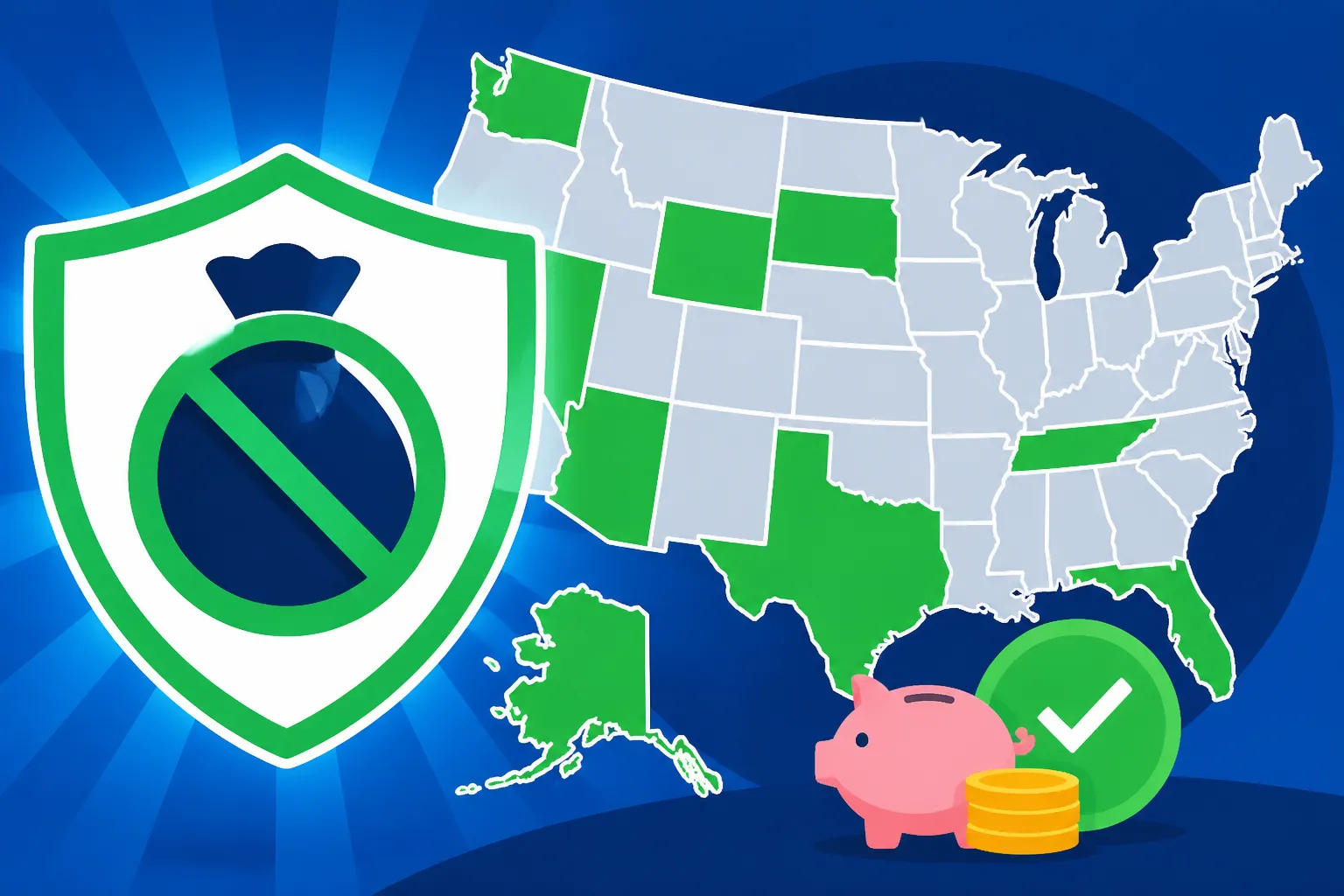
Opening your first paycheck after a big promotion only to see a massive chunk carved out for state taxes is a uniquely frustrating American experience. You worked the overtime, you took the extra responsibility, yet the state government feels entitled to a significant percentage of your effort. This comprehensive guide breaks down the nine states that allow you to keep your entire paycheck in 2026 and analyzes the real-world trade-offs of relocating to these tax havens.
The Nine States With No Personal Income Tax in 2026
The dream of a tax-free paycheck is a reality in a handful of states, but the list is more nuanced than it appears at first glance. As we move into 2026, the landscape of States With No Income Tax (2026 Full List) has become a focal point for remote workers and retirees alike. These states have made a conscious policy choice to fund their infrastructure and public services through alternative means, such as consumption taxes or natural resource levies. For someone living in a high-tax jurisdiction like California or New York, the prospect of an immediate 5% to 13% "raise" just by changing zip codes is incredibly alluring.
Alaska stands as the most unique entry on this list. Not only does it lack a state income tax, but it also lacks a state-level sales tax, though many local municipalities do charge their own. The state's massive oil reserves provide the revenue necessary to keep the lights on, and residents even receive a yearly dividend from the Permanent Fund. However, the trade-off is a high cost of living due to the geographic isolation. You might not pay the state a dime in income tax, but you will certainly feel the pinch when buying a gallon of milk or heating your home during the brutal winter months.
Florida and Nevada are perhaps the most popular destinations for those seeking to escape the taxman. Florida has long been a sanctuary for retirees, but in recent years, it has become a hub for tech and finance professionals fleeing the Northeast. Nevada relies heavily on its gaming and tourism industry to fill its coffers. Both states offer a lifestyle that is heavily subsidized by visitors. Every time a tourist loses money at a craps table in Las Vegas or buys a mouse-eared hat in Orlando, they are essentially paying the taxes that you, as a resident, get to avoid.
South Dakota, Tennessee, and Texas round out the middle of the country's tax-free options. Texas is often the first state people think of when they hear "no income tax," and its massive economy makes it a powerhouse for job seekers. However, it is vital to ask, Is Texas Really Tax Free? The Full Picture, because while your paycheck remains untouched, the state must collect revenue somehow. This usually manifests in some of the highest property tax rates in the nation. If you are a high earner who rents, Texas is a goldmine; if you are a homeowner on a fixed income, the "tax-free" label might start to feel like a bit of a misnomer.
The New Hampshire Transition From Interest and Dividends to True Zero
New Hampshire has long occupied a "middle ground" in the world of tax-free states, but 2026 marks a significant milestone. Historically, the Granite State didn't tax earned income (wages), but it did maintain a tax on interest and dividends. This meant that while workers were happy, retirees living off their portfolios still had to file a state return. Thanks to recent legislation, the New Hampshire Interest & Dividends Tax Repeal is officially complete by 2026, making it a true no-income-tax state for everyone, regardless of where their money comes from.
This shift is a massive win for the state’s "Live Free or Die" ethos. For years, residents had to meticulously track their investment income to ensure they weren't running afoul of the state's Department of Revenue Administration. The repeal simplifies the filing process significantly. If you live in New Hampshire in 2026, you essentially stop filing state income tax returns altogether. This puts the state in direct competition with Florida for the "snowbird" demographic—those who want the low-tax lifestyle but prefer the four seasons and the proximity to the Boston metropolitan area.
The impact of this change on the local real estate market cannot be overstated. New Hampshire already struggled with housing inventory, and the final repeal of the I&D tax has only made it more attractive to high-net-worth individuals. When you combine the lack of an income tax with the fact that New Hampshire also has no state sales tax, you have a very compelling financial argument for residency. However, like Texas, New Hampshire relies heavily on property taxes to fund its local schools and services. It is a state where you pay for your local community directly through your home value rather than through your productivity at work.
For retirees specifically, this transition is the final piece of the puzzle. Many seniors were hesitant to move to New Hampshire because their 401(k) distributions or brokerage account dividends were still being nicked by the state. Now that the hurdle is gone, we are seeing a shift in migration patterns. Using a tool like a SmartAsset tax calculator can help you see the exact dollar amount you save when that final percentage point is removed from your investment income. It’s often the difference between a modest retirement and one that allows for significantly more travel or legacy planning for grandchildren.
Beyond the Paycheck How These States Fund Themselves
It is a common misconception that "no income tax" means "low taxes across the board." States are not magical entities that run on goodwill; they require billions of dollars to maintain roads, police forces, and schools. When you remove the income tax lever, the state government must pull other levers harder. This usually involves higher sales taxes, specific excise taxes, or increased property taxes. Understanding this balance is crucial before you pack your bags and hire a moving van for a cross-country trek to a "tax-free" paradise.
In states like Tennessee and Washington, the sales tax is the primary engine of the economy. Tennessee often has one of the highest combined state and local sales tax rates in the country, sometimes exceeding 9%. This creates a regressive tax system where lower-income residents, who spend a larger percentage of their earnings on taxable goods, end up bearing a heavier burden than the wealthy. When you’re at the grocery store or the mall in Nashville, you’re paying the tax that isn’t coming out of your W-2. It’s a shift from taxing "what you earn" to taxing "what you spend."
Washington State presents a very modern example of this revenue-balancing act. While they famously have no personal income tax, they recently implemented a controversial tax on high-value capital gains. If you are looking into the Washington Capital Gains Tax Explained (7% / 9.9%), you’ll see that the state is targeting the ultra-wealthy to bridge budget gaps without touching the average worker's salary. This allows them to keep the "no income tax" headline while still collecting significant revenue from the tech billionaires in the Seattle area. It’s a surgical approach to taxation that sets it apart from more traditional states like Wyoming or South Dakota.
Property taxes are the other major "hidden" cost. If you look at Is Florida Tax Friendly for Workers?, you’ll find that while the state is very friendly to your paycheck, the cost of homeownership is rising due to both taxes and skyrocketing insurance premiums. Texas and New Hampshire consistently rank in the top ten for highest property tax rates. For many people, the amount they save on state income tax is almost exactly canceled out by the increase in their annual property tax bill. Before moving, it’s wise to use a SmartAsset property tax tool to compare your current bill with what you’d owe in your target destination.
Is It Actually Cheaper to Live in a No-Tax State
The million-dollar question—sometimes literally—is whether the move to a no-tax state actually improves your bottom line. The answer depends entirely on your spending habits, your income level, and your lifestyle. If you are a high-earning professional making $500,000 a year, moving from a 10% tax state to a 0% tax state saves you $50,000 annually. It is very unlikely that your sales tax or property tax increases will eat up that entire $50,000. For the "one percent," the math almost always favors the move.
However, for the average family making the median household income, the math is much tighter. You have to consider the "cost of living" as a whole. Many tax-free states have seen their housing prices explode as everyone else had the same idea to move there. A house in Austin, Texas, or Bozeman, Montana, might cost twice as much as a similar home in a "high tax" Midwestern city. When you factor in the mortgage interest on a much larger loan, the tax savings start to evaporate. You must ask yourself: Is It Cheaper to Live in a State With No Income Tax? for your specific budget, not just in theory.
Public services also vary wildly in these states. Some no-tax states have excellent infrastructure, while others rely on "user fees" for everything from toll roads to state park entries. In a state like Florida, you might save on income tax but find yourself paying hundreds of dollars a month in tolls just to commute to work. In other states, the public school systems might be underfunded, leading parents to opt for private schooling—an expense that far outweighs any potential tax savings. It’s about looking at the "total cost of life," not just the tax line on your pay stub.
To get a realistic picture, I always recommend doing a "shadow budget." Take your current expenses and run them through a SmartAsset cost of living calculator for your target city. Look at the price of gas, the cost of electricity (which can be very high in places like Nevada or Florida), and the typical grocery bill. Often, you'll find that while the government takes less of your money, the private sector and the local environment take more. It’s not a reason to avoid the move, but it is a reason to move with your eyes wide open.
| State | Primary Revenue Source | Property Tax Rank (1=Highest) | Sales Tax Notes |
|---|---|---|---|
| Alaska | Oil/Petroleum | 25 | No state sales tax; local taxes apply. |
| Florida | Tourism/Sales | 26 | Heavy reliance on tourist spending. |
| Nevada | Gaming/Tourism | 28 | High sales tax in metro areas. |
| New Hampshire | Property Tax | 3 | No sales tax; very high property tax. |
| South Dakota | Sales/Excise | 34 | Broad sales tax including services. |
| Tennessee | Sales Tax | 37 | Very high sales tax on groceries. |
| Texas | Property Tax | 6 | High local property tax rates. |
| Washington | Sales/Business | 23 | Recent capital gains tax for high earners. |
| Wyoming | Mineral/Natural Resource | 46 | Low taxes across most categories. |
Remote Work and the Residency Audit Trap
In the post-2020 world, the "digital nomad" or the remote worker living in a no-tax state while working for a company in a high-tax state has become common. However, the states you are leaving are not going to let go of your tax dollars without a fight. Establishing residency is about much more than just getting a new driver’s license. You need to understand State Tax Residency Rules Explained to avoid being double-taxed or audited by your former home state. New York and California are particularly aggressive in pursuing former residents who they believe haven't truly "left."
The most common hurdle is The 183-Day Rule for State Taxes. Most states consider you a resident for tax purposes if you spend more than half the year (183 days) within their borders. If you "move" to Florida but spend five months a year at your old house in New Jersey, you are playing a dangerous game. States track this through credit card swipes, cell phone tower data, and even social media posts. If they can prove you were physically present in their state for the majority of the year, they will claim 100% of your income for that year.
Another major pitfall is the "Convenience of the Employer" rule. This is a particularly nasty trap for those working for companies based in New York, Pennsylvania, or Nebraska. Even if you live in tax-free Florida, if your job is "based" in New York and you are working remotely for your own convenience rather than your employer's necessity, New York may still claim you owe them income tax. You must check the New York Residency Requirements for Taxes carefully if your paycheck is coming from a Manhattan-based firm. It’s a frustrating reality where you can live in a no-tax state and still end up with a massive tax bill from a state you haven't visited in months.
To win a residency audit, you have to prove "domicile"—the place you intend to return to and consider your permanent home. This involves moving your "near and dear" items: your family photos, your pets, and your most prized possessions. It means changing your voter registration, your library card, and even your primary care physician. If you still have a doctor in your old state and use your old gym membership, an auditor will argue that you never truly left. It’s a meticulous process, but failing to do it correctly can lead to years of legal headaches and back taxes.
Comparing the Top Contenders for 2026
If you’ve decided that a move is right for you, picking the right state depends on your stage of life. For young professionals, Washington and Texas are the clear front-runners. The job markets in Seattle and Austin are booming, particularly in tech, aerospace, and energy. These states provide the opportunity for massive income growth without the ceiling of a progressive state tax. In these environments, your career trajectory is the most important factor, and keeping that extra 7% to 10% of your salary can be used to aggressively fund retirement accounts or a down payment on a home.
For families, the decision becomes a bit more complex. You have to look at the quality of life and education. Florida and Tennessee have made significant investments in their university systems and school choice programs. However, you also have to deal with the reality of rapid population growth. Schools in places like Nashville or Tampa are often overcrowded, and infrastructure is struggling to keep up. You might save money on taxes, but you might spend more of your life sitting in traffic. It’s a trade-off between financial health and daily stress levels.
Retirees have it the best in Florida, Nevada, and now New Hampshire. Florida’s homestead exemption and lack of inheritance tax make it a haven for passing down wealth to the next generation. Nevada offers a lower cost of living than the coastal states and easy access to world-class entertainment and healthcare in Las Vegas. With the States With a Flat Income Tax (2026) trend continuing elsewhere, these zero-tax states remain the gold standard for those on a fixed income. They allow your nest egg to last just a little bit longer by removing the government as a beneficiary of your RMDs (Required Minimum Distributions).
Ultimately, there is no "perfect" state. Wyoming and South Dakota offer incredible natural beauty and very low overall tax burdens, but they lack the job diversity and urban amenities of Texas or Florida. If you hate the cold, Alaska and New Hampshire are out. If you hate the heat and humidity, Florida and Texas will be a struggle. The "best" state is the one where the tax savings align with your personal values and lifestyle preferences. I often suggest people spend a month in their target state during its "worst" season before making a permanent move.
Strategic Planning for a Tax-Free Move
Moving to a no-tax state should be treated like a major business decision. The first step is a deep dive into your current finances. Look at your last three years of tax returns and calculate exactly how much you paid in state and local income taxes. That is your "target" number. Then, estimate your new expenses in the target state. Will your car insurance go up? (It often does in Florida and Nevada). Will your property taxes double? Once you have these numbers, you can determine if the move provides a significant enough Return on Investment (ROI) to justify the cost of moving.
Timing is also a critical factor. If you move on July 1st, you will likely have to file as a part-year resident in two different states. This can be a filing nightmare. Many people find it cleaner to move as close to the beginning of the year as possible, though this isn't always practical for those with school-aged children or specific job start dates. If you do move mid-year, keep every single receipt related to the move. Some moving expenses may be deductible, and more importantly, they serve as "Documentary Evidence" of the exact date you changed your domicile.
Finally, don't try to do this alone if you have a complex financial life. While a SmartAsset search can give you the basics, a tax professional who specializes in multi-state residency is worth their weight in gold. They can help you navigate the "exit tax" nuances of your current state and ensure your new state residency is bulletproof. They can also advise on how to structure your business or investments to take full advantage of the new tax environment. Remember, the goal isn't just to pay zero tax this year; it’s to build a sustainable, low-tax life for the long haul.
Living in a state with no income tax is a powerful tool for wealth building, but it isn't a magic wand. It requires discipline and a holistic view of your finances. You have to be okay with the fact that you might pay more at the cash register or through your annual property tax bill. But for many of us, there is a profound psychological benefit to knowing that every dollar we earn through our hard work stays in our pockets until we choose to spend it. That freedom is still available if you know where to look.
State Income Tax Disclaimer
The information provided in this guide is for educational and informational purposes only and does not constitute professional tax, legal, or financial advice. Tax laws, including 2026 rates, brackets, and repeal schedules, are subject to change by state legislatures at any time. Every individual's financial situation is unique, and the trade-offs of moving to a no-income-tax state involve complex factors beyond simple tax rates. Always consult with a qualified Certified Public Accountant (CPA) or tax attorney before making significant residency changes or financial decisions.