Do You Pay State Tax Where You Live or Work?
It's a question that keeps so many of us up at night, especially when our lives don't fit neatly into a single state line: "Do I pay state tax where I live or where I work?" This seemingly simple query can unravel into a tangled mess of residency rules, source income, and tax credits, leaving you feeling utterly confused. This guide is here to untangle that knot, breaking down the often-complex rules around state income tax obligations when your home and workplace are in different states.
The General Rule: Domicile vs. Source Income
When it comes to state income tax, there are two big concepts that often clash: your domicile (where you permanently live) and the source of your income (where you physically earn it). Understanding the difference between these two and how they interact is absolutely crucial. Many people get tripped up right here, assuming one automatically dictates the other, but it's rarely that simple. States want their fair share, and they've got rules to make sure they get it, whether you're commuting daily or working remotely.
Understanding Your Domicile
Your domicile is the place you consider your true home – the place where you intend to return whenever you're away. It's not just about where you sleep at night; it's about your deeper connection to a state. Think of it as your permanent address for tax purposes. This is generally the state that has the primary claim on taxing your worldwide income.
For example, if you grow up in New York, go to college in Boston, and then take a job in Connecticut, but your family is still in New York, your driver's license is from New York, and you plan to move back to New York someday, New York might still consider you domiciled there. Establishing your domicile requires demonstrating a clear intent to make a state your principal home. This involves a collection of factors, not just one. Are you registered to vote there? Do you have your bank accounts there? Is your car registered there? Do you have a professional license in that state? All these things build a picture of your true home. For a deeper dive into what makes a state your official home, check out our guide on Domicile vs Statutory Residency.
What is "Source Income"?
"Source income," on the other hand, refers to income earned within the borders of a particular state, regardless of where you, the earner, actually live. If you physically perform work in a state, the income from that work is generally considered "sourced" to that state.
Let's say you live in New Jersey but commute daily into New York City for your job. The salary you earn from working in that New York City office is considered New York source income, even though your home, your family, and your life are clearly in New Jersey. Many states have specific rules about what constitutes source income, and these rules can be particularly complex for traveling professionals or those who work across state lines. This concept is a cornerstone of how states determine their taxing rights.
The Importance of Physical Presence
It really boils down to physical presence for source income. If your boots are on the ground in a state while you're earning money, that state likely has a right to tax that income. This is why a traveling salesperson might end up with tax obligations in multiple states, even if they only spend a few days in each one. For non-residents, most states only tax income sourced within their borders. So, if you live in Pennsylvania but own a rental property in Delaware, any income from that rental property would be considered Delaware source income and taxed by Delaware, even if Pennsylvania is your primary residence. It's less about where your paycheck gets deposited and more about where the actual work or activity generating that income takes place.
Navigating Common Scenarios
The general rules about domicile and source income are helpful, but real life is rarely "general." Most people find themselves in situations where these two concepts don't perfectly align. This is where the confusion really sets in, and why so many folks end up scratching their heads (or pulling their hair out!) trying to figure out their tax obligations.
Living in One State, Working in Another
This is perhaps the most common scenario that causes headaches. You live in State A but commute to State B for work. In this situation, you often have a dual tax obligation.
- State B (Work State): Will typically tax the income you earned within its borders because it's considered "source income" to State B. Your employer will usually withhold State B taxes from your paycheck.
- State A (Home State): Will tax your total income, as you are a resident domiciled there. This includes the income you earned in State B.
"Wait, so I'm paying tax on the same money twice?!" I hear you asking. Yes, it certainly feels that way, and it's a valid frustration. This is where mechanisms to avoid double taxation come into play. Most states offer a tax credit for taxes paid to another state. For instance, if you live in New Jersey and work in New York, you'll file a nonresident return with New York for the income earned there. Then, on your New Jersey resident return, you'll claim a credit for the taxes you paid to New York on that same income. This credit ensures you're not actually taxed twice on the same dollar. It's a lifesaver, but understanding how to properly claim it can be tricky. Our article on Working in One State, Living in Another: Tax Guide goes into much more detail on this exact situation.
Remote Work Across State Lines
Ah, the modern dilemma! The rise of remote work has blurred geographical lines like never before, and state tax departments are still catching up in many ways. If your employer is based in State X, but you live and perform all your work in State Y, where do you pay state income tax?
Generally, if you are a bona fide resident of State Y and perform all your work physically within State Y's borders, State Y will tax your income. Your employer should be withholding State Y taxes, even if their headquarters are in State X.
However, a few states have what's known as the "Convenience of the Employer" rule. This rule states that if you work remotely for an employer in one of these states, your income is still sourced to the employer's state unless your remote work is done out of necessity for the employer, rather than for your own convenience. New York is a classic example of a state with a strict convenience rule. So, if you're a New Jersey resident working remotely for a New York City company, New York might still claim your income as New York source income, especially if they deem your remote work to be for your convenience. This can lead to unexpected tax bills and a need to understand specific state laws. You can find more information on this complex topic in our guide on Remote Work State Taxes & Convenience of the Employer.
The Impact of Reciprocity Agreements
To simplify things for commuters, some states have entered into "reciprocity agreements." These agreements essentially say, "If you live in our state but work in the other state, you only pay income tax to your home state." It’s a fantastic relief for many, cutting down on paperwork and avoiding the hassle of filing multiple state returns and claiming credits.
For example, if you live in Pennsylvania and work in New Jersey, you might be able to file an exemption form (like Form NJ-165, Employee's Certificate of Nonresidence in New Jersey) with your employer, so they only withhold Pennsylvania income tax. You wouldn't need to file a New Jersey nonresident return. Not all states have these agreements, and the ones that do might not have them with every neighboring state. For instance, New Jersey and New York do not have a reciprocity agreement, which is why the New Jersey-New York commute is often a tax headache for so many. Knowing if your states have an agreement can save you a ton of stress. Our comprehensive State Reciprocity Agreements Explained article offers a full breakdown.
Here's a simplified look at how different scenarios generally play out:
| Scenario | Live in State A | Work in State B | Reciprocity? | Tax Filing Implications |
|---|---|---|---|---|
| Commute Daily | Resident | Non-Resident | No | File non-resident in B, resident in A (claim credit for taxes paid to B) |
| Commute Daily | Resident | Non-Resident | Yes | File resident in A only (employer withholds only for A) |
| Remote Worker (no convenience rule) | Resident | N/A | N/A | File resident in A only (employer should withhold for A) |
| Remote Worker (with convenience rule) | Resident | N/A | No | File non-resident in B (employer state), resident in A (claim credit for taxes paid to B) |
| Snowbird/Seasonal Resident | Domicile A | Part-year B | N/A | File resident in A, part-year resident in B for time spent there |
This table provides a high-level overview, but remember, individual state laws and your specific circumstances can add layers of complexity. This is where tools from financial information providers like SmartAsset can be helpful in comparing state tax burdens.
Special Considerations and Avoiding Double Taxation
The goal for most taxpayers is to pay what they owe, but ideally not a penny more, and certainly not twice on the same income. Understanding the specific mechanisms states use to address potential double taxation, as well as unique state tax landscapes, is key to navigating your multi-state tax situation effectively.
Credits for Taxes Paid to Another State
As mentioned, this is the primary way states prevent true double taxation. If you find yourself in a situation where both your resident state and a non-resident work state have a legitimate claim on the same income, your resident state will almost always offer a credit for the income tax you paid to the non-resident state. This ensures that while you might be filing in two states, you're not actually paying tax on the same dollar twice.
For example, if you live in Pennsylvania but commute to Ohio, you'd pay Ohio state income tax on your Ohio-sourced wages. When you file your Pennsylvania resident return, you'd then claim a credit for the amount of tax you paid to Ohio. It sounds straightforward, but calculating the exact credit can sometimes get a bit complicated, especially if only a portion of your income is subject to the other state's tax. It's often limited to the lesser of the tax paid to the other state or the tax that would have been due on that income in your home state. Getting this calculation right is critical. We have a dedicated resource that walks you through Credit for Taxes Paid to Another State to make sure you're getting every penny you deserve.
States with No Income Tax
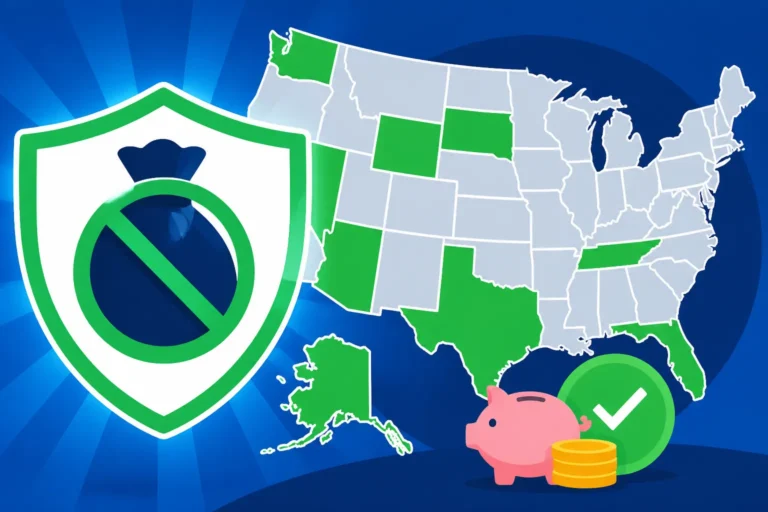
A dream for many! There are currently eight states that don't levy a general state income tax: Alaska, Florida, Nevada, South Dakota, Tennessee, Texas, Washington, and Wyoming. New Hampshire previously taxed only interest and dividend income but fully repealed that tax as of January 1, 2025, effectively making it the ninth state with no broad income tax.
If you live in one of these states but work in a state that does have an income tax, you'll still pay tax to the work state on your sourced income. However, since your home state (the no-income-tax state) doesn't have an income tax, you won't file a resident state income tax return there, and thus, there's no state-level credit to claim for taxes paid to the work state. This effectively means you're only paying state income tax to the state where you physically work. Conversely, if you live in an income tax state and work remotely for a company located in a no-income-tax state, you would generally only pay income tax to your resident state, as there's no state income tax in the employer's state to claim as source income (though certain rules like New York's convenience rule could still apply, depending on where the work is truly considered performed). For a full list, check out States With No Income Tax (2026 Full List).
Residency Audits and Proving Domicile
States are increasingly aggressive in pursuing tax revenue, especially from high-income earners who try to claim residency in a no-income-tax state while maintaining strong ties to a high-tax state like California or New York. This can trigger a state residency audit. These audits can be incredibly stressful and intrusive, as the state will meticulously examine every aspect of your life to determine your true domicile.
They'll look at things like:
- Where your mail is sent
- Where your children attend school
- Where your primary doctor and dentist are located
- Where your beloved pets live
- Your social and community ties (gym memberships, club affiliations)
- Utility bills, voter registration, driver's license, vehicle registration
- How much time you actually spend in each location (tracked via phone data, credit card statements, EZ-Pass records, etc.)
It’s not enough to say you've moved; you have to prove it with actions that demonstrate a clear intent to abandon your old domicile and establish a new one. This can be particularly challenging for "snowbirds" or individuals who truly split their time between multiple residences. Information from platforms like SmartAsset can help individuals understand the nuances of these residency rules when planning a move. Our guide on What Triggers a State Residency Audit? can help you prepare and understand what states are looking for.
How to Determine Your Specific Situation
Given all the variables—domicile, source income, reciprocity, remote work rules, and no-income-tax states—it's clear that there's no single, one-size-fits-all answer. Your unique circumstances dictate your specific state income tax obligations. This complexity is why relying on generalized advice can lead to mistakes. Taking the time to properly assess your situation or seek professional help is not just recommended, it's often essential to avoid costly errors or penalties.
Consulting State Tax Agencies
The most direct source of information about a state's tax laws is the state's own tax department or revenue agency. Each state maintains detailed websites, FAQs, and publications specifically addressing residency, withholding, and income sourcing rules. While these resources can sometimes be a bit dry and dense (they are government documents, after all!), they are the definitive authority.
Don't be afraid to search for your specific state's Department of Revenue or Franchise Tax Board (in California's case). Look for sections on "nonresident filing requirements," "residency definitions," or "credits for taxes paid to another state." Many states also have online forms or helplines where you can submit questions, though getting a definitive answer in writing might require a formal ruling, which can take time. These agencies are also the ones that dictate things like State Tax Residency Rules Explained or How to Change Your State Residency for Taxes.
Utilizing Tax Software and Professionals
For many, navigating these multi-state tax waters can feel overwhelming. This is where modern tax software and qualified tax professionals truly shine.
- Tax Software: Most major tax software programs, like TurboTax, H&R Block, or TaxAct, are designed to handle multi-state filings. They will guide you through the process, helping you determine residency, allocate income, and calculate credits for taxes paid to other states. They often ask a series of questions about your living and working arrangements to automatically generate the correct forms. While they simplify the process, you still need to accurately input your information.
- Tax Professionals: For particularly complex situations—like if you're a business owner with income from multiple states, have significant investment income, or are undergoing a residency audit—consulting with a Certified Public Accountant (CPA) or an Enrolled Agent (EA) specializing in multi-state taxation is highly advisable. They can provide personalized advice, help you strategize to minimize your tax burden legally, and even represent you in the event of an audit. They keep up with the latest State Income Tax Cuts & Changes for 2026 and other regulatory shifts. This expertise can be invaluable, offering peace of mind and potentially saving you more money than their fees.
Ultimately, whether you pay state tax where you live or where you work (or both!) depends on a careful analysis of your domicile, where your income is sourced, and the specific tax laws, reciprocity agreements, or convenience rules of the states involved. It's a puzzle with many pieces, but with the right information and resources, you can fit them together correctly.
Disclaimer
The information provided in this article is for general informational purposes only and does not constitute tax advice. Tax laws are complex and subject to change. Always consult with a qualified tax professional or refer to your specific state's tax authority for advice tailored to your individual situation.