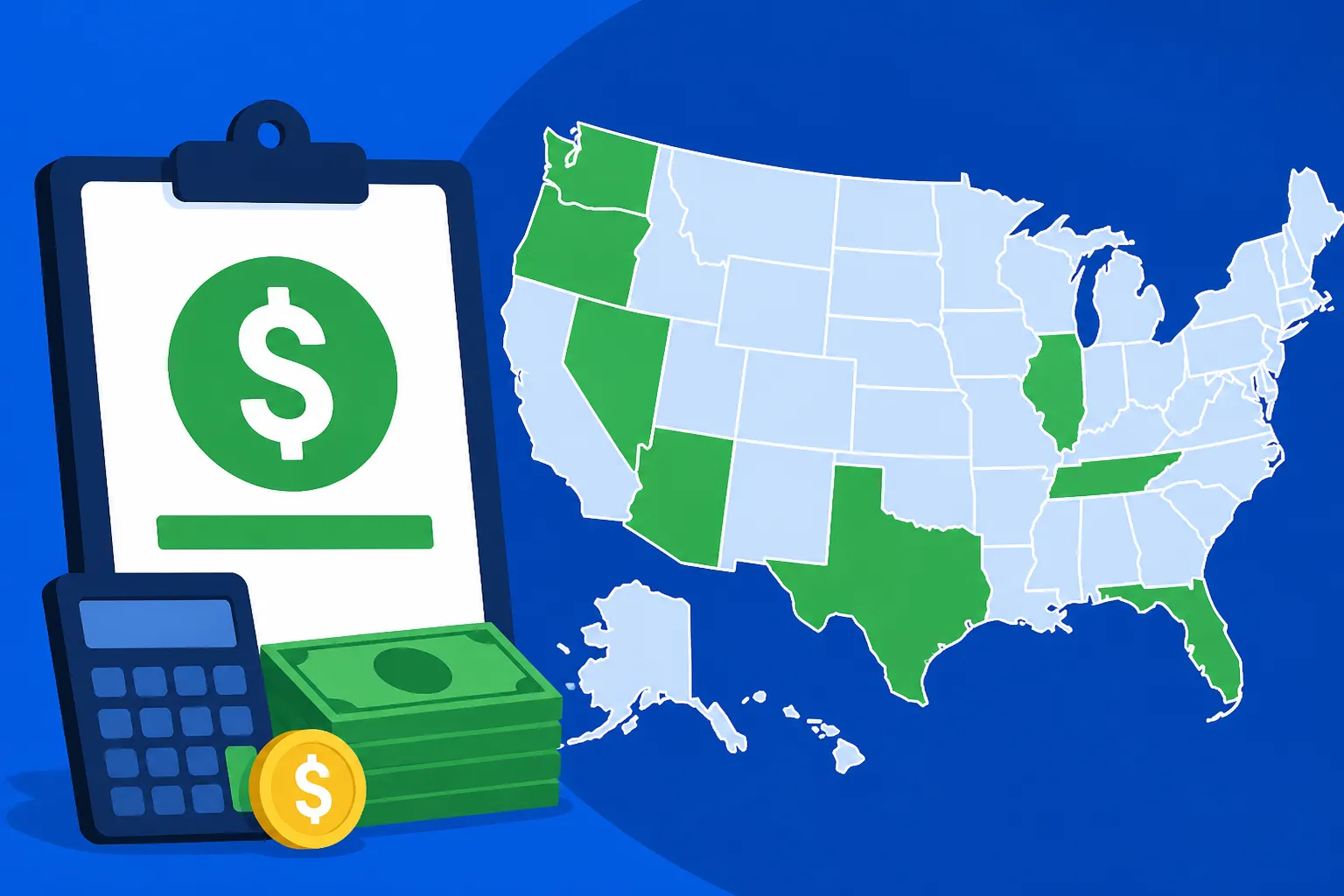
States With a Flat Income Tax (2026)
Opening your paycheck only to see a tangled web of deductions can feel like trying to solve a puzzle where the pieces keep changing shape. Many people find the complexity of progressive tax brackets exhausting, leading to a search for simplicity and predictability. This guide breaks down every state using a flat income tax in 2026, helping you understand how these systems affect your take-home pay and overall financial planning.
The Evolution and Philosophy of the Flat Tax
For decades, the standard for American taxation has been the progressive model, where you pay a higher percentage as your income climbs. However, there is a growing movement toward the flat tax, a system where everyone—from the barista in a local coffee shop in Des Moines to the corporate executive in a high-rise in Atlanta—pays the exact same percentage of their taxable income. The philosophy here is rooted in the idea of "tax neutrality," where the tax code does not pick winners or losers based on their earnings bracket.
Proponents of this system argue that it encourages economic growth by not penalizing success. If you know that every extra dollar you earn will be taxed at the same 3% or 4% rate, you might be more inclined to take that promotion or start a side hustle. From a lifestyle perspective, it also makes budgeting significantly easier. You don't have to worry about "jumping into a higher bracket" and seeing your marginal gains swallowed up by the state. When you use tools like SmartAsset to project your future earnings, the math becomes refreshingly straightforward in a flat tax environment.
However, it is vital to distinguish between a flat rate and a low tax burden. A state could have a flat tax of 5% while a neighboring state has a progressive system that starts at 2%. Depending on what you earn, the "simpler" system might actually cost you more. Understanding How State Tax Brackets Work: Marginal vs Effective is crucial here because even in a flat tax state, your effective rate will usually be lower than the stated flat rate due to standard deductions and personal exemptions.
Comprehensive List of Flat Tax States in 2026
The landscape of state taxation has shifted significantly. Several states that once used complex, multi-tiered brackets have transitioned to a flat model to remain competitive. This transition is often part of a larger trend of State Income Tax Cuts & Changes for 2026 aimed at attracting residents from high-tax coastal regions.
The Midwest Flat Tax Corridor
The Midwest has become the epicenter of the flat tax movement. Illinois has long maintained a flat tax, but it has recently been joined by neighbors like Iowa and Michigan. In Iowa, the transition has been particularly dramatic, moving from a highly progressive system with several brackets to a single, streamlined rate. This change was designed to stop the "wealth drain" to neighboring states with more favorable tax climates.
Michigan’s flat tax has a unique history, occasionally fluctuating based on state revenue triggers. For residents in cities like Grand Rapids or Ann Arbor, this means their tax bill remains relatively predictable year-over-year. Meanwhile, Indiana continues to offer one of the lowest flat rates in the country. If you are looking at Indiana County Income Taxes Explained, you will see that while the state rate is flat and low, local additions can change the final number on your return.
The Southeast Shift
Georgia is one of the most recent and high-profile additions to the flat tax club. For years, Georgia used a system that mirrored the federal progressive structure, but lawmakers recently implemented a flat rate to simplify the filing process for residents in booming hubs like the Savannah port area or the North Atlanta suburbs. This move was intended to signal to businesses that Georgia is "open for business" and focused on fiscal stability.
Mississippi has also moved toward a flat tax structure, essentially exempting a large portion of initial income and then applying a single rate to everything above that threshold. This is a common tactic: states will often pair a flat tax with a generous "zero-percent bracket" or a high standard deduction to ensure that lower-income earners are not disproportionately burdened. When you look at the Lowest Income Tax States in 2026, many of the names on that list are there specifically because they adopted a flat tax with a low percentage.
The Mountain West and Beyond
Colorado and Utah have been the standard-bearers for the flat tax in the West for a long time. Colorado’s rate is frequently adjusted via ballot measures, reflecting the state's unique Taxpayer’s Bill of Rights (TABOR), which requires excess revenue to be returned to taxpayers. This creates a scenario where the flat rate is not just a tax policy, but a reflection of the state's constitutional commitment to limited government spending.
Utah’s flat tax is often praised for its simplicity, as it ties closely to federal adjusted gross income. For a family living in Provo or Salt Lake City, filing state taxes is often a ten-minute task because there are very few "gotchas" or complex schedules to navigate. This simplicity is a major draw for remote workers who are increasingly looking for states that won't penalize their growing incomes.
Comparing Flat Tax Rates Across the Country
Not all flat taxes are created equal. Some states aim for the "flat and low" approach, while others use a flat tax but keep the rate relatively high to fund extensive state services. When comparing these states, it is helpful to look at the raw percentages alongside the standard deductions offered.
| State | 2026 Flat Tax Rate | Key Feature |
|---|---|---|
| Arizona | 2.50% | Currently one of the lowest in the nation. |
| Colorado | 4.40% | Subject to TABOR refunds in surplus years. |
| Georgia | 5.39% | Transitioned recently from progressive brackets. |
| Idaho | 5.80% | Consistently reduced from higher tiers. |
| Illinois | 4.95% | Constitutionally mandated flat tax. |
| Indiana | 3.05% | Low state rate, but watch for county taxes. |
| Iowa | 3.80% | Final stage of a multi-year phase-in. |
| Kentucky | 4.00% | Moving toward a 0% goal based on revenue. |
| Michigan | 4.25% | Rate can drop if state revenue exceeds growth. |
| Mississippi | 4.00% | First $10,000+ is often effectively exempt. |
| North Carolina | 4.50% | Aggressive cuts planned through the late 2020s. |
| Pennsylvania | 3.07% | One of the most stable rates in US history. |
| Utah | 4.55% | Highly simplified filing process. |
While these rates look straightforward, it is important to remember that local taxes can lurk beneath the surface. For example, if you live in Philadelphia, you are paying the state’s 3.07% rate, but you are also subject to the Philadelphia Wage Tax 2026, which adds a significant additional percentage to your total burden. Always check your specific municipality before assuming a flat tax state is the cheapest option.
Why Some States Choose a Flat Tax Over Progressive Brackets
The decision for a state like North Carolina or Kentucky to abandon a progressive system is usually a strategic one. Legislators often argue that progressive taxes are "volatile." In years when the stock market is booming and high-earners are cashing out gains, progressive states like California or New York see a massive influx of cash. However, during a recession, that revenue evaporates, leading to budget crises.
A flat tax provides a more stable and predictable revenue stream for the state government. Because the tax is spread evenly across the entire working population, the state is less dependent on the whims of a few thousand ultra-wealthy residents. From a taxpayer perspective, the benefit is the removal of the "success penalty." You never have to worry that a hard-earned bonus will push you into a bracket where the state takes a 10% or 12% cut of those specific dollars.
For people who move frequently, flat tax states offer a level of transparency that progressive states lack. If you are comparing California vs Texas Taxes Compared, you might find that while Texas has no income tax, its property taxes are astronomical. A flat tax state often sits in the "Goldilocks" zone—it has an income tax to fund roads and schools, but it keeps the rate low enough that it doesn't feel like a punishment for earning more. Using a calculator from SmartAsset can help you see exactly where that "sweet spot" lies for your specific salary.
The Hidden Complexity: Deductions and Exemptions
Don't let the term "flat tax" fool you into thinking everyone pays exactly the same amount of money. The "taxable income" is the key. Most flat tax states still allow for a standard deduction or personal exemptions. This means that for a worker earning $30,000 in a state with a 4% flat tax and a $15,000 standard deduction, they are only paying that 4% on the remaining $15,000. Their "effective" tax rate is actually only 2%.
This is how flat tax states maintain a level of fairness for lower-income residents. By increasing the standard deduction, states can effectively create a "0% bracket" for those who need it most. If you are wondering How Do I Calculate My State Income Tax in a flat state, you simply subtract your exemptions and deductions from your gross income, then multiply the remainder by the flat rate. It is much easier than the multi-step math required in states with six or seven different brackets.
Furthermore, some flat tax states still offer targeted credits. You might find a State Child Tax Credits 2026 program or a credit for property taxes paid. These can further reduce your bill, sometimes even resulting in a refund. It is a common misconception that flat tax states have "no loopholes." While they are simpler, they still offer ways to save if you know where to look.
The Impact of a Flat Tax on Small Business Owners
If you are a freelancer or a small business owner in a city like Indianapolis or Charlotte, a flat tax can be a godsend. Most small businesses are "pass-through" entities, meaning the business income is reported on the owner's personal tax return. In a progressive tax state, a highly successful year for your business could result in the state taking a massive bite out of your profits at the highest marginal rate.
In a flat tax state, your business growth is not penalized by a sliding scale. This allows for better reinvestment. If you know exactly what percentage you owe the state, you can set aside tax payments more accurately throughout the year. For those managing multiple streams of income, this predictability is invaluable. It avoids the year-end surprise where you realize you’ve been pushed into a higher bracket and suddenly owe thousands more than you anticipated.
Business owners often use SmartAsset to compare the tax implications of relocating their headquarters. Often, a move from a high-tax progressive state to a flat-tax state can save a mid-sized business tens of thousands of dollars annually. When you add in the fact that many of these states are also States With a Flat Income Tax (2026) and have lower corporate rates, the move becomes a no-brainer for many entrepreneurs.
Challenges and Criticisms of the Flat Tax Model
It wouldn't be a fair guide without addressing why some people dislike the flat tax. The primary criticism is that it is "regressive." In tax terms, a regressive tax is one where the burden falls more heavily on those with lower incomes. Critics argue that a 4% tax hurts someone making $40,000 much more than it hurts someone making $400,000. The person making $40,000 might need that 4% to pay for groceries or gas, while the person making $400,000 won't even notice it.
To counter this, many states are States Phasing Out Income Tax or significantly increasing their standard deductions to ensure that the bottom tier of earners pays nothing at all. Another criticism is that flat tax states might have to rely more heavily on sales or property taxes to make up for the revenue they lose by not taxing the wealthy at higher rates. This can lead to a "hidden" tax burden that isn't immediately obvious when you just look at the income tax rate.
If you are a high earner, you might consider these states the Best States for High Earners (Tax). But if you are in a lower income bracket, you really have to do the math. A state with a progressive tax might actually be cheaper for you if its bottom bracket is very low and its standard deduction is very high. This is why looking at the State Tax Burden by State 2026 is so important; it gives you the "all-in" cost of living in a state, not just the headline income tax number.
Transitioning States: Who Is Next for a Flat Tax?
The map of flat tax states is not static. Several states are currently in the middle of multi-year transitions. For example, Kentucky and North Carolina have passed laws that trigger automatic rate cuts whenever state revenue hits certain benchmarks. The ultimate goal for some of these states is to reach a 0% income tax, joining the ranks of Florida and Texas.
Other states are watching their neighbors closely. When one state in a region moves to a flat tax and starts seeing an influx of residents and businesses, the surrounding states often feel pressured to follow suit to remain competitive. This "race to the bottom" in tax rates is a major trend for 2026. If you live in a state that currently has a progressive system, keep an eye on your local legislature; you might find yourself in a flat tax state sooner than you think.
Understanding Graduated vs Flat State Income Tax Explained is the first step in participating in these local political debates. Whether you support the simplicity of a flat tax or the perceived fairness of a progressive one, knowing how the mechanics work allows you to plan your financial future with confidence. You can use tools like SmartAsset to see how your personal "bottom line" would change if your state made the switch.
How to Prepare for Filing in a Flat Tax State
If you have recently moved to a state like Arizona or Iowa, your first tax season might feel surprisingly easy. However, you still need to be diligent. You will still need to determine if you are a Resident vs Nonresident vs Part-Year Resident for tax purposes. If you moved halfway through the year, you'll have to split your income between your old state's progressive brackets and your new state's flat rate.
Even in a flat tax state, documentation is key. You still need to keep track of your federal adjusted gross income, as most state returns use that as their starting point. And while the state rate is flat, don't forget about those local taxes we mentioned earlier. Ohio is a prime example of this complexity; the state is moving toward a near-flat system, but Ohio City Income Taxes (RITA vs CCA) can be incredibly confusing and require separate filings.
Finally, always check for "reciprocity." If you live in a flat tax state but work in a neighboring state with a progressive system, you might owe taxes to both, or you might get a credit from one for taxes paid to the other. Detailed guides like Working in One State, Living in Another: Tax Guide are essential reading for anyone who commutes across state lines or works remotely for an out-of-state company.
State Income Tax Rates 2026
The trend toward a flat income tax represents a fundamental shift in how states view their relationship with taxpayers. It prioritizes simplicity, stability, and competition. While it may not be the perfect system for everyone, for many, the "what you see is what you get" nature of a flat tax provides a level of financial peace of mind that is hard to find in a complex, multi-bracketed world. As you plan your 2026 finances, take the time to run the numbers, consider your total tax burden, and use the resources available to ensure you aren't paying more than your fair share.
State Income Tax Disclaimer
This guide is provided for informational purposes only and does not constitute professional tax, legal, or financial advice. Tax laws, including flat tax rates and eligibility for deductions, are subject to frequent changes by state legislatures and may vary based on individual circumstances. Always consult with a qualified tax professional or CPA before making significant financial decisions or filing your state tax returns. Our goal is to provide a helpful overview of the tax landscape, but the specific details of your situation may require professional review.