What Is My State Tax Rate If I Make $100,000?
It's a question that keeps so many of us up at night, especially when you hit a significant financial milestone like earning $100,000: "What will my state actually take from that?" The truth is, there's no simple, one-size-fits-all answer, and the confusion around state income taxes can feel incredibly frustrating. This guide is here to untangle that complexity, helping you understand the myriad factors that influence your actual state tax rate when your income reaches that six-figure mark.
The Big Question: Why There's No Single Answer
You’d think earning $100,000 would come with a straightforward tax calculation, right? Just a simple percentage, and you're done. If only! The reality is, what you actually pay in state income tax on that $100,000 can vary wildly depending on where you live, what kind of income you have, and even what deductions and credits you qualify for. It's not just about a posted rate; it's about the entire tax ecosystem of your state.
Understanding Different State Tax Structures
States aren't created equal when it comes to how they tax your income. Some are quite direct, while others have intricate systems that can feel like a maze. Knowing which type of system your state uses is the very first step in demystifying your tax liability.
Progressive Tax States
Many states, just like the federal government, employ a progressive income tax system. This means that as your income goes up, different portions of it are taxed at higher rates. For instance, the first $10,000 might be taxed at 1%, the next $20,000 at 2%, and so on, with higher income "brackets" facing higher rates. So, if you make $100,000 in a progressive state, not all of that money is taxed at the highest bracket rate you see advertised. Only the portion of your income that falls into that highest bracket will be taxed at that specific percentage. This is a crucial distinction, often leading people to misunderstand the true impact of their marginal tax rate versus their effective tax rate. You can dive deeper into this topic by reading our guide on How State Tax Brackets Work: Marginal vs Effective. These states are often considered to have a more "fair" system, as those with higher incomes contribute a larger percentage of their earnings.
Flat Tax States
Then there are states that keep things a bit simpler with a flat income tax. In these states, nearly all taxable income is taxed at a single, uniform rate, regardless of how much you earn. So, if your state has a flat tax of 4.95% (like Illinois), then effectively all of your $100,000 of taxable income would generally be taxed at that 4.95%. While seemingly straightforward, even flat tax states can have their own sets of deductions and credits that influence your final tax bill. You can find a comprehensive breakdown in our States With a Flat Income Tax (2026) article. While the rate is fixed, the tax base (what income is actually taxed) can still be adjusted by various exemptions and deductions, so it's not always as simple as multiplying your gross income by the flat rate.
States with No Income Tax
And finally, the dream for many: states with no income tax at all! Currently, there are nine such states: Alaska, Florida, Nevada, New Hampshire (though it taxes interest and dividends), South Dakota, Tennessee, Texas, Washington, and Wyoming. If you're earning $100,000 in one of these states, you won't have to worry about a state income tax bill. However, it's a common misconception that these states are "tax-free." They still need to generate revenue, so they typically make up for the lack of income tax with higher property taxes, sales taxes, or other fees. For example, while Florida has no state income tax, it still relies on other forms of taxation. Don't be fooled into thinking you'll pay no taxes at all. Learn more about these states in our States With No Income Tax (2026 Full List) guide.
Beyond the Income Tax Rate: Deductions, Credits, and Local Taxes
The published state income tax rate is just one piece of the puzzle. What you actually pay is heavily influenced by a few other significant factors:
Deductions
Just like federal taxes, many states allow you to reduce your taxable income with deductions. This might be a standard deduction, which is a fixed amount you can subtract from your income, or you might be able to itemize deductions if your specific expenses (like mortgage interest, state and local taxes, or charitable contributions) exceed the standard amount. For a $100,000 earner, understanding whether your state offers a generous State Standard Deduction vs Itemized (2026) can significantly reduce your taxable income, and thus your overall tax burden. Some states even allow deductions for specific things like contributions to a 529 college savings plan or certain medical expenses.
Credits
Tax credits are even better than deductions because they directly reduce the amount of tax you owe, dollar for dollar. While deductions lower your taxable income, credits lower your tax liability. States offer various credits, such as the State Earned Income Tax Credits (EITC) Guide for low-to-moderate-income workers, or State Child Tax Credits 2026 for families. There can also be credits for things like dependent care, education expenses, or even energy-efficient home improvements. A $100,000 household with dependents and certain qualifying expenses might see their state tax bill dramatically lowered by these credits.
Local and City Income Taxes
This is often the sneakiest part of the tax landscape! Even if your state income tax rate looks reasonable, many cities and counties impose their own separate income taxes. These can really add up. For example, if you live and work in New York City, you'll pay not only New York state income tax but also NYC income tax. Similarly, cities like Philadelphia have their own wage tax. Ohio is another state where city income taxes are prevalent. If you're earning $100,000 in a city with its own income tax, your overall tax burden will be higher than someone earning the same amount in a city without one. Our article on Local & City Income Taxes in the US can give you a much clearer picture of where these additional taxes might apply.
A Deep Dive: What $100,000 Looks Like State by State
Let's get into some real-world examples to illustrate how varied your state tax bill can be when you're earning $100,000. It's truly eye-opening to see the differences.
States with No Income Tax: The "Almost Free" States
As we discussed, a handful of states don't levy a general income tax. If you make $100,000 in one of these locations, you generally won't owe state income tax on your wages. This includes states like Washington, Texas, and Florida. While this sounds fantastic, remember that these states generate revenue through other means. Florida, for example, is known for its reliance on sales tax and property taxes, which can still be significant, especially if you own a home. Nevada also foregoes income tax, but its economy thrives on tourism and the associated sales and hospitality taxes. So, while your paycheck might look a bit bigger from a state income tax perspective, it's crucial to consider the total tax picture when evaluating your financial situation. You'll still have federal taxes, property taxes, sales taxes, and potentially other local fees.
States with Flat Income Taxes: Predictable, But Not Always Low
For those making $100,000 in a flat tax state, the calculation often feels more straightforward. Take Pennsylvania, for instance, which has a relatively low flat income tax rate of 3.07% for 2026. On $100,000 of taxable income, you'd owe approximately $3,070 in state income tax. This consistency can be appealing for financial planning. Another example is Colorado, which has a flat tax rate of 4.40% for 2026. For a $100,000 income, that would mean around $4,400 in state income tax. However, even in flat tax states, local income taxes can play a role. For example, many cities in Pennsylvania, including Philadelphia, levy their own local income taxes, which significantly increase the overall tax burden for residents and those who work there. It's important not to confuse the state's flat rate with the absolute total you'll pay.
States with Progressive Income Taxes: Where Brackets Make a Difference
Progressive tax states are where it gets more nuanced for a $100,000 earner. Let's look at a few examples:
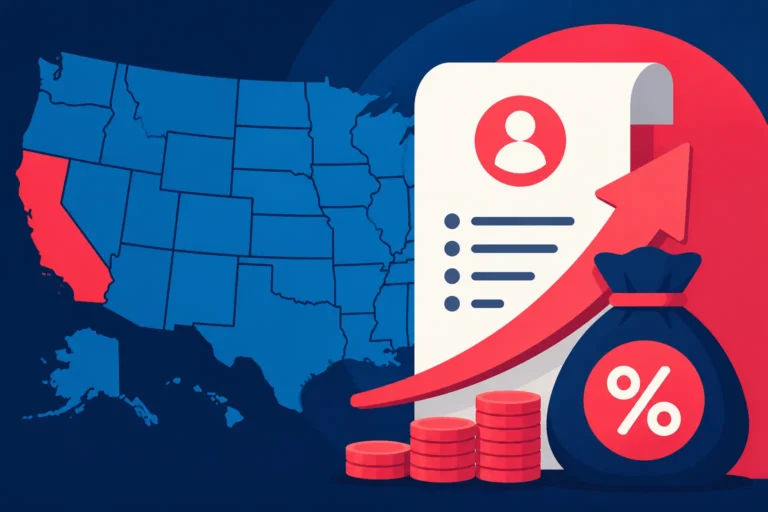
- California: Known for its high cost of living and progressive tax rates, California has multiple tax brackets. For 2026, a single filer making $100,000 would see their income fall into several brackets. A portion would be taxed at lower rates, and a higher portion (but not all) would hit the 8% or 9.3% bracket. Your effective state income tax rate would be a blend, likely much lower than the highest marginal rate you see. For a detailed view, check out our piece on Is California Tax Friendly? Full Breakdown. It's a prime example of how just looking at the top rate can be misleading.
- New York: Similar to California, New York state has a progressive income tax system. For a single filer making $100,000, different parts of that income would be taxed at various rates, likely topping out in a bracket around 5.9% or 6.4%. However, if you live in New York City, you'll also contend with separate city income tax rates. Our guide on NYC Income Tax Explained (2026 Rates) can illustrate how this adds up. The combination of state and city taxes can make New York one of the more expensive states for a $100,000 earner, despite its progressive structure.
- Ohio: Ohio transitioned to a flat tax in 2023, but it previously had a progressive system. For 2026, Ohio has a flat income tax rate of 2.75% after a 2025 reduction, making it a state with a relatively low flat tax. On $100,000, that's roughly $2,750 in state tax. However, Ohio is notorious for its numerous municipal income taxes, which can add anywhere from 0.5% to over 3% depending on your city of residence and employment. A tool like the one offered by SmartAsset can help you navigate these local complexities.
- North Carolina: This state has recently shifted towards a flat tax, with a rate of 4.25% for 2026. This means a $100,000 income would face approximately $4,250 in state income tax. This move to a flat rate is part of a trend among states to simplify their tax structures and potentially attract new residents and businesses. This simplification can make forecasting your tax liability easier for high-earners.
Real-World Scenarios and Factors Affecting Your Rate
Beyond the statutory tax rates, several real-world elements can significantly alter what you actually pay. Ignoring these can lead to unpleasant surprises come tax season.
The Impact of Deductions and Credits
Understanding and utilizing available deductions and credits is paramount to minimizing your state income tax liability, especially when earning $100,000. These aren't just for low-income earners; many benefit the middle and upper-middle class as well.
State Standard Deduction vs. Itemized Deductions
Most states offer a choice between taking a standard deduction or itemizing. The state standard deduction is a fixed amount that reduces your taxable income without needing to list specific expenses. For example, if your state's standard deduction is $12,000, your $100,000 income effectively becomes $88,000 for tax calculation purposes. If your itemized deductions (like property taxes, mortgage interest, or state income taxes paid up to the SALT cap) exceed the standard deduction, you might choose to itemize. This is where personalized tax planning comes in. Our guide on State Standard Deduction vs Itemized (2026) offers a deeper dive into this choice.
Family-Focused Credits
If you have dependents, various state tax credits can come into play. Many states offer their own versions of a child tax credit, sometimes called a dependent exemption credit, which can directly reduce your tax bill. For example, states like California and New York offer their own Child Tax Credits. Additionally, credits for dependent care expenses might be available if you pay for childcare while working. These credits are particularly impactful for families earning $100,000, as they represent a direct reduction in taxes owed, not just a reduction in taxable income.
The Overlooked: Local and City Income Taxes
This is where many people get caught off guard. Thinking only about state income tax rates can be a costly mistake, especially if you live or work in one of the many municipalities that levy their own income taxes.
Major City Income Taxes
Consider places like New York City, where residents pay a local income tax on top of their state income tax. For a $100,000 earner in NYC, this additional tax can easily add several thousand dollars to their annual tax bill. Similarly, in Philadelphia, if you work within the city limits, you're subject to the Philadelphia Wage Tax 2026 on your earnings, regardless of where you live. This means even if you commute in from a lower-tax suburb, your $100,000 salary could still be significantly impacted.
Regional Tax Authorities
Beyond major cities, some regions have their own income tax structures. In Ohio, for instance, many cities and villages impose municipal income taxes, often collected by regional authorities like RITA (Regional Income Tax Agency) or CCA (Central Collection Agency). These rates can vary widely, from under 1% to over 3%. So, while Ohio's state income tax might be a flat 2.75% for 2026, a $100,000 earner in Columbus might face an additional city tax, pushing their total effective rate much higher. It’s absolutely essential to research the specific city and county taxes that apply to your situation.
Your Residency Status Matters
It’s not just where you earn the money, but where you are legally considered to reside that dictates your state tax obligations. This is particularly relevant for those who work remotely, commute across state lines, or are "snowbirds" who split their time between states. Your state tax residency rules are complex and can sometimes lead to situations where you might owe taxes to more than one state, though mechanisms like credits for taxes paid to another state often prevent true double taxation. If you're pondering a move or have a hybrid work arrangement, understanding State Tax Residency Rules Explained is critical for accurately determining your state tax rate.
How to Estimate Your State Tax Liability
Given all these variables, how do you even begin to figure out what your state tax rate on $100,000 will truly be? Thankfully, there are tools and resources to help.
Using Online Calculators and Tools
For a good initial estimate, online tax calculators are incredibly useful. Websites like SmartAsset offer state-by-state income tax calculators that allow you to input your income, filing status, and location to get a rough idea of your state and local tax liability. These tools often account for standard deductions and typical scenarios, providing a solid starting point for understanding your potential tax burden. However, remember they are estimates and don't account for every single deduction or credit you might qualify for. They are excellent for getting a ballpark figure and comparing different scenarios, like if you're considering moving to another state.
Consulting with a Tax Professional
While online tools are great, for a truly accurate picture and personalized advice, nothing beats consulting with a qualified tax professional. This is especially true if your financial situation is complex, if you have income from multiple states, or if you're self-employed. A CPA or an enrolled agent can help you navigate specific state tax laws, identify all applicable deductions and credits, and ensure you're in compliance while minimizing your tax burden. They can also offer guidance on how to file your state taxes correctly, especially if you're dealing with issues like having to file as a Nonresident State Tax Return Guide or a How to File a Part-Year Resident Return if you moved states mid-year.
State Income Tax on $100,000 Income: A Snapshot (2026 Estimates)
This table provides a simplified look at estimated state income tax for a single filer earning $100,000, assuming only the standard deduction where applicable, and no city/local taxes unless explicitly noted. These are estimates and can vary based on many factors.
| State | Tax System | Estimated State Income Tax on $100,000 (Approx.) | Key Considerations |
|---|---|---|---|
| No Income Tax States | |||
| Florida | No Income Tax | $0 | High sales & property taxes. |
| Texas | No Income Tax | $0 | High property taxes. |
| Washington | No Income Tax | $0 | Capital gains tax for high earners, but not wage income. |
| Nevada | No Income Tax | $0 | Tourism-heavy taxes (sales, hospitality). |
| Flat Tax States | |||
| Pennsylvania | Flat (3.07%) | $3,070 | Many cities (e.g., Philadelphia) have local income taxes. |
| Colorado | Flat (4.40%) | $4,400 | Offers some state-specific deductions. |
| Illinois | Flat (4.95%) | $4,950 | State allows for some personal exemptions. |
| North Carolina | Flat (4.25%) | $4,250 | Moving towards lower flat rates. |
| Ohio | Flat (2.75%) | $2,750 | Widespread city income taxes can significantly increase burden. |
| Progressive Tax States | |||
| California | Progressive | $5,500 – $7,000+ (effective) | Highest marginal rates, but effective rate for $100k is lower. Very high cost of living. |
| New York | Progressive | $5,000 – $6,500+ (effective) | NYC residents pay additional city income tax. |
| Massachusetts | Progressive | $5,000 – $6,000+ (effective) | Progressive but sometimes has higher effective rates for mid-to-high earners. |
| Maryland | Progressive | $4,000 – $5,500+ (effective) | Counties levy "piggyback" income taxes on state tax. |
| New Jersey | Progressive | $3,000 – $4,500+ (effective) | Various deductions available, including retirement exclusions. |
Note: These are approximations for a single filer with standard deductions and do not include local taxes, which can vary greatly and impact the final amount owed.
Disclaimer
The information provided in this guide is for informational purposes only and does not constitute tax advice. State and local tax laws are complex and subject to change. It is highly recommended to consult with a qualified tax professional or financial advisor for personalized advice regarding your specific tax situation.