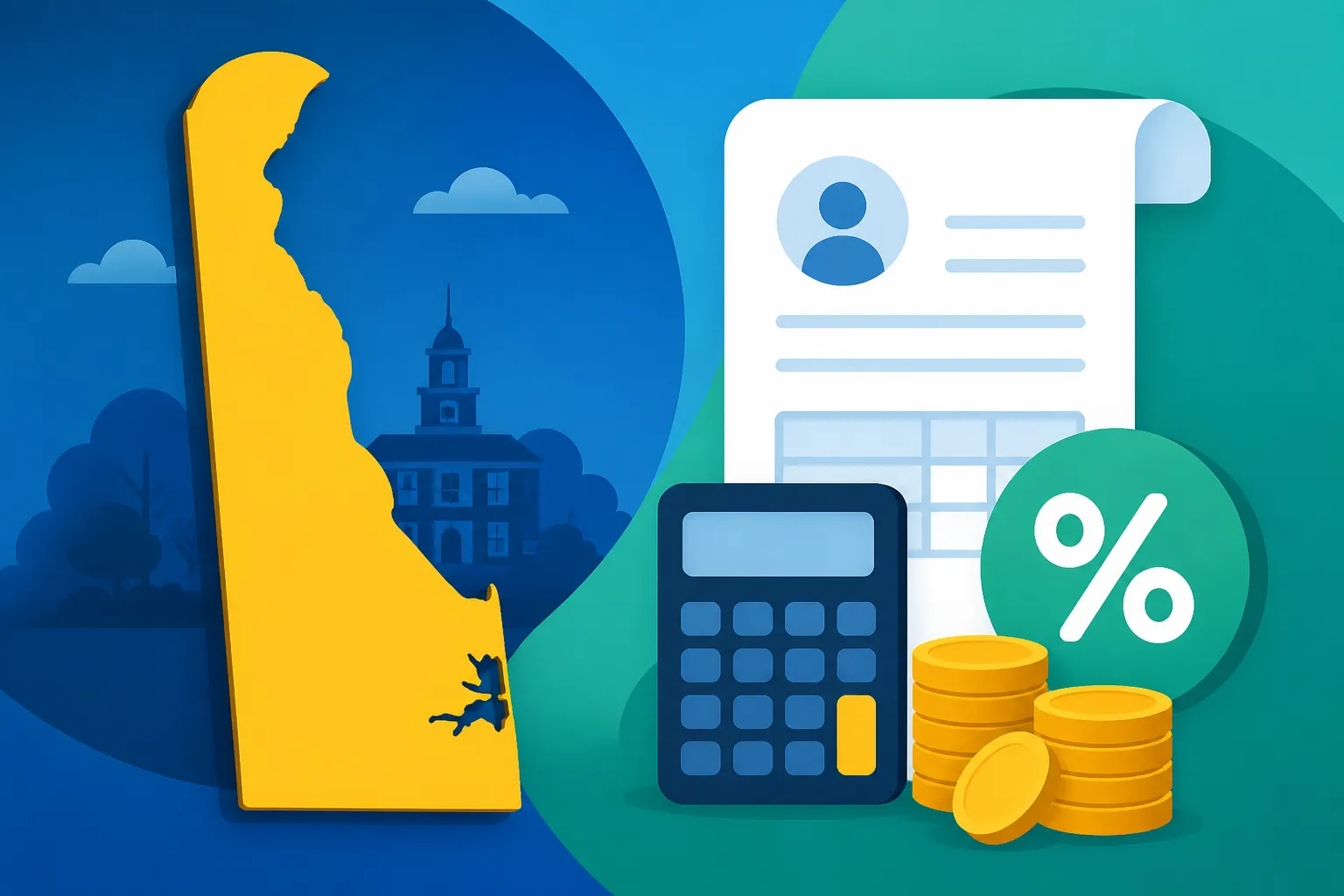
Delaware Income Tax Rate 2026
If you have recently moved to the First State or are planning a move for 2026, you likely heard about the lack of sales tax and assumed your wallet was safe. However, many residents face a harsh reality check when they see their first paycheck and realize that the Delaware state income tax is significantly more aggressive than its "tax haven" reputation suggests. This guide solves the confusion around the 2026 tax brackets, helps you navigate local city taxes, and explains how to maximize deductions to keep more of your hard-earned money.
Navigating the 2026 Delaware Graduated Income Tax Brackets
Delaware operates on a graduated income tax system, which is a fancy way of saying the more you earn, the higher the percentage the state takes. Unlike some of its neighbors that have moved toward a flat tax, Delaware maintains six distinct tax brackets. For 2026, these brackets remain a point of contention for many middle-class families because the top rate kicks in at a relatively low income level compared to the national average.
When you look at the 2026 landscape, the rates range from 2.2% to 6.6%. The "kicker" that surprises most people is that the maximum rate of 6.6% applies to all taxable income over $60,000. In an era of high inflation and rising wages, a huge portion of Delaware’s workforce finds themselves in the highest possible tax bracket very quickly. It is essential to understand How State Tax Brackets Work: Marginal vs Effective because your effective tax rate—what you actually pay out of your total income—will usually be lower than that 6.6% headline number.
To help you visualize where your income falls, here is the breakdown of the 2026 Delaware income tax brackets:
| Taxable Income Range | 2026 Tax Rate |
|---|---|
| $2,001 – $5,000 | 2.20% |
| $5,001 – $10,000 | 3.90% |
| $10,001 – $20,000 | 4.80% |
| $20,001 – $25,000 | 5.20% |
| $25,001 – $60,000 | 5.55% |
| Over $60,000 | 6.60% |
If you are trying to project your take-home pay, using a tool like a SmartAsset tax calculator can give you a more nuanced view of how these brackets interact with your federal obligations. Many residents find that while they save money at the grocery store or the mall due to the 0% sales tax, the state income tax bill can feel like a bit of a gut punch every April. This is especially true if you are coming from a state with a lower flat rate or a much higher threshold for the top bracket.
One thing to keep in mind is that these brackets apply to your "taxable income," not your gross salary. Before you apply these percentages, you get to subtract your deductions and exemptions. For many, this is where the strategy begins. If you feel like your bill is too high, it might be because you aren't fully utilizing the Delaware Tax Credits & Deductions Guide to lower that initial taxable number.
Maximizing Deductions and Credits to Lower Your Bill
Since the top tax rate hits so early, your primary goal should be reducing your taxable income through every legal avenue available. Delaware offers a choice between a standard deduction and itemized deductions. For 2026, the Delaware standard deduction remains relatively low at $3,250 for single filers and $6,500 for those married filing jointly. When you compare this to the much higher federal standard deduction, it becomes clear why so many Delawareans feel the pinch.
If you own a home in a high-property-tax area like North Wilmington or have significant charitable contributions, you should definitely look into itemizing. Delaware generally allows you to itemize on your state return even if you took the standard deduction on your federal return. This is a crucial distinction. In many other states, you are locked into whatever choice you made for Uncle Sam, but Delaware provides this small window of flexibility. Understanding the State Standard Deduction vs Itemized (2026) rules is perhaps the most effective way to shave a few hundred dollars off your year-end liability.
Beyond deductions, Delaware offers a "Personal Credit" which acts as a direct reduction of the tax you owe. For 2026, this credit is $110 per person. If you are married with two children, that is a $440 direct reduction in your tax bill. While it might not seem like much, every bit helps when you are staring down a 6.6% rate. SmartAsset often highlights that while Delaware’s credits are helpful, they don’t always scale as well for larger families as the credits found in more progressive tax states.
If you are a parent, you should also be looking at the Delaware State Income Tax Calculator Guide to see how the child care credit integrates. Delaware allows a credit equal to 50% of the federal child and dependent care credit. For working parents in places like Newark or Dover, where daycare costs are skyrocketing, this credit is a vital lifeline. It’s one of the few areas where the state’s tax code acknowledges the specific financial burdens of modern families.
The Reality of Local Taxes and Multi-State Commuting
One of the biggest "gotchas" in the Delaware tax world isn't even on the state form. If you work within the city limits of Wilmington, you are subject to a 1.25% city wage tax. This applies regardless of whether you live in the city or just commute there for work. If you live in a quiet suburb like Hockessin but work in a bank tower downtown, that 1.25% is taken right off the top, in addition to your state and federal taxes.
For those who live in Delaware but work across the border in Pennsylvania or Maryland, things get even more complicated. Delaware does not have "tax reciprocity" with its neighbors. This means if you live in Claymont but work in Philadelphia, your employer will withhold Pennsylvania taxes. You will then have to file a nonresident return in PA and a resident return in DE.
Fortunately, Delaware provides a "Credit for Taxes Paid to Another State." This prevents you from being double-taxed on the same dollar, but it requires meticulous record-keeping. You’ll want to check out the Delaware Nonresident Income Tax Rules if you find yourself in this situation. The math can get messy, and many residents use SmartAsset resources to ensure they aren't overpaying one state at the expense of another.
The commute between Delaware and Pennsylvania is particularly common, and taxpayers often struggle with the difference in rates. Pennsylvania has a flat tax of 3.07%, which is lower than Delaware's top rate. This often means that even after the credit, you still owe a little bit extra to Delaware because their rate is higher. If you are in this boat, reading the guide on Live in PA Work in DE: State Taxes can clarify how to handle the withholding so you don't end up with a surprise bill in April.
Tax Considerations for Retirees and the 2026 Outlook
Delaware has long been marketed as a retirement destination, and for good reason. While the income tax is high for workers, the state is much gentler on those in their golden years. If you are 60 or older, Delaware allows you to exclude up to $12,500 of your pension and qualified retirement income from your state taxes. If you are under 60, you can still exclude up to $2,000.
More importantly, Delaware is one of the states that does not tax Social Security benefits. This is a huge win for retirees on a fixed income. When you combine the lack of sales tax with the Social Security exemption, the state suddenly looks much more "tax-friendly" than it does for a 30-year-old professional. If you are considering a move to a 55+ community in Sussex County, you should verify these benefits by looking at Does Delaware Tax Social Security? to see how it fits into your broader financial plan.
As we look toward the rest of 2026, there is ongoing talk in the state legislature about adjusting the brackets to account for "bracket creep"—the phenomenon where inflation pushes people into higher tax brackets even though their purchasing power hasn't increased. While no major overhauls have been finalized yet, staying informed is key. Many people find that Is Delaware a Tax-Friendly State? is a question with a different answer depending on whether you are an active worker or a retiree.
Finally, remember that residency matters. If you spend more than 183 days in the state, Delaware considers you a resident for tax purposes. If you moved mid-year, you'll need the Delaware Part-Year Resident Tax Guide to ensure you only pay tax on the income earned while you were physically living in the state. Managing these details can be a headache, but it’s the difference between a smooth filing season and an expensive audit. SmartAsset remains a solid resource for tracking these shifting state-level trends as 2026 progresses.
Even with the higher-than-expected income tax, Delaware remains a unique place to live. The trade-off for that 6.6% bracket is the total absence of sales tax and relatively low property taxes compared to New Jersey or New York. By understanding the brackets, claiming your credits, and accounting for local wage taxes, you can navigate the First State's tax system without losing your peace of mind.
Disclaimer on Delaware State Taxes
This guide is intended for informational purposes only and does not constitute professional tax, legal, or financial advice. Tax laws, including brackets, deductions, and local ordinances, are subject to change by state and local legislative bodies. While we strive to provide the most accurate and up-to-date information for the 2026 tax year, you should always consult with a qualified tax professional or refer to the Delaware Department of Finance for specific guidance regarding your individual tax situation. No sales tax does not mean no tax liability, and individual results will vary based on income level, filing status, and residency.