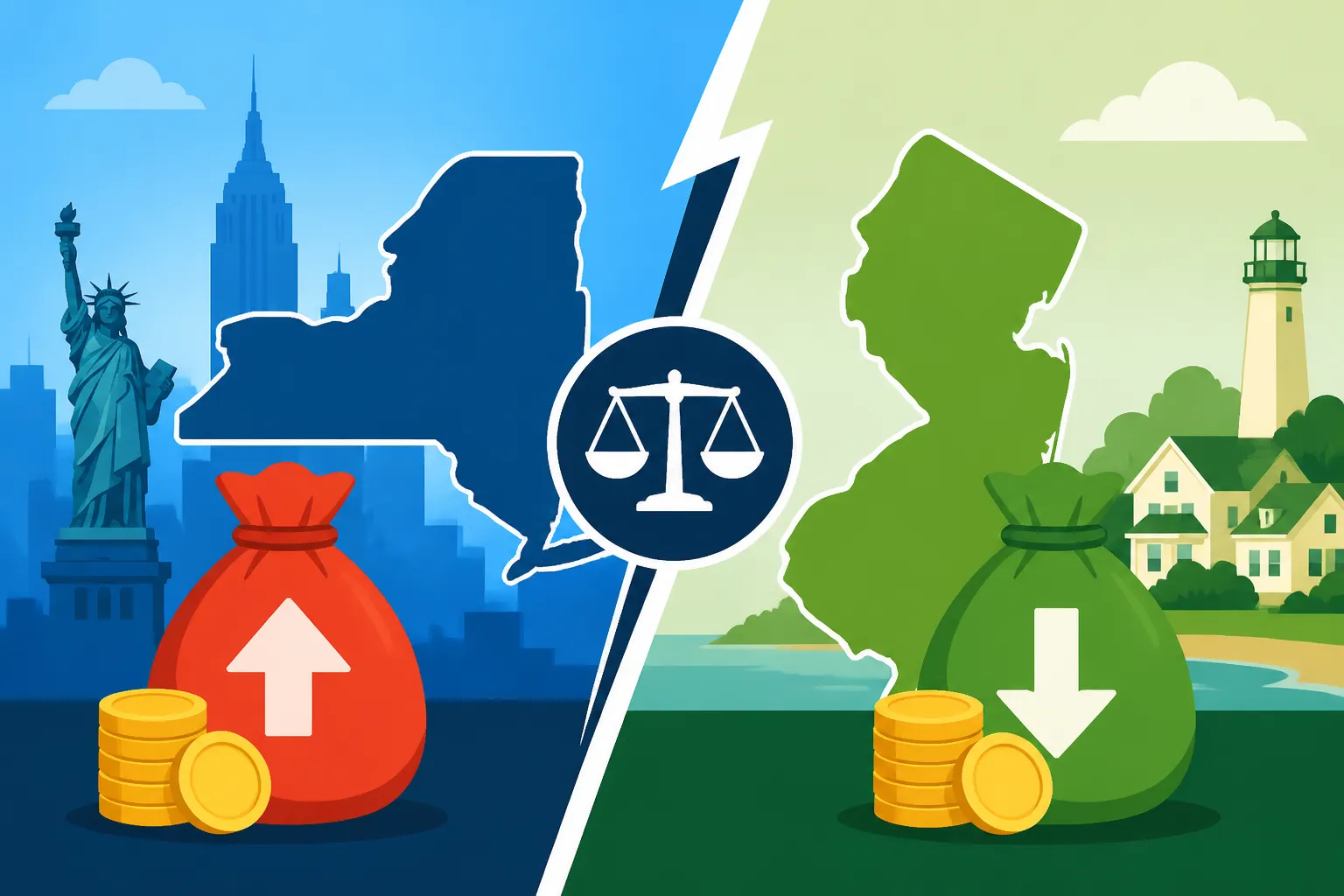
New York vs New Jersey Taxes Compared
Navigating the tax landscape between New York and New Jersey can feel like deciphering a secret code, especially if you're commuting across state lines or pondering a move. The rules are different, the rates vary, and what looks like a good deal on paper might hide some less obvious financial pitfalls. This guide aims to clear up the confusion, offering a realistic, in-depth comparison of the tax systems in both states so you can make informed decisions.
The Core Difference: Income Tax Structures
When you’re looking at where to live or work, the state income tax is usually the first thing that jumps out at you. And let me tell you, it's a big one when comparing New York and New Jersey. Both states employ a progressive income tax system, meaning the more you earn, the higher percentage you're generally expected to pay. However, the rates, brackets, and even local taxes can create vastly different outcomes for your paycheck.
New York's Progressive Tax System
New York State has one of the more aggressive progressive income tax systems in the country. For 2026, the tax brackets start quite low and climb steadily, with top earners facing some of the highest state income tax rates. It's not just the state, either. If you're living or working in New York City, you're also going to contend with a city income tax on top of the state tax. This layered taxation can make a substantial difference in your take-home pay compared to other areas.
For instance, a single individual making, say, $75,000 a year living in Buffalo, NY, would pay only state income tax, which includes several brackets. However, if that same individual earned $75,000 while living and working in Manhattan, they would also be subject to New York City’s local income tax. This additional layer of taxation means that the effective tax rate for a resident of New York City will be considerably higher than for someone with the same income living elsewhere in the state. Understanding New York Income Tax Brackets 2026 is crucial for anyone earning income in the Empire State. You can dive deeper into the complexities of Local & City Income Taxes in the US to grasp the full picture.
New Jersey's Progressive (but different) Tax System
New Jersey also operates on a progressive income tax model, but its brackets and rates often look a little different from New York's. While New Jersey also has multiple brackets, for many middle-income earners, the state income tax burden can feel somewhat lighter than in New York, especially when you factor out the additional city taxes that NY imposes. However, New Jersey does have its own top-tier rates that can still be quite high for very high earners.
Consider a family with a combined income of $150,000 living in Bergen County, New Jersey. Their state income tax obligation would be calculated based on New Jersey's specific progressive brackets for that income level. If that same family were to earn that income and reside in, say, Albany, NY, their state tax would be different. The devil is truly in the details of those brackets. It's important to remember that there is no income tax reciprocity agreement between New York and New Jersey, which means if you live in one state and work in the other, things get complicated quickly. This is a common pain point for commuters, as highlighted in topics like NJ-NY Commuter Taxes (No Reciprocity).
Beyond Income Tax: Other Key Tax Considerations
While income tax often grabs the headlines, it’s far from the only tax you’ll pay. Property taxes and sales taxes can significantly impact your overall financial picture, sometimes even more than income tax, depending on your lifestyle and location. When you're comparing the cost of living between New York and New Jersey, ignoring these other taxes would be a huge mistake.
Property Taxes: A Major Factor
This is where New Jersey often gets a bad rap, and for good reason. New Jersey consistently ranks among the states with the highest property tax rates in the nation. For a homeowner, this can easily be the largest single tax expense they face annually. It's not uncommon for average property tax bills in desirable New Jersey towns like Short Hills or Demarest to be well over $10,000, and often significantly higher, even for moderately sized homes.
New York also has substantial property taxes, especially in suburban areas surrounding New York City, like Westchester County or on Long Island. While certain areas of New York might rival New Jersey in property tax rates, on average, New Jersey tends to have a higher median property tax bill statewide. It's essential to look at specific towns and counties, as there can be massive variations. For instance, according to data available through resources like SmartAsset, the average effective property tax rate in New Jersey often hovers around 2%, while New York's statewide average is lower, but with pockets, especially downstate, that are very high. And don't forget, the federal How the SALT Cap ($40,000) Affects State Taxes limits the deduction you can take for state and local taxes, including property taxes, on your federal return, which can sting homeowners in both high-tax states.
Sales Taxes: Everyday Impact
Sales tax is another everyday expense that adds up over time. Both New York and New Jersey have a statewide sales tax, but there are differences to be aware of, including how certain items are treated and whether local jurisdictions add their own sales taxes.
As of early 2026, New York's statewide sales tax rate is 4%, but many local jurisdictions levy additional sales taxes. For example, New York City adds a local sales tax, bringing the combined rate to 8.875% on most taxable goods and services. This means that nearly every purchase, from a new appliance to a cup of coffee (in many cases), will carry a significant tax burden.
New Jersey, on the other hand, currently has a statewide sales tax rate of 6.625%. What's interesting about New Jersey is that certain essential items, like most clothing and footwear, and many food items purchased for home consumption, are exempt from sales tax. This can lead to some savings, especially for families. If you’re regularly making larger purchases or buying a lot of clothes, these exemptions in New Jersey could make a noticeable difference in your budget compared to the higher combined rates in New York, particularly in NYC.
Inheritance and Estate Taxes
For individuals with substantial assets, or those planning for their legacy, inheritance and estate taxes become critical. These taxes can significantly impact how wealth is transferred.
New York is one of the states that still levies an estate tax. The New York estate tax applies to estates above a certain exemption threshold and can have rates as high as 16% on the taxable portion of the estate. This is a significant consideration for wealthier individuals residing in the state, and it often leads to complex estate planning strategies to minimize the impact.
New Jersey, in recent years, has made some significant changes. While it previously had both an estate tax and an inheritance tax, the estate tax was fully repealed for deaths occurring on or after January 1, 2018. New Jersey does still have an inheritance tax, but it only applies to transfers to beneficiaries who are not closely related to the decedent (e.g., siblings, nieces/nephews, friends). Spouses, civil union partners, children, grandchildren, parents, and grandparents are entirely exempt from the New Jersey inheritance tax. This makes New Jersey generally more favorable for direct family transfers compared to New York.
Real-World Scenarios and Commuter Complexities
The reality of living in one state and working in another is a common scenario in the New York-New Jersey metropolitan area. This cross-border lifestyle introduces a layer of tax complexity that many people find frustrating. It's not as simple as just paying taxes where you live or where you work – it often means dealing with both, though thankfully not double taxation.
Living in New Jersey, Working in New York
This is arguably the most common commuter pattern. If you live in New Jersey but work in New York, your income earned in New York is taxable by New York State. And, if you're working in New York City, you'll also be subject to New York City income tax. Your employer will typically withhold New York State and, if applicable, New York City taxes from your paycheck.
However, as a New Jersey resident, your worldwide income (including the income earned in New York) is also subject to New Jersey income tax. But fear not, you won't be taxed twice on the same dollar! New Jersey offers a credit for taxes paid to another state. This credit generally allows you to offset your New Jersey tax liability by the amount of income tax you paid to New York (and NYC). The catch is that the credit is limited to what your New Jersey tax liability would have been on that income. For high earners, especially those working in NYC, your New York tax burden (including city tax) might be higher than your New Jersey tax burden on the same income, meaning you could end up paying more in total taxes than if you only lived and worked in New Jersey. Resources explaining How to Avoid Double Taxation Between States are invaluable here. Also, remember that New York has the "convenience of the employer" rule, which can impact remote workers who technically work for a New York-based company but reside in New Jersey. Understanding New York Convenience Rule & Remote Work is critical for these individuals.
Living in New York, Working in New Jersey
While less common, many people do live in New York and commute to New Jersey for work. In this scenario, New Jersey will tax the income you earn within its borders. Your employer will withhold New Jersey income tax from your paychecks.
As a New York resident, you are subject to New York State income tax (and potentially New York City income tax if you live there) on your worldwide income, which includes the money you earned in New Jersey. Similar to the inverse situation, New York provides a credit for taxes paid to other states. This credit will reduce your New York tax liability by the amount of income tax you paid to New Jersey, up to what your New York tax would have been on that specific income. Generally, New York's top income tax rates are higher than New Jersey's for many income levels, particularly when factoring in NYC tax, so you might end up owing the difference to New York after applying the credit.
Here's a simplified look at how income taxes might compare for a single filer earning $100,000 in 2026, assuming standard deductions and no other complexities:
| Income Level ($100,000) | Live in NY (outside NYC), Work in NJ | Live in NYC, Work in NJ | Live in NJ, Work in NY (outside NYC) | Live in NJ, Work in NYC |
|---|---|---|---|---|
| NJ Income Tax Paid | ~$3,000-$4,000 (est.) | ~$3,000-$4,000 (est.) | N/A | N/A |
| NY/NYC Income Tax Paid | N/A | N/A | ~$5,000-$6,000 (est.) | ~$8,000-$9,000 (est.) |
| Credit for Taxes Paid | Applied on NY return | Applied on NYC return | Applied on NJ return | Applied on NJ return |
| Net State/Local Tax | Higher of NY/NJ after credit | Higher of NY/NJ after credit | Higher of NY/NJ after credit | Higher of NY/NJ after credit |
Note: These are rough estimates for illustrative purposes only. Actual tax liability depends on specific income, deductions, and bracket changes for 2026. Consult a tax professional for personalized advice.
The key takeaway here is that you generally pay taxes to the state where the income is sourced (where you physically perform the work), and then your resident state gives you a credit for those taxes paid. This prevents true double taxation but doesn't necessarily mean you pay less overall. Understanding State Tax Residency Rules Explained is crucial to ensure correct filing.
Financial Planning and Strategic Moves
Given the significant tax differences, it's natural for individuals and families to consider how their choices impact their financial well-being. Thinking about where to settle down, where to run a business, or where to retire often involves a deep dive into the comparative tax burdens.
Considering a Move: What to Evaluate
If you're contemplating a move between New York and New Jersey, or even just relocating within one of these states, taxes are a huge piece of the puzzle, but they’re not the only piece. You really need to look at the whole picture – what SmartAsset calls your "tax burden" (which includes income, property, sales, and other taxes) in conjunction with your overall cost of living. A state with lower income taxes might have significantly higher property taxes, or vice versa, completely offsetting any perceived savings.
For example, a family might look at New Jersey's lower income tax rates (especially if they're not subject to city income tax) and think it's a no-brainer. However, if they buy a home in a highly rated school district in Bergen County, their property tax bill could easily be $15,000-$20,000 or more annually, quickly eroding those income tax savings. Conversely, someone moving from a high-property-tax area of New York to a lower-property-tax area in New Jersey (or vice-versa) might see different results.
You should consider:
- Total Tax Burden: Don't just look at one type of tax. Use online calculators and resources to estimate your combined income, property, and sales tax burden based on your specific income, assets, and spending habits. Tools like SmartAsset can be incredibly helpful here.
- Cost of Living: Beyond taxes, consider housing costs (rent or mortgage), transportation, groceries, and other daily expenses. Sometimes, a state with higher taxes might have a lower overall cost of living in certain areas, or the reverse could be true. It’s all about finding the balance that works for your budget, which is a great topic discussed in Cost of Living vs Taxes by State.
- Lifestyle: Think about proximity to work, family, schools, amenities, and cultural attractions. Saving a few thousand dollars in taxes might not be worth a miserable commute or being far from loved ones.
It's a really complex decision, and sometimes people even consider leaving these high-tax states altogether, much like those contemplating Moving From California to Avoid State Tax.
Retirement and Other Income Considerations
For retirees, the tax landscape shifts significantly. Many states offer special exemptions or deductions for retirement income, and these can vary wildly between New York and New Jersey.
- Social Security: Neither New York nor New Jersey taxes Social Security benefits. This is a relief for many retirees in both states.
- Pensions and 401(k)/IRA Withdrawals: This is where the differences become more apparent. New York offers a pension and annuity exclusion for individuals meeting certain age requirements, allowing them to subtract a significant portion of eligible retirement income from their taxable income. New Jersey also offers a substantial exclusion for pension, annuity, and IRA withdrawals, especially for those over a certain age and with specific income levels. It's really worth exploring Does New York Tax Retirement Income? and Does New Jersey Tax Retirement Income? for the precise details, as these exclusions are subject to change and specific criteria.
- Capital Gains: Both states generally tax capital gains as ordinary income, but the rates you'll pay will depend on your overall income level and the state's progressive tax brackets. For high earners with significant investment portfolios, this is a critical consideration.
For individuals with high incomes, whether from employment or investments, carefully comparing the overall tax burden can reveal which state is truly more favorable. Understanding articles like Best States for High Earners (Tax) can offer further perspective on how these states stack up against others.
Disclaimer
Please remember that tax laws are complex and subject to change. The information provided in this article is for general informational purposes only and does not constitute tax, financial, or legal advice. You should consult with a qualified tax professional or financial advisor for advice tailored to your specific situation.