How the SALT Cap ($40,000) Affects State Taxes
If you live in a high-tax state, you probably remember the absolute gut punch that came with the 2017 tax changes, which capped your State and Local Tax (SALT) deduction at a measly $10,000. It felt like being penalized twice for living in a productive area. This guide explores the massive shift to a $40,000 SALT cap in 2026 and how it changes the math for your home, your income, and your future.
Understanding the SALT Deduction and the 2026 Shift
The State and Local Tax deduction, affectionately known as SALT in the accounting world, has been one of the most contentious parts of the federal tax code for nearly a decade. For those of us living in places where property taxes alone can easily clear $15,000 a year, the previous $10,000 cap was more than just a nuisance—it was a significant financial burden that effectively led to double taxation on a large portion of our income. When you look at State Income Tax vs Federal Income Tax, the interaction between the two is where most families either win or lose their tax battle.
What Exactly is SALT?
At its core, the SALT deduction allows taxpayers who itemize their deductions on their federal income tax return to deduct certain taxes paid to state and local governments. This includes state and local income taxes (or sales taxes, if you choose that route instead), as well as real estate and personal property taxes. Before the Tax Cuts and Jobs Act of 2017, there was no limit on this deduction. You could pay $50,000 in property taxes in New Jersey and deduct every penny from your federal taxable income.
In the current 2026 landscape, the $40,000 cap represents a middle ground that many policy experts argued for years would provide relief to the middle class without giving a "blank check" to the ultra-wealthy. If you are navigating How State Tax Brackets Work: Marginal vs Effective, understanding how these deductions lower your federal "base" is the first step in realizing how much money stays in your pocket versus going to the Treasury.
The Jump From $10,000 to $40,000
The move to a $40,000 cap is a monumental shift for homeowners in suburban corridors. Under the old $10,000 rule, a family in a modest home in a high-tax county was treated the same as someone in a much lower-cost area. Now, that extra $30,000 of "deductible room" acts as a massive shield. For a family in the 24% or 32% federal tax bracket, being able to deduct an additional $30,000 can result in thousands of dollars in direct federal tax savings.
This change finally acknowledges that the cost of living and the cost of public services vary wildly across the country. Using tools from SmartAsset, many taxpayers are finding that they no longer need to look for complex "workarounds" to manage their liability. The $40,000 ceiling covers the vast majority of dual-income professional households, leaving only the very high earners in the most expensive ZIP codes still feeling the "cap" squeeze.
Why the Cap Exists in the First Place
Critics of the SALT deduction often argue that it essentially forces residents of low-tax states to subsidize the higher spending of states like California or New York. From their perspective, the cap encourages states to be more fiscally responsible. However, from the perspective of a taxpayer in a high-tax state, the deduction is about fairness—ensuring you aren't paying federal tax on money that you never actually "kept" because it went to your local school district or state roads.
The $40,000 compromise was born out of a need to balance these two philosophies. It prevents the federal government from completely subsidizing massive state spending while ensuring that the "average" high-state-tax resident isn't being crushed by the weight of their local obligations. It’s a nuance that often gets lost in political debates but is felt acutely every April.
How the SALT Cap Affects High-Tax States
The states feeling the most significant impact from the $40,000 cap are, unsurprisingly, those that top the charts for property taxes and graduated income tax rates. When we look at the Highest Income Tax States in 2026, the list is populated by states that provide a lot of services but demand a high price for them. For residents in these areas, the $40,000 cap is the difference between a tax bill they can manage and one that forces them to consider moving.
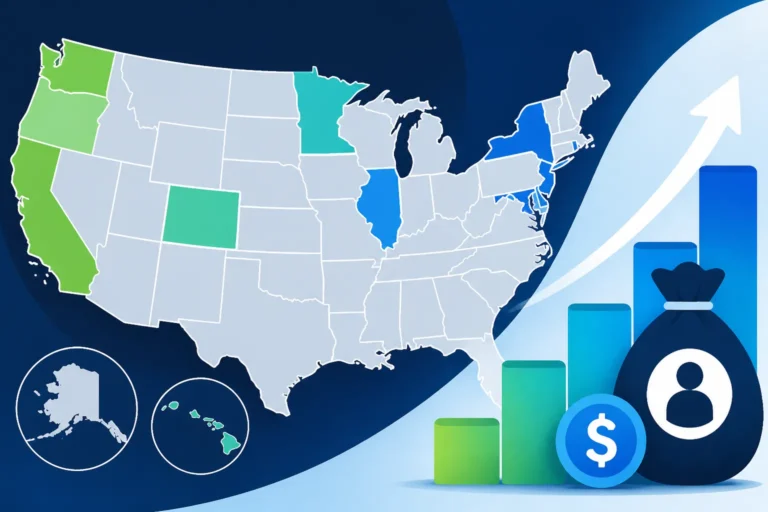
The Impact on California and New York
California and New York have long been the "poster children" for the SALT debate. In California, the combination of high property values and California Income Tax Brackets 2026 creates a situation where even a middle-management professional can easily exceed a $10,000 threshold. With the $40,000 cap, a much larger portion of that California tax burden becomes federally deductible. This effectively lowers the "net cost" of living in the Golden State for many residents.
Similarly, in New York, where local property taxes in Westchester or Nassau County are legendary, the $40,000 cap provides a significant breather. A family paying $22,000 in property taxes and $15,000 in state income tax can now deduct the full $37,000. Under the old rules, they lost $27,000 of that deduction. This shift has slowed the "tax exodus" that many feared would permanently hollow out the Empire State's tax base.
The Blue State Tax Phenomenon
There has been much discussion about whether the SALT cap was a targeted political move against "Blue" states. Regardless of the intent, the mathematical reality is that states with high levels of public investment—and thus higher taxes—were hit hardest. The 2026 relief of a $40,000 cap has changed the narrative. It has allowed state governments to maintain their social programs without the immediate threat of their highest earners fleeing to places like Florida or Texas solely for federal tax reasons.
State legislatures in these regions have been closely monitoring their State Tax Burden by State 2026 rankings. The $40,000 cap has given these states more "room" to breathe. For example, if a state wanted to increase local education funding through a property tax hike, they can now do so knowing that for many of their residents, that increase will be federally deductible, effectively softening the blow to the taxpayer’s wallet.
How SmartAsset Tools Help Visualize These Burdens
When you're trying to figure out if you're actually better off under the new rules, the math can get fuzzy. This is where SmartAsset is a lifesaver. Their interactive tax maps allow you to plug in your specific ZIP code and see exactly how your local property tax rates interact with your state income tax. By visualizing the "all-in" tax cost, you can see how much of your total state and local burden fits under the $40,000 umbrella.
Many users find that while their state taxes look high on paper, the federal deduction makes the "effective" cost much more comparable to states that might have no income tax but significantly higher sales or hidden fees. It’s about looking at the whole picture rather than just one line item on your W-2.
Strategy for Itemizing vs Standard Deduction
The most practical question for any taxpayer in 2026 is: "Should I still take the standard deduction, or is it finally time to itemize again?" For several years, the standard deduction was so high—and the SALT cap so low—that itemizing simply didn't make sense for most people. The $40,000 cap has flipped that logic on its head for millions of homeowners.
| Deduction Scenario | $10,000 SALT Cap (Old) | $40,000 SALT Cap (2026) | No SALT Cap (Pre-2017) |
|---|---|---|---|
| Max SALT Deduction | $10,000 | $40,000 | Unlimited |
| Commonly Covered Group | Low-tax state residents | High-tax state middle class | Ultra-high net worth |
| Itemizing Incentive | Very Low | Moderate to High | Very High |
| Impact on Homeowners | Minimal benefit | Significant benefit | Full benefit |
| Federal Tax Savings | Base level | High for high-tax states | Maximum |
Crossing the Threshold in 2026
To decide whether to itemize, you have to compare your total itemized deductions—SALT, mortgage interest, charitable donations, and medical expenses—against the 2026 standard deduction. Because the SALT portion can now go up to $40,000, it is much easier to "beat" the standard deduction. Even if you only have a modest mortgage, if your state and local taxes are $30,000, you are likely already very close to the threshold where itemizing saves you more money.
Checking the State Standard Deduction vs Itemized (2026) guidelines for your specific state is also crucial. Some states require you to use the same method on your state return that you used on your federal return. If itemizing on your federal return saves you $2,000, but forces you into a less favorable position on your state return, you have to look at the combined net benefit. It’s a bit of a balancing act that requires a fresh look at your numbers every year.
Real-World Scenario: The Suburban Homeowner
Let’s look at a hypothetical couple, Mark and Sarah, living in a suburb of Chicago. They pay $14,000 in property taxes and roughly $10,000 in Illinois state income tax. They also have $12,000 in mortgage interest and give $3,000 to charity.
Under the old $10,000 SALT cap, their total itemized deductions would have been $25,000 ($10,000 SALT + $12,000 mortgage + $3,000 charity). If the standard deduction for a married couple was $29,000, they would have just taken the standard deduction and "lost" the benefit of their high taxes.
However, with the $40,000 cap, they can now deduct the full $24,000 of their state and local taxes. Their total itemized deductions jump to $39,000. By itemizing, they are now deducting $10,000 more than the standard deduction would allow. In a 24% tax bracket, that’s an extra $2,400 in their pocket.
Comparing State-Level Deduction Options
It's important to remember that state governments have their own rules. While the federal government now allows a $40,000 SALT deduction, your state might not allow you to deduct those same taxes on your state return (which makes sense, as you wouldn't deduct a tax from itself). However, many states allow deductions for property taxes or offer specific credits.
When you look at the New York Income Tax Brackets 2026, you have to calculate your state liability first, then use that number to see how much of it you can "recoup" through the federal SALT deduction. This circular relationship is why tax planning in high-tax states has become a year-round activity for many families.
State-Level Workarounds and Legislative Responses
When the $10,000 cap was first implemented, state legislatures went into a frenzy trying to find "workarounds" to protect their residents. Some of these were struck down by the IRS, but others, like the Pass-Through Entity (PTE) tax, have become permanent fixtures of the tax landscape. Even with the cap raised to $40,000, these strategies remain vital for business owners and high earners.
Pass-Through Entity (PTE) Taxes
The PTE tax is perhaps the most successful "legal workaround" in modern tax history. It allows S-corporations and partnerships to pay state income taxes at the entity level rather than passing the income through to the individual partners. Because the entity is paying the tax as a business expense, it is fully deductible on the federal level and is not subject to the personal SALT cap—whether that cap is $10,000 or $40,000.
For a small business owner in a state like New Jersey or Connecticut, this is a massive win. It effectively bypasses the SALT cap entirely for their business income. Even with the personal cap raised to $40,000, a business owner making significant profits will still find the PTE tax elective to be the superior strategy. It’s one of the first things you should discuss with a professional if you have any "1099" or K-1 income.
Charitable Contribution Credits (And Why They Failed)
In the early days of the SALT cap, states like New York and New Jersey tried to create "charitable funds" that residents could pay into instead of paying taxes. In exchange, the state would give them a tax credit. The idea was that charitable contributions were fully deductible on the federal level, thus bypassing the SALT cap.
The IRS quickly caught on and issued regulations that essentially killed this strategy, stating that if you receive a tax credit in exchange for a "donation," it’s not really a donation. While some states still have minor programs like this for specific causes (like private school scholarships), the broad "SALT workaround" via charity is largely a thing of the past. The $40,000 cap has made these complex and risky schemes much less necessary for the average person.
Interaction Between State and Federal Audits
One unintended consequence of the SALT cap—and the push for workarounds—is increased scrutiny from both the IRS and state tax authorities. If you are claiming a full $40,000 SALT deduction, you need to have your documentation in order. This includes property tax bills and proof of state tax payments.
States have also become more aggressive in tracking residency. If you claim to live in a no-income-tax state but spend 200 days a year in a high-tax state, they will come looking for their share. Understanding How to Change Your State Residency for Taxes is more than just getting a new driver's license; it’s about creating a "fact pattern" that survives an audit.
Long-term Financial Planning Under the New Cap
With the $40,000 cap firmly in place for 2026, the long-term financial planning landscape has shifted. For many, the "panic" of high-state taxes has subsided into a manageable calculation. However, for those looking at retirement or a career change, the question remains: is the location worth the cost?
Moving to a Tax-Friendly State
Even with a $40,000 deduction, you are still paying those taxes to the state. A deduction only reduces your taxable income; it doesn't give you a dollar-for-dollar credit. Therefore, moving to a state with lower costs remains a popular strategy for those who are "location independent." When researching States With No Income Tax (2026 Full List), it’s easy to see the appeal of places like Florida, Nevada, or Texas.
However, the $40,000 cap makes the "math of moving" more nuanced. If you can deduct almost all of your state taxes now, the "penalty" for staying in a high-tax state is significantly reduced. You might find that the quality of life, proximity to family, or career opportunities in a high-tax state are worth the remaining non-deductible tax portion.
Is It Cheaper to Live in a State with No Income Tax?
This is the golden question, and the answer is rarely a simple "yes." Often, states with no income tax make up for that lost revenue through higher sales taxes, higher property taxes, or fewer public services. For example, some counties in Texas have property tax rates that would make a New Yorker wince.
Using SmartAsset’s cost of living calculators is the best way to do an apples-to-apples comparison. You might find that after you account for the $40,000 federal SALT deduction, the total cost of living in a "high-tax" state is actually lower than in a "no-tax" state once you factor in commuting costs, utility rates, and other local fees. Always look at the Is It Cheaper to Live in a State With No Income Tax? analysis before packing your bags.
Timing Property Tax Payments
For those who are consistently right at the $40,000 limit, timing becomes a strategic tool. Property taxes are usually deductible in the year they are actually paid. If your local municipality allows for early payments or has a billing cycle that straddles the end of the year, you might be able to "bunch" your payments into one year to maximize your itemized deductions, then take the standard deduction the following year.
This requires careful planning and a clear understanding of your local tax calendar. It’s a common strategy for homeowners who know they will have a high-income year and want to maximize every possible deduction to lower their federal bracket.
Looking Ahead: The Future of State Tax Deductibility
The 2026 landscape is a result of years of political negotiation and the "sunsetting" of various parts of the 2017 tax code. While the $40,000 cap feels like a stable middle ground for now, tax laws are never truly set in stone. As a taxpayer, staying informed is your best defense against unexpected bills.
Legislative Expiration and Renewals
Many of the current tax provisions are tied to federal budget cycles. There is always a possibility that a future Congress could raise the cap further, remove it entirely, or—in a search for revenue—lower it back to $10,000. This uncertainty makes long-term real estate investments in high-tax areas slightly more complex.
When you buy a home with a $25,000 tax bill, you are making a bet that the SALT deduction will remain favorable enough to keep your "net" cost manageable. It’s one reason why suburban home prices in high-tax states are so sensitive to federal tax news.
What it Means for Your 2026 Return
As you prepare for the 2026 tax season, the most important thing you can do is gather your records early. Because so many more people will be itemizing thanks to the $40,000 cap, you’ll need to be more diligent than you’ve been in the last few years.
Don't just assume the standard deduction is the winner. Run the numbers both ways. Use a professional or high-quality software to ensure you aren't leaving money on the table. For many, 2026 will be the first year in a long time that they actually feel the benefit of their local tax payments on their federal return.
Final Thoughts for the Average Filer
Tax laws are frustrating, dense, and often feel unfair. The $40,000 SALT cap isn't a perfect solution, but for the millions of people who felt targeted by the previous $10,000 limit, it is a significant and welcome relief. It restores a level of balance to the federal tax code and acknowledges the reality of living in high-cost, high-service areas of the country.
By staying proactive, using tools like SmartAsset, and understanding how your state and federal taxes interact, you can turn a complex headache into a clear financial strategy. Whether you decide to stay put in your high-tax suburb or move to a tax-free haven, make sure you're making that choice based on the full math of 2026.
State Income Tax Disclaimer
This guide is for informational purposes only and does not constitute professional tax, legal, or financial advice. Tax laws, including SALT cap limits and state-specific regulations, are subject to change and can vary significantly based on individual circumstances. Always consult with a qualified CPA or tax professional before making major financial decisions or filing your tax returns.