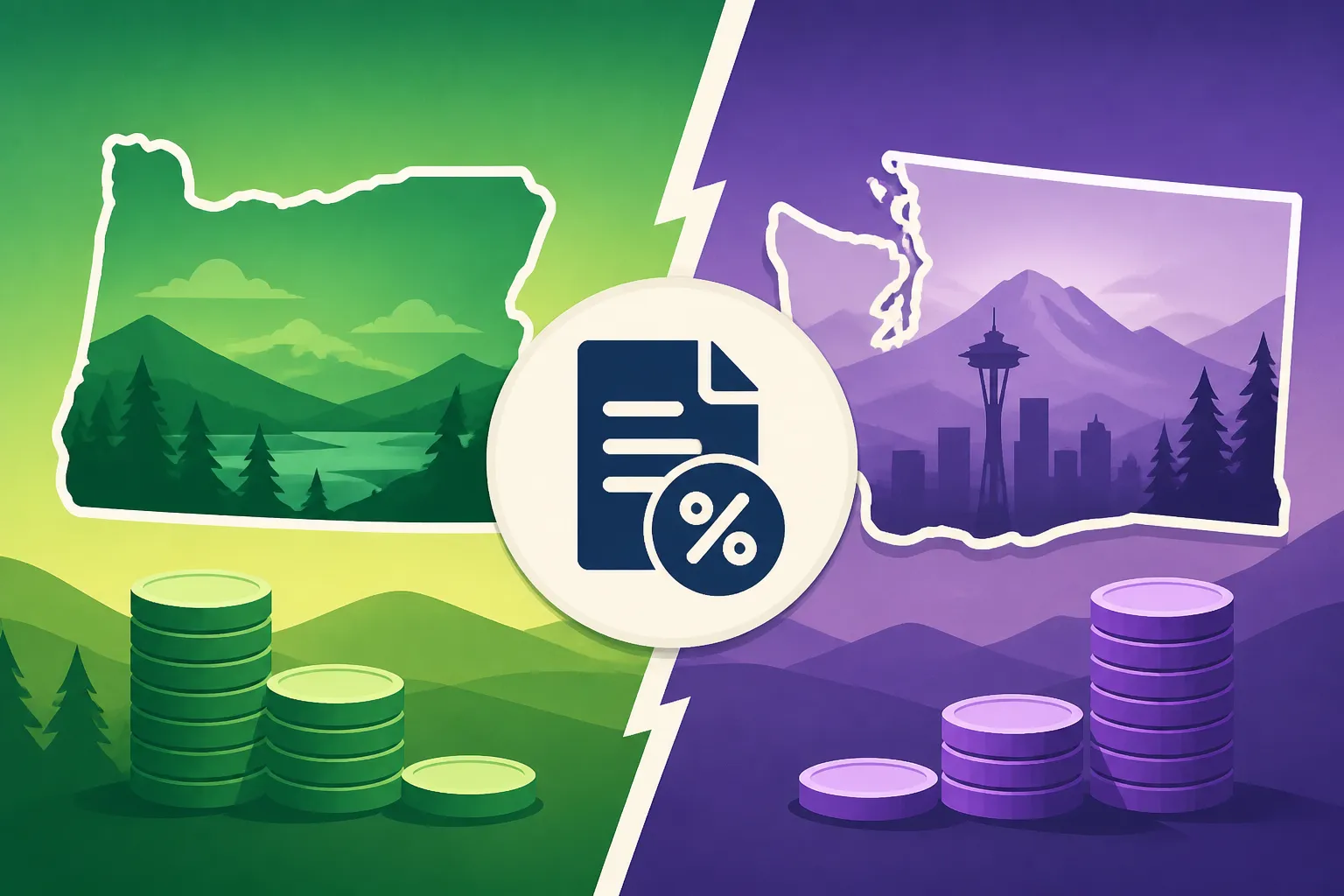
Oregon vs Washington Taxes Compared
Deciding where to live, especially when states with such distinct tax landscapes are neighbors, can feel like navigating a maze blindfolded. Many folks look across the Columbia River, wondering if Oregon's charm or Washington's lack of income tax makes for a better financial fit. This guide will meticulously unpack the tax differences between Oregon and Washington, helping you understand how each state's approach could impact your finances and lifestyle in 2026 and beyond.
The Big Picture: Income Tax vs. No Income Tax
This is where the rubber truly meets the road when comparing Oregon and Washington. The foundational difference in their tax philosophies dictates much of what follows. It's not just a small variation; it's a completely different approach to funding public services, and it significantly impacts every resident's wallet.
Oregon's Progressive Income Tax Structure
Oregon operates on a progressive income tax system, meaning the more you earn, the higher your tax rate on each additional dollar of income. This is a common structure across many U.S. states, designed to place a greater tax burden on those with higher incomes. For 2026, while the exact brackets will be adjusted for inflation, the general structure and rates are expected to remain similar to prior years. Currently, Oregon's top income tax rate is 9.9% on taxable income above a certain threshold (which typically adjusts annually).
For a practical example, imagine someone earning $70,000 annually. Their income wouldn't be taxed at a flat 9.9%. Instead, various portions of their income would fall into different tax brackets, each with its own rate. The first chunk might be taxed at 4.75%, the next at 6.75%, then 7.6%, and so on, until the highest applicable rate is reached. This is how marginal tax rates work, and it's why understanding How State Tax Brackets Work: Marginal vs Effective is so important. This progressive structure means that lower-income residents pay a smaller percentage of their earnings in state income tax, while high-earners contribute a significantly larger portion. It's a key reason why Oregon is counted among the Progressive Income Tax States 2026.
This progressive system also means that if you're a high-income earner, say an executive in Portland making several hundred thousand dollars a year, a substantial portion of your income will be subject to that near 10% top state income tax rate. This can be a major factor for professionals considering a move, especially if their income falls squarely into those higher brackets. For a full picture of how Oregon stacks up against others, you might want to review State Income Tax Rates 2026: All 50 States Ranked.
Washington's Income Tax-Free Status Mostly
Now, let's look across the river at Washington. When people talk about Washington's tax system, the first thing that usually comes up is the absence of a statewide personal income tax. This is a massive draw for many individuals, particularly those with high incomes, as their wages, salaries, and traditional investment income are not subject to a state income tax. This fact alone makes Washington one of the most financially attractive states for many working individuals and retirees, firmly placing it on the States With No Income Tax (2026 Full List).
However, the "mostly" in our heading is crucial. In a significant shift, Washington introduced a 7% capital gains tax on the sale or exchange of long-term capital assets exceeding $250,000 in a calendar year, which took effect in 2022. This tax specifically targets high-value capital gains, such as profits from selling stocks, bonds, or other investments, but notably excludes real estate, retirement accounts, and certain small business sales. While this isn't a broad income tax on wages, it is an income-based tax that impacts a specific segment of earners and investors.
So, while your paycheck won't be taxed by the state of Washington, if you're someone with a substantial investment portfolio or other significant capital gains, you will face this specific tax. It's important to be aware of the nuances, as detailed in guides like Washington Capital Gains Tax Explained (7% / 9.9%), because it can significantly alter the tax picture for certain high-net-worth individuals who might otherwise assume they're entirely free of state income-related taxes. For the average wage earner, however, the absence of a general income tax remains a huge financial benefit in Washington.
Beyond Paychecks: Sales, Property, and Other Key Taxes
The income tax comparison is just one piece of the puzzle. Both states need to fund their public services, and where one state collects less in income tax, it often makes up the difference in other areas. This is where sales taxes, property taxes, and other levies come into play, creating a complex web that requires a holistic view to truly understand your potential tax burden.
The Sales Tax Flip-Flop
Here's another stark contrast between Oregon and Washington: sales tax. If you love to shop and hate seeing that extra percentage tacked onto your total, Oregon is your paradise. The Beaver State is one of only a handful of states in the U.S. that does not impose a statewide sales tax. That means the price you see on the tag is generally the price you pay, whether you're buying groceries, clothing, or a new car. This can translate to significant savings, especially on large purchases, and is a major reason why many Washington residents will cross the border to shop in places like Portland.
Washington, on the other hand, relies heavily on sales tax revenue. The state has a robust statewide sales tax, which stands at 6.5%. But that's just the starting point. Local jurisdictions – cities, counties, and special districts – are permitted to add their own sales taxes, often pushing the combined rate significantly higher. For example, residents in major urban centers like Seattle or Tacoma often face combined sales tax rates that hover around 10.25% or even higher. Imagine buying a new appliance for $1,000; in Washington, you could easily pay over $100 in sales tax alone, whereas in Oregon, you'd pay nothing extra. This difference becomes particularly noticeable when considering your overall spending habits. To get a comprehensive view of how various taxes contribute to the financial landscape, resources like SmartAsset often compile data on overall tax burdens, helping you see the bigger picture.
Property Tax Realities
Property taxes are another major consideration, and while both states have them, their effective rates and assessment methods can differ. It's crucial to remember that property taxes are primarily local taxes, meaning they are assessed and collected by counties, cities, and school districts, rather than the state government itself. This leads to considerable variation even within a single state.
Based on recent data, the average effective property tax rate in Washington tends to be slightly higher than in Oregon, but the difference isn't as dramatic as with income or sales taxes. For instance, a homeowner in Multnomah County, Oregon (home to Portland) might face a different rate than someone in King County, Washington (home to Seattle). These rates are calculated as a percentage of your home's assessed value, which itself is subject to local appraisal methods and market conditions. Generally, you can expect to pay anywhere from 0.8% to 1.2% or more of your home's value annually in property taxes in both states, with specific rates fluctuating wildly depending on your exact location and local levies.
For example, if you own a home valued at $500,000, an effective property tax rate of 1% would mean an annual tax bill of $5,000. In an area with a 1.2% rate, that jumps to $6,000. These figures can quickly add up, making property taxes a significant ongoing expense, regardless of which side of the Columbia River you reside on. When evaluating your move, it's essential to look up the specific property tax rates for the counties and cities you're considering. It's a key component of your total State Tax Burden by State 2026.
Fuel, Estate, and Other Taxes
Beyond the big three (income, sales, property), both Oregon and Washington levy other taxes that contribute to the overall cost of living and doing business.
- Fuel Taxes: Both states have excise taxes on gasoline and diesel, which contribute to road maintenance and infrastructure projects. These rates can change, but both states typically have some of the higher fuel taxes in the nation. As of recent data, Washington's gas tax rate is 49.4 cents per gallon, while Oregon's is 40 cents per gallon. This might not seem like a huge difference on a single fill-up, but it adds up quickly for daily commuters or those with long drives.
- Estate Taxes: This is another area of divergence. Washington is one of a handful of states that imposes an estate tax, meaning a tax on the transfer of property after someone's death, above a certain exemption amount (for 2026, this threshold will likely be around $2.2 million). Oregon does not have a state estate tax, which can be a significant factor for individuals with substantial assets planning their legacy.
- Business Taxes: For entrepreneurs and business owners, the tax landscape also varies. Oregon has a corporate excise tax and a corporate minimum tax, as well as a Corporate Activity Tax (CAT) on gross receipts over $1 million. Washington, lacking a corporate income tax, relies on a Business and Occupation (B&O) tax, which is a gross receipts tax levied on the gross income of various business activities without deductions for costs of doing business. This can mean very different tax burdens for different types of businesses.
These "other" taxes, while perhaps not as universally impactful as income or sales tax, can play a critical role in the financial planning of specific individuals and businesses.
Who Wins? Scenarios for Different Residents
It's clear that neither Oregon nor Washington is universally "better" or "worse" from a tax perspective. The best state for you depends entirely on your personal financial situation, income sources, spending habits, and life stage. Let's explore a few common scenarios to illustrate this complexity.
The Commuter Conundrum: Living in One State, Working in Another
This is a classic dilemma for many people in the Portland-Vancouver metropolitan area. Imagine you live in Vancouver, Washington, enjoying no state income tax on your wages. But your job is across the Columbia River in Portland, Oregon. What happens then?
In this scenario, Oregon, as the source state of your income, will tax your earnings. You'll file an Oregon nonresident income tax return for the wages earned there. However, since Washington doesn't have a state income tax, you won't owe any state income tax to Washington on that income, nor would you get a credit for taxes paid to Oregon on your Washington return. This is a common situation covered in articles like Working in One State, Living in Another: Tax Guide.
The reverse is also possible: living in Oregon and working in Washington. If you live in Portland and commute to Vancouver for work, your wages earned in Washington will not be subject to Washington state income tax (because Washington doesn't have one). However, because you are an Oregon resident, your worldwide income—including those wages earned in Washington—will be subject to Oregon state income tax. This is where understanding State Tax Residency Rules Explained becomes paramount. In either case, the key is to understand the source of your income and your official domicile to avoid headaches and potentially How to Avoid Double Taxation Between States. This geographic proximity with vastly different tax rules highlights why individual circumstances are so important.
Retirement and Investment Income
For retirees, the tax picture can swing dramatically between the two states.
- Oregon's Retirement Taxation: Oregon generally taxes most forms of retirement income, including pensions (both private and public), 401(k) and IRA withdrawals, and often Social Security benefits, depending on your overall income. While there are some potential deductions or subtractions for certain types of retirement income or for individuals over a certain age, these benefits are subject to Oregon's progressive income tax rates. This makes Oregon less tax-friendly for many retirees compared to states with no income tax. If you're thinking about retiring in the Beaver State, it's wise to research Does Oregon Tax Retirement Income? to fully understand your obligations.
- Washington's Retirement Taxation: Washington, with no state income tax on wages, also does not tax traditional retirement income like Social Security benefits, pension income, or withdrawals from 401(k)s and IRAs. This makes it significantly more attractive for many retirees, especially those whose primary income sources are these distributions. The capital gains tax mentioned earlier could apply to gains from selling investment properties or large stock portfolios, but it generally doesn't affect typical pension or IRA withdrawals. For many, this makes Washington one of the Most Tax-Friendly States for Retirees 2027, particularly when combined with the lack of sales tax on essentials like groceries. You can further explore this by looking into topics such as Does Washington Have State Income Tax?.
The difference here is substantial. A retiree living off a pension and Social Security could see a significant portion of their income taxed away in Oregon, while in Washington, those same income streams would largely be state tax-free (aside from federal taxes, of course).
Overall Tax Burden and Cost of Living
It's a common mistake to look at just one tax — typically income tax — and assume you've got the whole picture. However, the true measure of a state's tax-friendliness is its overall tax burden, which includes income, sales, property, and other taxes relative to residents' income.
According to various financial analyses, including those from SmartAsset, Washington tends to have a higher overall tax burden for many average-income households compared to Oregon, largely due to its high sales and property taxes. While Washington boasts no income tax, its reliance on sales tax means that everyone, regardless of income, pays a percentage on most goods and services purchased. Low-income households, which spend a larger proportion of their income on taxable goods, can feel the pinch of sales tax more acutely.
Conversely, Oregon's lack of sales tax can offset its income tax for many. However, for high-income earners, Oregon's progressive income tax can quickly push their total tax bill higher than what they might experience in Washington, even with Washington's capital gains tax and higher sales/property taxes.
Beyond taxes, you also need to factor in the Cost of Living vs Taxes by State. Major metropolitan areas like Portland and Seattle both have higher costs of living than national averages, particularly for housing. A lower tax burden might be negated if housing, groceries, or transportation costs are significantly higher in one area than another. For instance, while Washington's tax system might look appealing on paper, the notoriously high cost of living in the Seattle area could diminish any perceived tax savings. It's truly a balancing act, and what's "best" for one person might be detrimental to another.
| Tax Type | Oregon | Washington |
|---|---|---|
| State Income Tax | Yes, Progressive (up to 9.9%) | No (on wages/salaries) |
| Capital Gains Tax | Yes (part of general income tax) | Yes (7% on gains > $250k, with exemptions) |
| State Sales Tax | No | Yes, 6.5% state + local (up to ~10.5% combined) |
| Property Tax | Yes (locally assessed, avg. effective ~0.9%) | Yes (locally assessed, avg. effective ~1.0%) |
| Estate Tax | No | Yes (on estates > ~$2.2 million) |
| Social Security | Taxable (depending on income) | Not Taxed |
| Pensions/401(k) | Taxable (with some potential deductions) | Not Taxed |
| Fuel Tax | ~40 cents/gallon | ~49.4 cents/gallon |
Making Your Decision: More Than Just Tax Rates
Ultimately, the choice between Oregon and Washington isn't just a spreadsheet exercise comparing tax rates. It's about finding the right balance between financial implications, lifestyle preferences, and the types of public services you value.
Beyond the Numbers: Lifestyle and Services
States with higher taxes often, though not always, translate those revenues into more robust public services. Oregon's progressive income tax helps fund its education system, social programs, and infrastructure. Residents often feel a direct connection between their tax contributions and the quality of their communities. Similarly, Washington's reliance on sales and property taxes supports its own array of state and local services.
Consider what matters most to you. Do you value easy access to state parks and outdoor recreation, both of which are abundant in both states? Are quality public schools a top priority for your family? How about public transportation? While both states offer incredible natural beauty and vibrant cities, the specific character of Portland, Oregon, with its unique culture and emphasis on local businesses, might appeal to some more than the bustling, tech-driven atmosphere of Seattle, Washington. Your personal and professional goals, as well as the kind of community you wish to be a part of, should weigh heavily in your decision, not just the tax implications.
Professional Advice and Planning
Given the complexities, especially when crossing state lines for work or considering retirement, it's almost always a good idea to seek professional tax advice. A qualified tax advisor specializing in multi-state taxation can help you navigate the intricacies of residency rules, income sourcing, and potential credits or deductions. They can model different scenarios based on your specific income, assets, and spending habits to provide a truly personalized estimate of your total tax burden in either state.
Online resources and tools from reputable financial planning services like SmartAsset can be a fantastic starting point for understanding general tax burdens and comparing states. Their comprehensive tools and calculators can give you a preliminary estimate, but for decisions as significant as changing your state of residence, a professional consultation can provide invaluable peace of mind and help you optimize your financial planning. Don't let the headlines about "no income tax" or "no sales tax" be the sole determinant; dig deeper, ask questions, and consult experts to make the most informed decision for your financial future.
Disclaimer
Please remember that tax laws are constantly evolving. The information provided in this article is for general informational purposes only and is based on current tax laws and projections for 2026. It is not intended as financial or tax advice. You should consult with a qualified tax professional or financial advisor for advice tailored to your specific situation.