Progressive Income Tax States 2026
Starting a new job or finally landing that hard-earned promotion should be a moment of pure celebration, but for many of us, that joy is quickly followed by a "wait, what?" moment when we see our first paycheck. As your income climbs, you often find yourself pushed into higher tax tiers, leaving you wondering where all that extra money actually went. This guide breaks down exactly how progressive income tax states operate in 2026 and helps you navigate the shifting landscape of state-level brackets so you can plan your finances with confidence.
Understanding the Mechanics of Progressive Taxation
When we talk about a progressive tax system, we are essentially looking at a "pay-as-you-grow" model. Unlike a flat tax where everyone pays the same percentage regardless of their lifestyle or income level, a progressive system is designed to place a larger responsibility on those with a higher "ability to pay." While this sounds equitable in theory, for the person sitting in the middle of a bracket jump, it can feel like a penalty for success.
The Philosophy of Ability to Pay
The underlying logic used by state legislatures is that the first $10,000 you earn is significantly more important for your survival—paying for groceries, rent, and basic utilities—than the $10,000 you earn after you’ve already cleared $200,000. Because of this, progressive states apply lower rates to your initial earnings and gradually increase the percentage as your income rises. Understanding How State Tax Brackets Work: Marginal vs Effective is the first step in realizing that a higher tax bracket doesn't mean your entire paycheck is suddenly taxed at a higher rate; it only applies to the dollars that fall within that specific window.
Marginal vs Effective Tax Rates
This is where many people get tripped up. If you hear that a state has a top tax rate of 9%, and you just crossed into that bracket, you might panic thinking 9% of your total income is gone. In reality, you are dealing with a marginal rate. Your effective tax rate—the actual percentage of your total income that goes to the state—is almost always lower because you benefit from the lower rates on your first several thousand dollars of earnings. Tools like SmartAsset can be incredibly helpful here to visualize this "blended" rate so you aren't surprised by your year-end liability.
The Multi-Bracket Shuffle
In 2026, we are seeing a massive divergence in how states structure these tiers. Some states, like Alabama, keep it relatively simple with just a few brackets. Others, like California, have a complex ladder of nearly a dozen different tiers. The more brackets a state has, the more "progressive" it is considered to be, as it can more precisely target specific income levels. This granularity is intended to prevent "bracket creep," where inflation pushes low-income earners into tiers meant for the wealthy, though it also makes filing a bit more of a headache.
Heavy Hitters The Top Progressive States in 2026
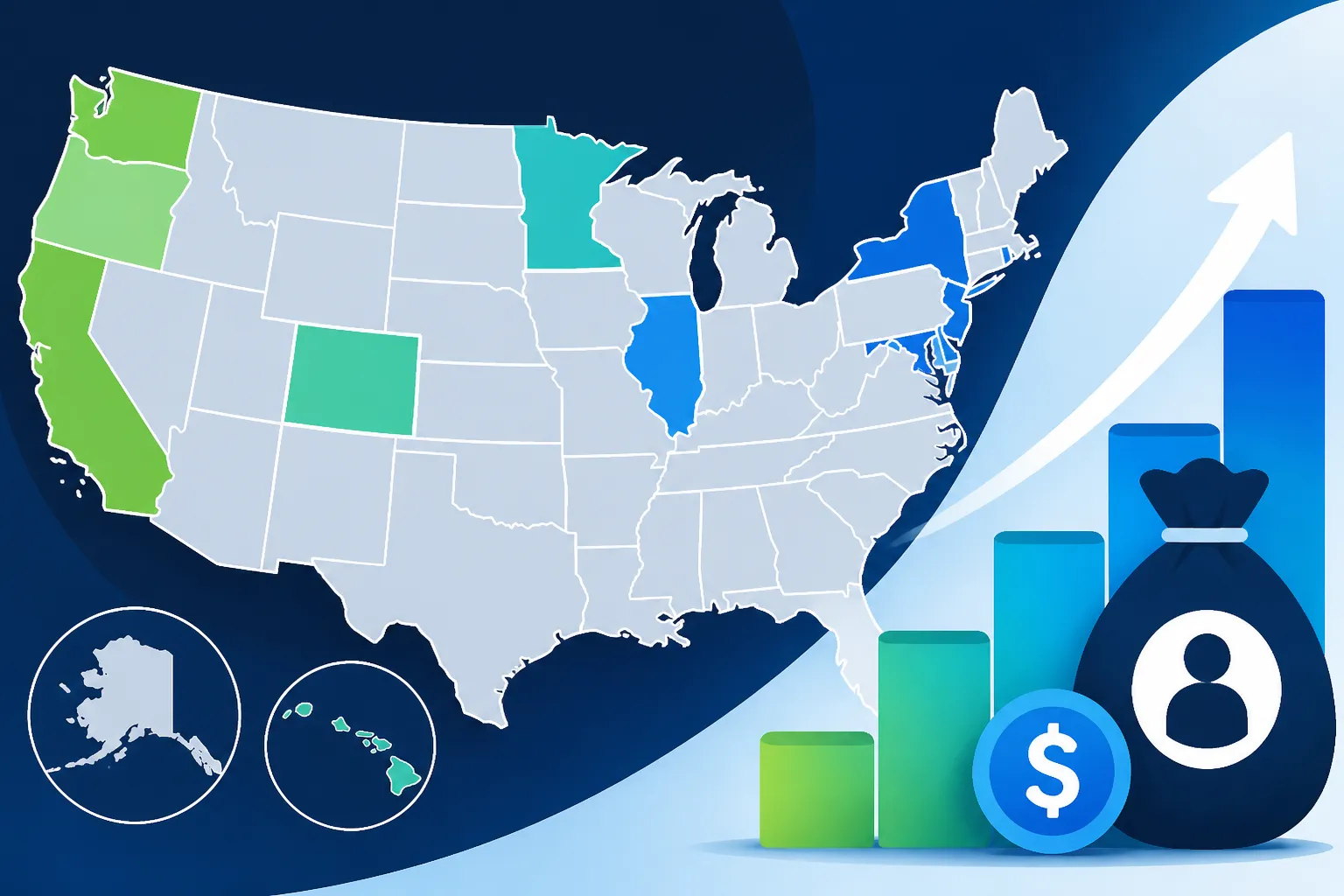
If you live in the Northeast or along the West Coast, you are likely very familiar with the progressive model. These states often have higher service demands and use their income tax revenue to fund everything from high-end infrastructure to expansive social programs. However, for the individual taxpayer, these rates can be eye-watering if you aren't prepared for the jump.
California Complex Tiers and Surcharges
California remains the king of the progressive mountain. With a system that features numerous brackets, it starts quite low for modest earners but scales up rapidly. For those at the very top of the ladder, there is also the Mental Health Services Act surcharge, which adds an additional 1% to income over $1 million. If you are trying to figure out your specific liability, looking at California Income Tax Brackets 2026 will show you just how quickly those percentages climb. It is a state that rewards those starting out but expects a significant contribution from its high earners.
New York High Earner Surcharges
New York has a long history of aggressive progressive taxation, and 2026 is no different. The state uses its tax code not just to raise revenue, but to balance the needs of the massive upstate regions with the economic engine of the city. While the state brackets are steep on their own, residents of the five boroughs also have to contend with local levies. If you are living in Manhattan, for instance, you should definitely check out NYC Income Tax Explained (2026 Rates) to see how the state and city taxes stack up together. Using a calculator from SmartAsset can help you see the combined impact of these two overlapping progressive systems.
New Jersey Wealth Brackets
New Jersey often mirrors its neighbor, New York, in terms of tax philosophy. It features a highly progressive structure that specifically targets high-income individuals with "millionaire tax" brackets. For many families living in the suburbs of North Jersey, the struggle is real: you have a high cost of living, high property taxes, and a state income tax that bites harder the more you try to keep up. It’s a state where tax planning isn't just for the ultra-wealthy; it's a survival skill for the middle class.
| State | Number of Brackets | Top Marginal Rate (2026) | Key Feature |
|---|---|---|---|
| California | 10 | 13.3% | Includes 1% Mental Health Surcharge |
| New York | 9 | 10.9% | Significant NYC local add-ons |
| New Jersey | 7 | 10.75% | High brackets for $1M+ earners |
| Hawaii | 12 | 11.0% | Very granular tiers |
| Minnesota | 4 | 9.85% | Steep climb for middle-class earners |
Comparing Progressive Systems to Other Models
Not every state believes the progressive model is the way to go. As we move forward, we are seeing a significant trend where states are abandoning their multi-tier systems in favor of simplicity. Understanding these differences is crucial if you are considering a move for work or retirement.
The Flat Tax Shift of 2026
A "flat tax" is exactly what it sounds like: one rate for everyone. Several states that used to be progressive have recently switched or are in the process of phasing in a flat rate. For example, Georgia Flat Tax Rate 2026 reflects a major policy shift aimed at attracting businesses and high-income professionals. Proponents argue it's fairer and simpler, while critics say it places a disproportionate burden on lower-income residents who spend a larger share of their earnings on basics.
Progressive vs No-Income-Tax States
Then there are the "holy grail" states for many taxpayers—those with no state income tax at all. Places like Florida, Texas, and Nevada are often the first choice for people fleeing high-bracket states. However, it’s rarely a "free" ride. These states have to fund their budgets somehow, usually through higher sales taxes or property taxes. Before you pack your bags, it’s worth looking at States With No Income Tax (2026 Full List) to see the full picture. Sometimes, a progressive state with a low starting bracket and high deductions can actually be cheaper for a middle-income family than a "tax-free" state with massive property tax bills.
The Impact of Local and City Taxes
Even in progressive states, you have to watch out for the "stealth" taxes. Some cities within progressive states have their own income taxes that operate on a flat or progressive basis. For example, if you work in Pennsylvania, you might deal with a flat state tax but a progressive or flat local tax depending on where you live. Local & City Income Taxes in the US are often overlooked during the budgeting process but can add an extra 1% to 4% to your total tax burden, effectively making a "low" tax state feel much more expensive.
Strategies for Navigating High Bracket States
If you live in a state with a progressive tax system, your goal shouldn't be just to "pay less," but to pay exactly what you owe and no more. Because progressive systems rely heavily on your taxable income, anything you do to lower that number (Aritmetic Adjusted Gross Income) has a magnified effect.
Utilizing State-Specific Deductions
Most progressive states offer their own set of deductions and credits that don't always align with the federal ones. It is vital to know whether your state follows the federal standard deduction or requires you to itemize separately. For families, the State Child Tax Credits 2026 can be a massive lifesaver, often providing a dollar-for-dollar reduction in what you owe the state. These credits are designed to offset the progressive nature of the tax for those with dependents.
529 Plans and Retirement Contributions
One of the smartest ways to "lower" your bracket is to put money into state-sanctioned savings vehicles. Many progressive states allow you to deduct contributions to a 529 college savings plan directly from your state taxable income. You can find more details in the 529 Plan Tax Deductions by State guide. Similarly, contributing to a traditional 401(k) or IRA reduces your federal AGI, which is the starting point for most state tax returns. By lowering that number, you might keep yourself from crossing into a higher state marginal bracket.
Residency Rules and Part-Year Moves
With the rise of remote work, more people are splitting their time between states. If you live in a high-tax progressive state but work remotely for a company in a low-tax state, you generally owe taxes where you are physically located. However, if you move mid-year, you become a "part-year resident." This requires a specific filing process to ensure you aren't being double-taxed on the same dollar. Checking a resource like SmartAsset can help you estimate the tax impact of a move before you sign a new lease. If you are making a permanent transition, understanding How to Change Your State Residency for Taxes is essential to prevent your old state from claiming a piece of your new income.
The Evolving Landscape of State Tax Policy
The tax codes we see are not set in stone. State governments are constantly adjusting their brackets to account for economic shifts, political priorities, and the ever-present threat of inflation.
Recent Legislative Changes for 2026
Several states have passed "triggers" that automatically lower or raise tax rates based on the state's budget surplus. In 2026, we are seeing some states like West Virginia and Kentucky continue their march toward lower rates, while other states are looking at "wealth taxes" to fund specific projects. Keeping an eye on State Income Tax Cuts & Changes for 2026 is the only way to stay ahead of the curve. What was a high-tax state three years ago might be a moderate-tax state today.
Inflation Adjustments and Bracket Creep
One of the biggest frustrations with progressive taxes is "bracket creep." This happens when your wages go up to match inflation, but the tax brackets stay the same. You aren't actually "wealthier" in terms of purchasing power, but the state starts taxing you like you are. Fortunately, many progressive states now automatically adjust their bracket thresholds for inflation each year. This ensures that a cost-of-living raise doesn't inadvertently result in a lower take-home pay because of a jump in your marginal rate.
The SALT Cap Reality
For those in states like California, New York, and New Jersey, the federal State and Local Tax (SALT) deduction cap remains a major pain point. Because you can only deduct a limited amount of state taxes on your federal return, the high rates in progressive states feel even heavier. You should look into How the SALT Cap ($40,000) Affects State Taxes to see if your state has implemented any "workarounds," such as pass-through entity taxes, which can help business owners mitigate some of this burden.
Retirement Income Considerations in Progressive States
If you are nearing the end of your career, the way a state taxes retirement income should be a top priority. A state that was great for your working years might be a nightmare for your golden years if it doesn't offer exemptions for pensions or Social Security.
Pensions and 401k Withdrawals
Some progressive states are surprisingly friendly to retirees. While they may tax high wages aggressively, they might exempt a significant portion of pension income or 401(k) distributions. For instance, Does New York Tax Pensions? reveals that the state offers a generous exclusion for many retirees, which can make staying in-state much more affordable than it first appears. It’s a classic "give and take" where the state targets active workers to fund the services that retirees rely on.
Social Security Taxation
The good news is that the number of states taxing Social Security continues to dwindle. Even highly progressive states have realized that taxing the primary income source for many seniors is politically and economically risky. However, a handful of states still do it, often using their own progressive tiers to determine how much of your benefit is "fair game." If you are planning your retirement budget, checking States That Don't Tax Social Security (2026) is a non-negotiable step to ensure your fixed income goes as far as possible.
State Income Tax Disclaimer
The information provided in this guide is for educational and informational purposes only and does not constitute professional tax, legal, or financial advice. Tax laws, including rates, brackets, and deductions, are subject to frequent legislative changes and vary significantly by individual circumstances. You should always consult with a qualified tax professional or CPA to discuss your specific situation before making any financial decisions or filing your tax returns. Historical data and 2026 projections are based on current legislative trajectories and may be updated as new laws are enacted.