Graduated vs Flat State Income Tax Explained
Moving from a high-tax state like California to a flat-tax haven like Arizona sounds like a simple financial win, but many taxpayers find themselves blindsided by the confusing math of tax brackets versus flat rates. Whether you are seeing a smaller paycheck than expected after a promotion or trying to decide where to retire, understanding how graduated and flat systems differ is essential. This guide breaks down the mechanics, philosophies, and real-world costs of these two competing tax models to help you navigate your next big move or financial milestone.
Understanding the Fundamentals of State Taxation
The first thing most of us notice about our paychecks, aside from the total amount, is that the government takes a significant cut before we even see a dime. While we all deal with the IRS every April, the way your specific state handles your earnings can vary wildly depending on where you call home. State income tax is essentially a fee paid to the state government to fund local infrastructure, schools, public safety, and health services. However, unlike the federal government, which uses a standard progressive system, states have the freedom to experiment with different structures.
When you look at the State Income Tax vs Federal Income Tax dynamic, you start to realize that the state portion often feels more personal because it directly impacts the local services you use every day. Some states choose to tax every dollar you earn, while others only tax specific types of income like interest or dividends. Understanding the underlying logic of your state’s revenue department is the first step in regaining control over your financial planning. It is not just about the percentage; it is about how that percentage is applied to your unique life circumstances.
Choosing where to live is one of the most significant tax decisions you will ever make. It is common to feel a sense of frustration when you realize that your neighbor across the state line is keeping thousands of dollars more of their salary simply because of a different legislative philosophy. This guide exists to validate those frustrations and provide the clarity you need to compare these systems objectively. By the time you finish reading, you will understand exactly why your tax bill looks the way it does and how to project your future liabilities with much greater accuracy.
Graduated Income Tax Systems: The Progressive Approach
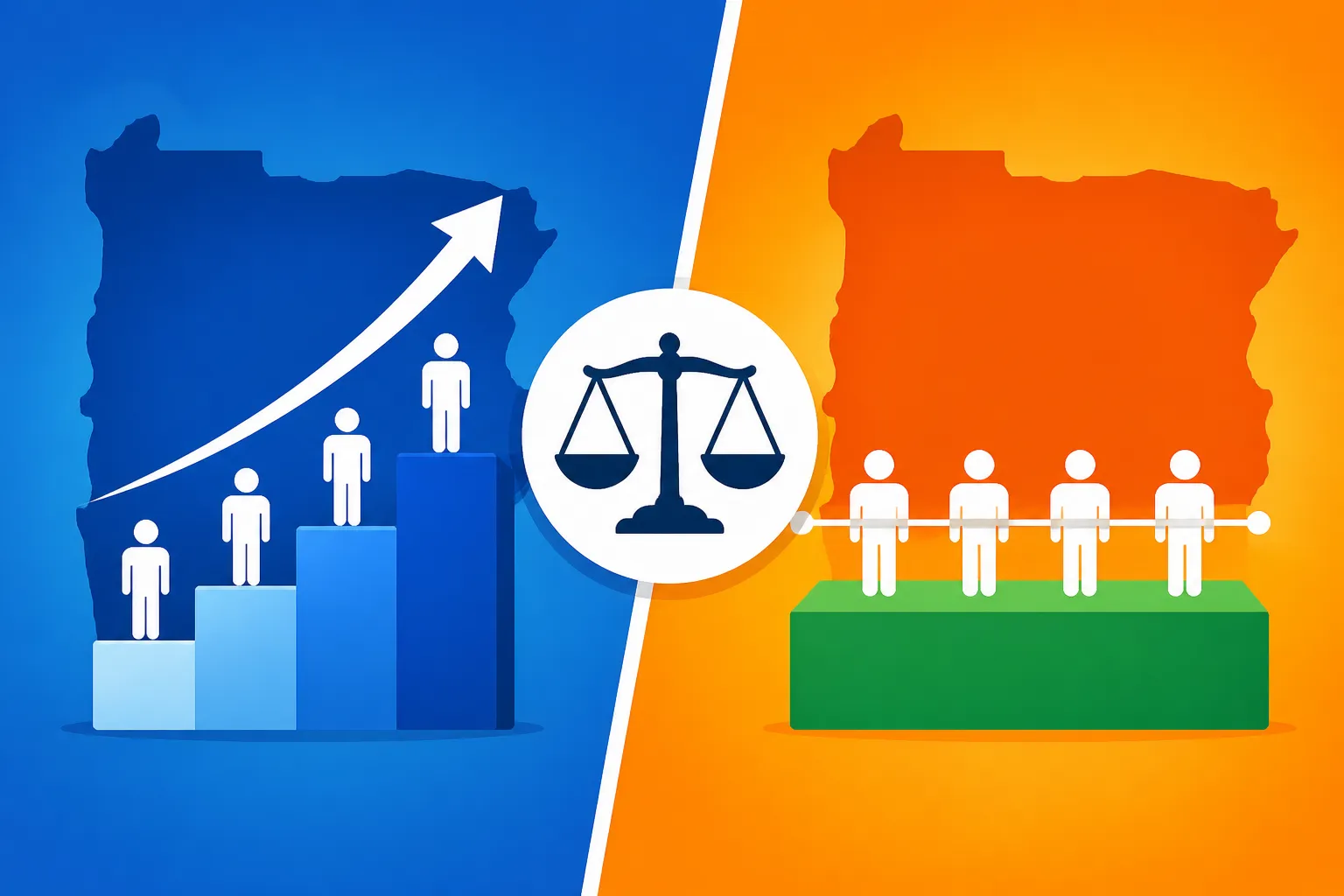
A graduated income tax, often referred to as a progressive tax, is a system where the tax rate increases as your taxable income increases. The core idea here is "ability to pay." Proponents argue that those who earn more can afford to contribute a higher percentage of their income to public coffers without sacrificing their quality of life. For someone living in a state with a graduated system, your income is divided into segments, and each segment is taxed at a different rate.
To truly grasp this, you have to understand How State Tax Brackets Work: Marginal vs Effective. Many people mistakenly believe that if they get a raise that pushes them into a higher bracket, all of their income is suddenly taxed at that higher rate. This is a common myth that causes unnecessary stress. In reality, only the portion of your income that falls within that specific bracket is taxed at the higher percentage. The money you earned below that threshold is still taxed at the lower, previous rates. This "staircase" model ensures that earning more money almost always results in more take-home pay, even if the government's slice gets slightly larger.
Let’s look at a real-world scenario. Imagine you are living in a state with a graduated system where the first $20,000 is taxed at 2% and everything over that is taxed at 5%. If you earn $25,000, you aren't paying 5% on the whole amount. You pay 2% on the first $20,000 and 5% only on the remaining $5,000. This nuance is vital for accurate budgeting. States like California, Hawaii, and New Jersey are famous for having many brackets, which creates a highly tailored tax experience where your contribution is tied very closely to your annual earnings.
Flat State Income Tax: The One-Size-Fits-All Model
On the other side of the debate is the flat tax model. This system is prized for its simplicity and transparency. In a flat-tax state, every taxpayer pays the exact same percentage of their taxable income, regardless of whether they earn $30,000 or $3,000,000. For many, this feels like the most "fair" approach because everyone is playing by the same percentage rule. It eliminates the "success penalty" that some feel is inherent in progressive systems.
Currently, there is a growing list of States With a Flat Income Tax (2026) as more legislatures move toward this model to attract businesses and high-income earners. For a busy professional or a small business owner, the beauty of a flat tax is predictability. You can look at your gross revenue and instantly know that a fixed percentage—say 3% or 4.5%—is going to the state. There are no complicated "staircase" calculations or surprises when you hit a certain income milestone. This simplicity often reduces the cost of tax compliance and makes filing your state return a much faster process.
However, the flat tax is not without its critics. Opponents argue that a flat rate is actually "regressive" in practice. For a family earning $40,000 a year, a 5% tax takes $2,000, which might represent the difference between paying for childcare or falling behind on rent. For a billionaire, that same 5% has zero impact on their daily survival. This is why many flat-tax states include a generous standard deduction or personal exemptions to protect lower-income residents from being taxed on their first several thousand dollars of earnings.
The Financial Impact: Graduated vs. Flat
When you are trying to decide which system is better for your wallet, you cannot just look at the top-line number. You have to dive into the Marginal vs Effective Tax Rate Calculator Guide to see what you are actually paying on average. Your effective tax rate is the actual percentage of your total income that goes to the state after all deductions, exemptions, and credits are applied. Surprisingly, a high-earner in a flat-tax state might actually pay more than a low-earner in a graduated-tax state, even if the graduated state has a higher "top" rate.
The interplay between deductions and rates is where the real magic (or frustration) happens. Many graduated states offer a wide array of credits for things like child care, education, and energy efficiency. These can significantly lower your effective rate. Conversely, flat-tax states often have fewer bells and whistles in their tax code, relying on the low, single rate to be the primary incentive. When you're using a tool like SmartAsset to compare potential job offers in different states, you have to account for these nuances to get an apples-to-apples comparison of your purchasing power.
Consider a middle-class family earning $80,000. In a graduated state, they might benefit from lower early brackets and various family credits, resulting in an effective rate of 3.5%. In a flat-tax state with a 4.5% rate and no credits, they might actually end up with a higher tax bill. However, as that same family’s income grows to $200,000, the graduated state’s higher brackets might kick in, pushing their effective rate to 6%, while the flat-tax state remains a steady 4.5%. This is why high-income earners often migrate toward flat-tax jurisdictions.
| Feature | Graduated Income Tax | Flat Income Tax |
|---|---|---|
| Calculation Method | Income split into brackets; rates rise with income | Single rate applied to all taxable income |
| Primary Advantage | Higher earners pay a larger share (Social Equity) | Simplicity, predictability, and ease of filing |
| Primary Disadvantage | Complex to calculate; can discourage higher earnings | Can be harder on lower-income households |
| Predictability | Harder to estimate without detailed math | Very easy; fixed percentage of gross pay |
| Common States | CA, NY, NJ, MN, OR | IN, IL, MI, NC, AZ, CO |
States Moving Toward Flat Tax Models in 2026
The tax landscape in the United States is currently undergoing a massive shift. We are seeing a historic trend of State Income Tax Cuts & Changes for 2026 as governors and state legislatures compete for residents in the remote-work era. Many states that historically used graduated systems are now passing legislation to "flatten" their tax code. The logic is simple: by offering a competitive, low, flat rate, states hope to lure wealthy individuals and corporations away from high-tax coastal states.
This trend is particularly visible in the Midwest and the South. States that once had five or six brackets are consolidating them down to one. This transition period can be confusing for taxpayers who are used to the old system. Often, these changes are phased in over several years, with the rates dropping annually until they hit a target flat percentage. If you live in one of these states, it is crucial to stay updated on the annual adjustments so you don't over-withhold or under-withhold on your W-4 at work.
For those planning their future, these shifts can represent significant savings. If you are five years away from retirement, moving to a state that is actively phasing out its progressive tax in favor of a flat 3% rate could save you tens of thousands of dollars over the course of your golden years. Keeping an eye on state budget surpluses and legislative sessions is a pro move for anyone serious about wealth preservation. Websites like SmartAsset frequently update their state-by-state breakdowns to reflect these rapid legislative movements.
No Income Tax States: The Third Alternative
While the debate usually centers on graduated versus flat, we cannot ignore the "third way"—states that have no income tax at all. This is the ultimate goal for many tax-conscious Americans. If you look at the States With No Income Tax (2026 Full List), you’ll see popular destinations like Florida, Texas, Nevada, and Washington. In these states, the "flat rate" is effectively 0%. On the surface, this looks like an unbeatable deal, but it is important to remember that the government always finds a way to get paid.
States without an income tax must fund their budgets through other means, most commonly higher sales taxes or property taxes. For example, while Texas has no state income tax, its property taxes are among the highest in the nation. If you are a high-income renter, Texas is a massive win. If you are a retiree on a fixed income living in a high-value home, the lack of income tax might be offset by a staggering property tax bill. It’s all about where you sit on the financial spectrum.
Before you pack your bags and head for a "tax-free" state, you should do a total cost of living analysis. Some states also implement high "sin taxes" on alcohol and tobacco or charge significant fees for vehicle registration. It’s also worth noting that some states are very aggressive about auditing people who claim to have moved there while still maintaining ties to their old, high-tax home. Understanding State Tax Residency Rules Explained is vital if you plan to move to a no-tax state to ensure you aren't hit with a "dual residency" tax bill that wipes out your savings.
Navigating the Complexities of Local and City Taxes
Just when you think you’ve mastered the difference between graduated and flat state taxes, the local government enters the chat. In many parts of the country, Local & City Income Taxes in the US add an extra layer of complexity that can catch the unwary taxpayer off guard. This is especially true in the Northeast and the Rust Belt. You might move into a state with a reasonable flat tax, only to discover that the city you work in takes another 2% or 3% right off the top.
The most famous example is New York City. Residents there don't just pay a graduated state tax; they also pay a graduated city tax. If you are trying to understand your paycheck in the Big Apple, you have to look at the NYC Income Tax Explained (2026 Rates) to see the full picture. Similarly, cities like Philadelphia and many municipalities in Ohio and Michigan have their own local income or "wage" taxes. These are often flat rates, but they apply regardless of what the state does.
This "layering" of taxes is one of the biggest frustrations for taxpayers. It’s not uncommon for a person to live in one jurisdiction and work in another, leading to a nightmare of "nonresident" tax filings. If your state doesn't have a reciprocity agreement with your neighboring state, you might find yourself paying a flat tax to the city where you work and a graduated tax to the state where you live. This is where professional advice or robust tax software becomes non-negotiable.
Practical Strategies for Managing Your State Tax Burden
Now that you understand the "why" and "how" of these systems, the question remains: what can you do about it? The most effective strategy is to be proactive rather than reactive. Don't wait until April 14th to see how a flat tax vs. graduated tax impacts your bottom line. Use a tool like the SmartAsset tax calculator early in the year to run different scenarios. If you're considering a raise or a new job, calculate exactly how much of that extra money will actually end up in your bank account after the state takes its cut.
Another strategy is to be very intentional about your residency. If you are a remote worker, you often have the flexibility to choose where you "live" for tax purposes. However, states are becoming increasingly aggressive about this. If you want to change your tax home, you need to follow the rules for How to Change Your State Residency for Taxes to the letter. This means changing your driver's license, registering to vote, and spending the majority of your time in the new state. A "paper move" is a recipe for an audit.
Finally, look for state-specific deductions and credits that are often overlooked. Even in flat-tax states, there are often incentives for contributing to a 529 college savings plan or making energy-efficient home improvements. By maximizing these "above-the-line" deductions, you can lower your taxable income base, ensuring that whether your state uses a flat or graduated model, the percentage they take is applied to the smallest possible number. Knowledge is your best defense against a high tax bill, and staying informed about these shifting state laws is the key to long-term financial health.
State Tax Disclaimer
The information provided in this guide is for educational and informational purposes only and does not constitute professional legal, financial, or tax advice. Tax laws, including rates, brackets, and residency requirements, are subject to frequent changes by state legislatures. Always consult with a qualified Certified Public Accountant (CPA) or tax professional before making significant financial decisions or moving to a new state for tax purposes. Individual results may vary based on specific income levels, deductions, and local tax jurisdictions.