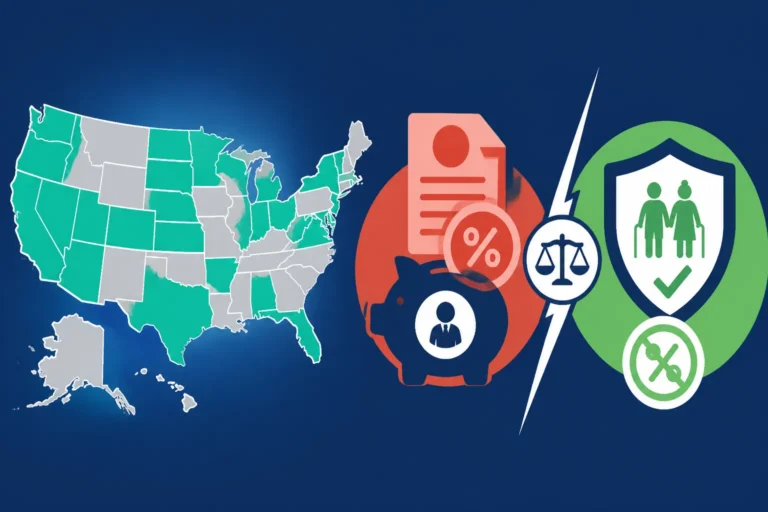
Government & Teacher Pension Taxation by State
It can be incredibly confusing trying to figure out how your hard-earned government or teacher pension will be taxed, especially when you're planning for retirement or considering a move. Many retirees find themselves blindsided by state tax rules that can significantly impact their financial well-being. This comprehensive guide will unravel the complexities of how different states tax these specific types of retirement income, helping you understand what to expect and how to plan effectively.
Understanding Government and Teacher Pensions
When we talk about government and teacher pensions, we're really diving into a specific slice of the retirement pie. These aren't your typical private sector 401(k)s, and often, states recognize that with different tax treatment. It's crucial to understand the distinct nature of these pensions to properly assess their tax implications.
Defining Public vs. Private Pensions
The main distinction here lies in who your employer was. A public pension typically refers to retirement benefits earned through employment with a federal, state, or local government entity, including public school systems, state universities, municipal offices, police, and fire departments. These are defined benefit plans, meaning your payout is predetermined by a formula, usually based on your salary, years of service, and age at retirement. In contrast, private pensions are offered by non-government employers and include everything from traditional defined benefit plans in the corporate world to the more common defined contribution plans like 401(k)s.
While both represent deferred compensation, the funding and oversight are different. Public pensions are often managed by state or municipal retirement systems, like the California Public Employees' Retirement System (CalPERS) or the Teachers' Retirement System of Illinois (TRS). These systems are backed by public funds and often have legislative provisions regarding their tax treatment. Private pensions, on the other hand, fall under federal ERISA guidelines and typically don't enjoy the same state-level tax carve-outs that public pensions might.
Federal vs. State/Local Government Pensions
This is where it gets even more granular. You might have worked for the federal government, say for the U.S. Postal Service, the military, or a federal agency, participating in a system like the Civil Service Retirement System (CSRS) or the Federal Employees Retirement System (FERS). Or, you might have spent your career as a public school teacher in Texas or a state employee in Georgia. Both are "government" pensions, but their source can sometimes affect state taxation, especially when a state offers exemptions for its own public employees but not federal ones.
For instance, a state might completely exempt pensions from its own state and local government employees, including teachers, but still tax federal pensions. This distinction is vital because it means two retirees living side-by-side could have vastly different state tax burdens, even if both worked in public service. Many state tax forms will specifically ask you to differentiate between federal and state/local government pensions.
Key Differences in Tax Treatment
The biggest differentiator in tax treatment stems from historical precedents and state legislative priorities. States often want to incentivize public service within their borders or retain retirees who contributed to their state's workforce. This leads to various exemptions, subtractions, or credits specifically for public pensions. For example, some states entirely exempt income from their own public retirement systems, while others might offer a partial exclusion up to a certain dollar amount.
It's not uncommon for these specific provisions to change over time, too, often influenced by state budgets or shifting political landscapes. What might have been a fully tax-exempt pension a few years ago could now be partially taxed, or vice versa, as states implement State Income Tax Cuts & Changes for 2026 or phase out certain exemptions. Always double-check the most current tax laws for your specific state and pension type.
How States Generally Tax Retirement Income
Understanding how states approach retirement income taxation in general sets the stage for grasping the nuances of government and teacher pensions. It's a patchwork quilt of rules across the country, making it essential to know your specific state's philosophy.
Taxation of Pensions: A General Overview
At a high level, states fall into a few broad categories when it comes to taxing pensions and other retirement income. Some states are very tax-friendly, while others take a more significant bite. This usually boils down to whether they have a state income tax at all, and if they do, how they classify and tax various types of retirement distributions.
Seven states currently have no state income tax on wages and salaries, meaning they naturally don't tax pension income either: Alaska, Florida, Nevada, South Dakota, Tennessee, Texas, and Wyoming. New Hampshire taxes only interest and dividends, but it's important to note that New Hampshire is phasing out that tax in 2026. For those living in these states, the question of pension taxation is largely moot at the state level. However, many states that do levy an income tax still offer significant exemptions or deductions for retirement income, particularly for pensions. It's a complex picture, and as detailed in our guide on How Each State Taxes Retirement Income (50-State Guide), there's a lot to consider.
The Role of Residency in Pension Taxation
Your tax residency is perhaps the most critical factor in determining which state gets to tax your pension. It's not always as simple as where you physically live. States have specific rules to determine if you are a "resident," "nonresident," or "part-year resident" for tax purposes. Generally, the state where you are legally domiciled and where you spend most of your time is the one that has the primary right to tax your worldwide income, including your pension.
However, complications arise if you earned your pension in one state but retired to another. For example, if you worked as a teacher in California for 30 years and then moved to Arizona for retirement, California generally cannot tax your pension once you've established domicile elsewhere, even though the pension originates from California's public system. Arizona, as your new state of residence, would then apply its own rules to your pension income. This is a common scenario that retirees, often called "snowbirds," face, and understanding State Tax Residency Rules Explained is paramount to avoiding unexpected tax bills. Tax forms often ask about your residency status because it directly impacts your filing obligations and how your income is treated. Many financial planning tools, like those offered by SmartAsset, emphasize the importance of understanding residency rules for retirement planning.
Federal Taxation of Pensions
Before we dive deeper into state specifics, let's not forget the federal government. Most pensions, whether public or private, are subject to federal income tax. This includes income from defined benefit plans and distributions from defined contribution plans like 401(k)s or IRAs. Social Security benefits are also often federally taxable, depending on your combined income.
The federal taxation rules apply regardless of which state you live in. So, even if your state fully exempts your pension, you'll still report it on your federal tax return (Form 1040) and pay federal income tax on it, unless it's a Roth account. This dual layer of taxation—federal and state—is why it's so important to examine both when planning your retirement budget. This article focuses on the state aspect, but it's a piece of a larger tax puzzle.
Specific State Approaches to Pension Taxation
Now, let's get into the nitty-gritty of how various states handle those hard-earned government and teacher pensions. It's not a one-size-fits-all situation; states have carved out different policies, creating a mosaic of tax landscapes for retirees.
States Fully Exempting Public Pensions
Some states offer a fantastic benefit for their former public employees: a full exemption of their state or local government and teacher pensions from state income tax. This means that if you receive a pension from that state's public retirement system, that specific income won't be subject to their state income tax. This can be a significant financial advantage, making these states particularly attractive for those who spent their careers in public service there.
For example, Illinois fully exempts all retirement income, including public and private pensions, from state income tax. Pennsylvania and Mississippi are also known for being very tax-friendly toward retirement income, with broad exemptions. While these states might have other taxes, such as property or sales taxes, the lack of state income tax on pension income can be a huge relief for retirees. It's one of the key factors to consider when identifying the Most Tax-Friendly States for Retirees 2027.
States That Tax All or Most Pensions
On the flip side, some states take a more straightforward approach: they tax all or most pension income just like any other ordinary income. These states don't offer special carve-outs or broad exemptions specifically for government or teacher pensions. This means your public pension will be included in your taxable income and subject to the state's regular income tax rates.
For instance, California is well-known for its progressive income tax system, and it generally taxes all pension income, including public pensions, at its regular rates. The same goes for states like Oregon and Vermont, which largely follow federal rules for taxing retirement income. If you're retiring in one of these states, it's crucial to factor in that your entire pension might be subject to state income tax when calculating your post-retirement budget. Tools like SmartAsset's retirement tax calculator can help model these scenarios, showing you how your income might be affected.
The Nuances of State-Specific Rules
Beyond the broad categories, many states have highly nuanced rules. These aren't always straightforward "yes" or "no" answers but involve age requirements, specific types of pensions, or caps on exclusions. For example, a state might exempt military retirement pay entirely but only offer a partial deduction for a state teacher's pension.
Consider Georgia, which offers a significant exclusion for retirement income, including pensions, but it's capped at a certain amount for those over 65. Or look at New Jersey, which has a generous exclusion for retirement income for those who meet certain age and income criteria. These specific provisions often require careful reading of state tax instructions or consultation with a tax professional familiar with local laws. This level of detail highlights why a general understanding isn't enough; you really need to dive into the specifics of your situation.
States with No Income Tax or Special Exemptions
For many contemplating retirement, finding a state that minimizes taxes on their hard-earned income is a top priority. Government and teacher pensions can be a substantial part of that income, making states with favorable tax rules especially attractive.
The "No Income Tax" Advantage
The most straightforward way to avoid state income tax on your pension is to reside in one of the states that simply doesn't have a broad individual income tax. These states don't differentiate between types of income; if there's no income tax, there's no tax on your pension, whether it's from public service or a private company.
Currently, these states include Alaska, Florida, Nevada, South Dakota, Tennessee, Texas, and Wyoming. While New Hampshire and Washington have historically been listed in this category, New Hampshire taxes interest and dividends (though it's being phased out for 2026), and Washington has a capital gains tax. But for most forms of income, including pensions, these states are genuinely "tax-free" at the state level. This can represent massive savings over a multi-decade retirement. For example, if you're a retired teacher from a high-tax state contemplating a move, establishing Florida domicile means your pension income, along with your Does Florida Tax Social Security?, won't be subject to state income tax. This is often a huge draw for retirees looking to stretch their dollars further.
States with Broad Exemptions for Public Pensions
Even in states that do have an income tax, some provide such generous exemptions for public pensions that they almost act like no-income-tax states for these specific retirees. These states recognize the value of public service and often create policies to keep their retired teachers and government workers within their borders.
Illinois, for instance, fully exempts all retirement income, including public pensions, from state income tax. This means if you retired from a public school system or state agency in Illinois, your pension income is completely free of state income tax. Similarly, Pennsylvania offers a broad exemption for qualified retirement income, which typically includes public pensions. Understanding these specific exemptions is key, as they can differ from how other types of retirement income (like private 401(k) distributions) are treated. It's a significant consideration if you are looking at States With No Income Tax (2026 Full List) or states that offer broad relief for retirees.
Case Study: How Florida Handles Pensions
Let's take Florida as a prime example of a state with no income tax. If you retire to Florida, whether you're receiving a pension from the Florida Retirement System (FRS) or a federal pension from your time with the U.S. government, that income will not be subject to Florida state income tax. This is because Florida simply does not levy an income tax on individuals.
This makes Florida a very attractive destination for retirees, especially those with substantial pension income. It simplifies tax planning significantly, as you only need to concern yourself with federal income tax on that pension. The key, as mentioned earlier, is properly establishing residency. Moving from a high-tax state like New York to Florida involves more than just buying a new home; you need to demonstrate intent to make Florida your permanent home, often by obtaining a Florida driver's license, registering to vote, and filing a declaration of domicile. Many sources, including SmartAsset, provide valuable insights on how to establish Florida domicile to fully reap these benefits.
States with Partial Exemptions or Deductions
While some states offer complete tax freedom or sweeping exemptions for government and teacher pensions, many others fall into a middle ground. These states typically have an income tax but provide various ways to reduce the taxable portion of your pension through partial exemptions, deductions, or credits. It requires a bit more calculation but can still lead to significant savings.
Age-Based or Income-Based Exclusions
A common approach states take is to offer exclusions that depend on the retiree's age or total income. These are designed to provide tax relief, often targeting those in lower or middle-income brackets, or simply recognizing that older retirees may have fixed incomes.
For example, states like Colorado offer a substantial retirement income subtraction. For those aged 65 or older, you can subtract up to a certain amount of your pension and other retirement income from your taxable income. This amount changes, but it's a significant portion for many. Similarly, states like Virginia provide an income tax subtraction for taxpayers aged 65 and older, allowing them to subtract a specific amount of retirement income from their adjusted gross income. These rules mean that if your pension falls below a certain threshold or you're above a particular age, a large portion, or even all, of your pension might be effectively shielded from state tax. It pays to understand the full scope of Retirement Income Exclusions by State available.
Military and Public Safety Pension Exclusions
Beyond general government and teacher pensions, many states have specific provisions for military retirement pay and pensions for public safety officers (police, firefighters, EMTs). These often receive even more favorable treatment due to the nature of the service. It's a way for states to honor service members and first responders.
For instance, a significant number of states fully exempt military retirement pay from state income tax. This means that if you're a retired veteran, your military pension might be completely untaxed by your state, even if a state teacher's pension would be partially or fully taxed. States like North Carolina have recently moved to full exemptions for military pensions, making them more attractive for military retirees. Similarly, some states extend special exemptions to police and firefighter pensions. If you fall into one of these categories, it's crucial to investigate if your state provides specific, enhanced exclusions. Our guide on Military Retirement Tax by State (Full List) dives into this area in detail.
Specific Dollar Amount Deductions
Another common method states use to lighten the tax load on pensions is offering a flat dollar amount deduction. This means you can subtract a fixed sum from your pension income before it's subject to state tax, regardless of your age or other income sources (though some limits may apply).
Kentucky, for example, allows taxpayers to exclude a certain amount of retirement income, including public pensions, from state income tax. This specific dollar amount is periodically adjusted. Similarly, some states might have specific caps on how much of a state public pension can be taxed. These deductions can make a notable difference in your overall state tax liability, especially for those with moderate pension incomes. It’s always important to check the current amounts for your specific state, as these figures can be updated annually. Consulting with a financial advisor or checking resources like SmartAsset can help ensure you're maximizing these deductions.
Navigating Multi-State Pension Taxation
The world of state income tax gets particularly intricate when you're dealing with a pension earned in one state but you've since moved or plan to move to another. This is a common scenario for retirees, and it's where careful planning can prevent double taxation or unexpected tax bills.
When You Retire in a Different State
One of the most frequent questions retirees have is about taxation when they've earned their pension in State A but decide to retire and establish domicile in State B. Generally, once you've officially changed your state residency for taxes and established a new domicile, the state where you earned your pension no longer has the right to tax that income. Instead, your new state of residence (State B) will typically apply its own tax rules to your pension.
For example, if you spent 30 years as a teacher in New York, contributing to the New York State Teachers' Retirement System, but then you retire and move to Florida, New York cannot tax your pension once you are no longer a resident. Florida, having no state income tax, also won't tax it. This is a powerful motivator for many to move to states with lower tax burdens on retirement income. However, the key here is proving you've truly changed your domicile. This involves more than just moving your belongings; it's about severing ties with the old state and establishing new ones in the new state, as detailed in our guide on How to Change Your State Residency for Taxes. States like California and New York are known for being quite aggressive in auditing former residents to ensure they have truly moved for tax purposes.
Credit for Taxes Paid to Another State
While rare for pension income specifically after a permanent move, the concept of a "credit for taxes paid to another state" is essential if you maintain dual residency or have income that is legitimately taxable by more than one state. This often comes into play for workers who live in one state and work in another, or for part-year residents. For pensions, this credit typically isn't needed if you've fully changed domicile, as the old state should cease taxing your pension.
However, if for some reason your former state of employment does attempt to tax your pension, and your new state of residence also taxes it, your new state will usually offer a credit for taxes paid to the other state. This mechanism is designed to prevent "double taxation" on the same income. For example, if you moved mid-year, you might be considered a part-year resident in two states. In such a case, you'd file returns in both states, and your new state of residence would likely offer a credit for any taxes you paid to your former state on income earned while you were still considered a resident there. This is especially relevant if you are filing taxes in multiple states during your transition.
Special Considerations for Moving States
Moving states in retirement is a big decision with major tax implications. Beyond just pensions, you need to consider how your new state will tax other forms of retirement income, such as 401(k) and IRA withdrawals, Social Security, and any other investments. It’s a holistic financial picture.
States can also differ significantly on other tax burdens, like property taxes, sales taxes, and estate taxes. A state with no income tax might have higher property taxes, or vice versa. Therefore, a comprehensive comparison, perhaps using a tool like SmartAsset's tax-friendly states calculator, is crucial. For instance, while Texas has no income tax, its property taxes can be quite high. Our comparison of California vs Texas Taxes Compared illustrates how these different tax structures can affect your overall financial burden. Always look at the full tax picture, not just one type of income. Before making a final move, it's wise to consult with a tax professional specializing in multi-state taxation to ensure you're fully prepared and maximizing your tax savings.
State-by-State Overview of Public Pension Taxation
To give you a clearer picture, here's a general overview of how different states approach public and teacher pension taxation. Please remember this is a simplified view, and specific situations (like military pensions or special exemptions) might vary. Always consult your state's current tax guidelines.
| State | General Income Tax | Public/Teacher Pension Taxation | Notes |
|---|---|---|---|
| No Income Tax States | |||
| Florida | No | Exempt | No state income tax means no tax on pensions. |
| Nevada | No | Exempt | No state income tax means no tax on pensions. |
| South Dakota | No | Exempt | No state income tax means no tax on pensions. |
| Tennessee | No (on wages) | Exempt | Taxes only interest & dividends (phasing out), not pension income. |
| Texas | No | Exempt | No state income tax means no tax on pensions. |
| Wyoming | No | Exempt | No state income tax means no tax on pensions. |
| Alaska | No | Exempt | No state income tax means no tax on pensions. |
| States with Full Exemptions | |||
| Illinois | Yes | Fully Exempt | All retirement income, including public pensions, is exempt. |
| Mississippi | Yes | Fully Exempt | All retirement income is exempt. |
| Pennsylvania | Yes | Fully Exempt | Most qualified retirement income is exempt. |
| States with Partial Exemptions/Deductions | |||
| Colorado | Yes | Partial Deduction | Retirement income subtraction available, often age-based. |
| Georgia | Yes | Partial Exclusion | Up to $65,000 for those 65+ in 2026. |
| New Jersey | Yes | Partial Exclusion | Significant exclusion based on age and income thresholds. |
| Virginia | Yes | Partial Deduction | Age-based subtraction for retirement income. |
| States Generally Taxing Pensions | |||
| California | Yes | Generally Taxable | Public pensions are taxed as ordinary income. |
| New York | Yes | Generally Taxable | Most public pensions are taxed as ordinary income. Check for specific exclusions like for federal pensions. |
| Oregon | Yes | Generally Taxable | Most public pensions are taxed as ordinary income. |
| Vermont | Yes | Generally Taxable | Most public pensions are taxed as ordinary income. |
Note: This table provides a general overview and does not cover every nuance or specific exemption (e.g., for military or public safety pensions) in each state. Tax laws are subject to change.
Final Thoughts and Planning Ahead
Navigating state taxation of your government or teacher pension is definitely not a simple task, but understanding the nuances can save you a substantial amount of money in retirement. Whether your state offers full exemptions, partial deductions, or taxes pensions as ordinary income, being informed is your best defense against unexpected tax burdens.
The key takeaway is that your pension's tax treatment is highly dependent on where you live and what kind of pension you have. Don't assume all retirement income is treated equally, or that rules in one state apply to another. Always research the specific laws of your current or prospective retirement state, and consider how a move might impact your overall tax picture. Tools and resources, including those from SmartAsset, can be incredibly helpful in modeling these scenarios. By planning ahead and staying informed, you can ensure your hard-earned pension provides the financial security you deserve in your golden years.
Disclaimer
The information provided in this article is for informational purposes only and does not constitute tax or financial advice. State tax laws are complex and subject to change. Please consult with a qualified tax professional or financial advisor for personalized advice regarding your specific situation.