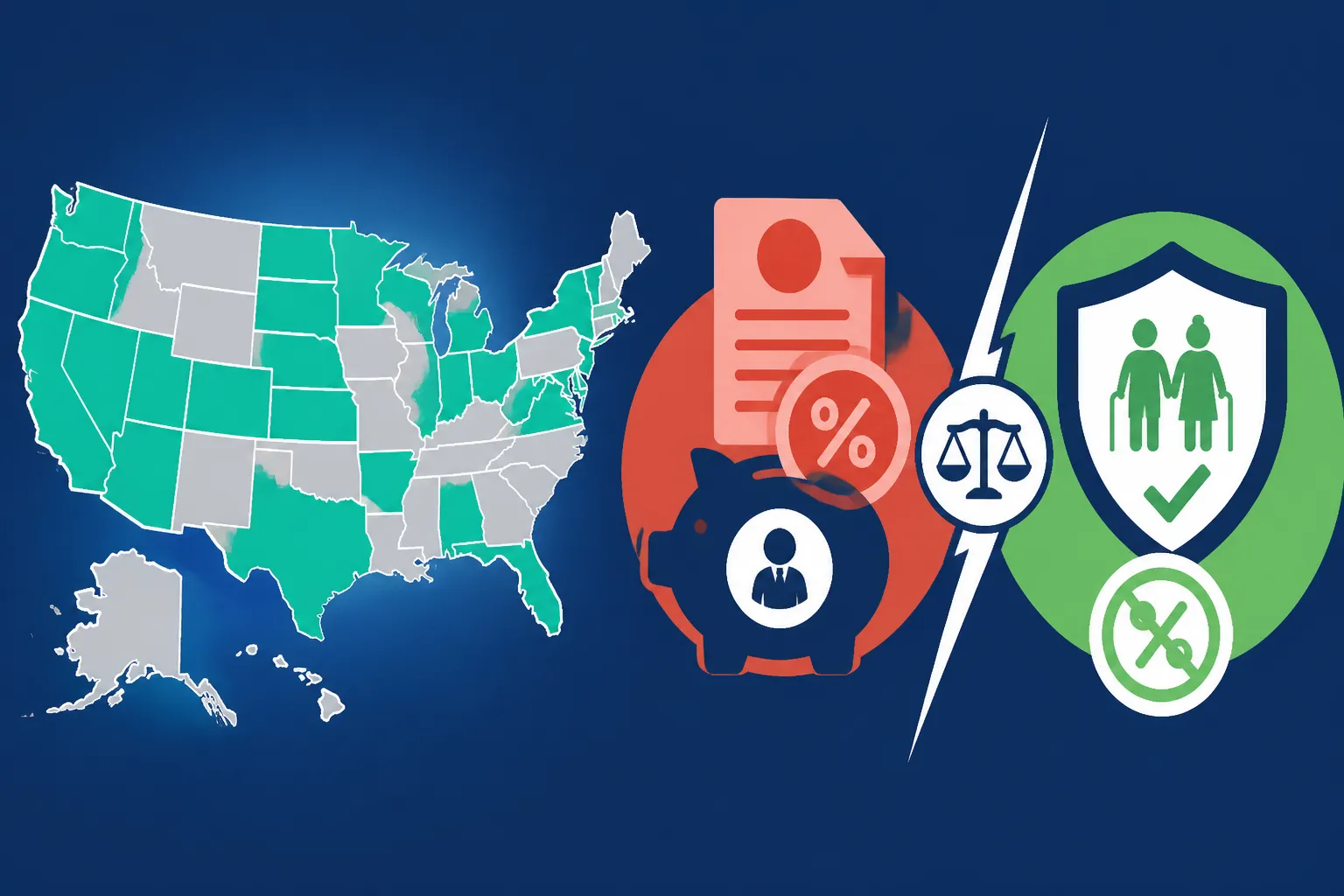
States That Tax 401k but Not Social Security
It can feel incredibly frustrating to plan for retirement, diligently save in your 401(k), and then face a confusing maze of state tax laws that seem to treat different parts of your hard-earned nest egg in wildly different ways. You might be wondering why some states leave your Social Security benefits untouched but take a bite out of your 401(k) withdrawals. This comprehensive guide is here to untangle that knot, helping you understand the specific states that tax 401(k)s but not Social Security, why they do it, and how you can best prepare for your financial future in retirement.
Understanding How States Tax Retirement Income
Navigating state taxes in retirement is far from straightforward. Many folks assume that all retirement income is treated equally, or that if a state is "tax-friendly," it applies universally to all sources of income. Oh, if only it were that simple! The reality is a patchwork of rules, exemptions, and thresholds that can vary significantly from state to state, making it a crucial part of your retirement planning.
The Nuance of State Tax Laws for Retirees
When you're looking at your retirement finances, it's not just about the federal government anymore. Each state has its own unique approach to generating revenue, and how they decide to tax retirees often reflects their economic priorities and how much they want to attract or retain older residents. Some states might heavily rely on property taxes or sales taxes, allowing them to be more generous with income tax exemptions for retirees. Others might have broader income taxes that, while perhaps offering some relief, still apply to a significant portion of your retirement funds.
This complexity means that what works for your friend retiring in Florida, a state famous for its lack of income tax, might be entirely different for you if you're planning to stay in, say, New York or Massachusetts. You can't just generalize. You really need to dig into the specifics of your state, or the state you're considering moving to, to understand the full picture of your tax burden. Many retirees find themselves blindsided by these state-level differences, especially when they begin drawing down on their investments, thinking they had a solid plan. It’s a common frustration, and one that absolutely warrants a detailed look.
Differentiating 401(k)s and Social Security for State Taxes
The reason states often treat 401(k) distributions and Social Security benefits differently comes down to a few key factors, largely related to the source of the income and the public policy goals behind taxing (or not taxing) them. Social Security, for many, is seen as a foundational safety net, often representing a significant portion, if not all, of a low-to-moderate income retiree's financial support. States might choose to exempt these benefits to protect vulnerable seniors and ensure they have enough to cover basic living expenses. It’s a policy decision often rooted in social welfare and minimizing hardship.
On the other hand, 401(k) withdrawals, along with other private pensions and IRA distributions, are generally considered deferred income. This means you didn't pay tax on the contributions when you earned them, and the investment grew tax-free. When you withdraw these funds in retirement, they are typically taxed as ordinary income at the federal level, and many states follow suit. These funds are often seen as part of an individual's accumulated wealth, and states may view them as a more appropriate target for income taxation, especially for higher earners, compared to Social Security benefits. This distinction is really important because it shapes where your money goes when you finally start enjoying your retirement savings.
States That Tax 401(k) Withdrawals But Exempt Social Security
It's a common scenario: you've saved diligently in your 401(k) for decades, and you're now ready to start drawing from it. But for many retirees, the reality hits when they realize their state income tax bill includes those distributions, while their Social Security checks are left untouched. This isn't an anomaly; it's a deliberate choice by numerous states.
List of Key States and Their Approaches
Several states choose to exempt Social Security benefits from state income tax, either fully or partially, while simultaneously taxing distributions from 401(k)s and other private retirement accounts. This approach aims to provide a basic level of financial security for most retirees, recognizing Social Security as a vital income source, while still generating revenue from other, often larger, retirement savings. Here are some prominent examples and their general approaches:
- California: While famous for its high income tax rates, California does not tax Social Security benefits. However, distributions from 401(k)s, IRAs, and other private pensions are fully taxable as ordinary income. So, if you're a retiree in Los Angeles drawing from your 401(k), expect to pay state tax on that income, but your Social Security is safe.
- New Jersey: The Garden State generally exempts Social Security benefits from state income tax. For other retirement income, including 401(k) withdrawals, New Jersey offers a significant exclusion for seniors, which can reduce or eliminate the tax burden for many middle-income retirees. However, if your income exceeds certain thresholds, your 401(k) distributions become taxable.
- New York: Similar to its neighbor, New York provides a full exemption for Social Security benefits. For 401(k) and other pension income, there's a generous pension and annuity exclusion for individuals aged 59 1/2 or older. If your annual pension and annuity income (which includes 401(k) withdrawals) is below this exclusion amount, it's generally not taxed. However, any amount above that threshold is subject to New York's progressive income tax rates.
- Massachusetts: This state does not tax Social Security benefits at the state level. However, income from 401(k)s, IRAs, and other private pensions is typically taxed as ordinary income. Massachusetts has a relatively flat income tax rate, so while your Social Security is safe, your private retirement distributions will contribute to your taxable income.
- Connecticut: Social Security benefits are fully exempt for taxpayers below certain adjusted gross income (AGI) thresholds. If your AGI is above those thresholds, a portion of your Social Security may become taxable. However, 401(k) withdrawals and other pension income are generally subject to state income tax, though some relief might be available through pension exclusions for lower-income individuals.
- Colorado: The Centennial State provides a deduction for Social Security benefits, often resulting in most, if not all, being exempt, especially for lower and middle-income retirees. For other retirement income like 401(k) distributions, retirees can exclude a certain amount, but any income beyond that exclusion is taxed. This means many will still pay tax on a portion of their 401(k) withdrawals.
- Maryland: Social Security benefits are exempt from state income tax. Maryland also offers a substantial exclusion for qualifying retirement income for those aged 65 and older, or permanently disabled, which can significantly reduce the tax on 401(k) withdrawals. But for those with higher incomes, a portion of their 401(k) income will still be subject to state tax.
These examples illustrate that while the intent to protect Social Security recipients is common, the mechanism for taxing 401(k)s and other retirement income can differ significantly, often involving exclusions or income thresholds.
How These States Structure Their Exemptions
The specific ways these states differentiate between Social Security and 401(k)s can be quite intricate, and it’s where retirees often need to pay closest attention. For Social Security, the exemption is often outright. For instance, in states like California and Massachusetts, your Social Security benefits simply aren't considered taxable income at the state level, regardless of your overall income. This provides a clear, predictable benefit for all Social Security recipients in those states. It simplifies planning for that particular income stream, giving a sense of security that it won't be chipped away by state taxes.
However, for 401(k) withdrawals, the story often changes. While they're generally not fully exempt, many states recognize that retirees need some relief. This is where exclusions and deductions come into play. A state like New Jersey or New York, for example, offers a specific dollar amount that retirees can subtract from their total pension and annuity income (which includes 401(k) distributions) before applying their state income tax rates. This exclusion might be quite generous, effectively making many retirees' 401(k) withdrawals non-taxable up to a certain point. Think of it as a special allowance for seniors. However, if your withdrawals exceed that amount, the excess becomes taxable. Similarly, states like Maryland and Colorado use various subtractions or exemptions based on age and income levels, designed to lighten the load on retirement income without completely eliminating the tax. Understanding these specific thresholds and exclusions is key to accurately forecasting your state tax liability in retirement. You can read more about various state approaches in our guide on Retirement Income Exclusions by State.
Why States Choose Different Approaches
The varied landscape of state retirement income taxation isn't accidental; it's a result of deliberate policy choices driven by a mix of economic realities, political philosophies, and strategic goals. These decisions have tangible effects on residents' wallets and the state's overall financial health.
Economic Philosophies and Revenue Needs
One of the primary drivers behind how a state taxes retirement income is its underlying economic philosophy and, quite frankly, its need for revenue. States operate on budgets, just like households, and they need reliable income to fund public services like roads, schools, and healthcare. If a state has a relatively diverse economy with a strong tax base from other sources, such as property taxes, sales taxes, or a robust business sector, it might feel less pressure to heavily tax individual income, including retirement income. In such cases, they might choose to be more lenient on certain income streams like Social Security, or offer generous exclusions for 401(k)s, as a way to ease the burden on their senior population.
Conversely, states with less diverse revenue streams might rely more heavily on income taxes, leading to a broader application of those taxes to all forms of income, including 401(k) distributions. The decision to exempt Social Security often stems from a recognition of its role as a basic living stipend for many, making it a less palatable target for taxation, especially from a social equity standpoint. Taxing Social Security disproportionately affects lower and middle-income retirees, and many states prefer to avoid that. However, 401(k)s and other pensions, often seen as supplemental or accumulated wealth, are viewed as more appropriate for taxation to meet essential state revenue needs. It’s a delicate balancing act between supporting residents and keeping the state’s coffers full.
Attracting or Retaining Retirees
Beyond pure revenue, states also use their tax policies as a strategic tool to attract and retain certain demographics, particularly retirees. There's a well-known phenomenon of "snowbirds" and others migrating to states with perceived tax advantages in retirement, like Florida or Texas, which have no state income tax at all. You can explore this further in our article, Moving to a Tax-Friendly State for Retirement. To compete, states with income taxes have to find ways to make themselves appealing.
Exempting Social Security and offering exclusions for other retirement income, even if 401(k)s are still partially taxed, can be a significant part of this strategy. For example, a state like New Jersey or New York, which are generally considered high-tax states, uses its specific retirement income exclusions as a way to say, "Hey, we know our taxes are higher overall, but we still value our senior residents and want to make it feasible for them to stay." By making Social Security completely tax-free and offering substantial exclusions on 401(k)s, they aim to reduce the tax burden enough to prevent a mass exodus of their retired population, who often contribute to the local economy in other ways (e.g., property taxes, sales taxes). This strategy isn't about eliminating all taxes, but about making the tax environment palatable enough to keep their experienced, often civic-minded residents within their borders.
Navigating Your Retirement Taxes in These States
Understanding which states tax your 401(k) but not your Social Security is just the first step. The real challenge, and where SmartAsset tools often come in handy, is figuring out how to manage your finances within these specific tax environments. It requires thoughtful planning, especially concerning when and how you draw from your various retirement accounts.
Planning for 401(k) Withdrawals
If you live in a state that taxes your 401(k) withdrawals but not your Social Security, strategic planning around those distributions becomes absolutely vital. You can't just pull money out haphazardly; timing and amount really matter. For instance, if your state offers an exclusion for a certain amount of retirement income, you might aim to keep your annual 401(k) withdrawals below that threshold if possible, to minimize or even eliminate state income tax on those funds.
This often involves coordinating your withdrawals with other income sources, like your Social Security benefits or any part-time work income. For example, if you're single and your state allows a $25,000 exclusion for retirement income, and you also receive $20,000 in Social Security (which is untaxed by the state), you might plan your 401(k) withdrawals to not exceed that $25,000 mark. Going over it means the additional amount is taxed at your state's ordinary income rates, potentially pushing you into a higher effective tax bracket overall. Financial advisors often suggest a "tax-efficient withdrawal strategy" that looks at all your accounts—401(k), IRA, Roth IRA, taxable brokerage accounts—to create a sequence of withdrawals that minimizes your overall tax burden, both federal and state. This strategy can be especially beneficial in states with progressive income tax rates.
Considerations for Relocation
For some retirees, the state tax landscape is a major factor in deciding where to live out their golden years. If you're in a state that heavily taxes your 401(k) withdrawals and you find that burdensome, you might start looking at options for moving to a more tax-favorable state. This could mean considering one of the nine states with no income tax at all, or a state that has broader exemptions for all types of retirement income. When comparing states, you shouldn't just look at income tax; you need to consider the full tax picture, including property taxes, sales taxes, and even inheritance or estate taxes.
For example, a state with no income tax might have significantly higher property taxes, which could offset any income tax savings, especially if you own a valuable home. It’s also crucial to understand the state's residency rules before making a big move, as some states, like California or New York, have complex rules about establishing domicile and may still try to tax your income if you don't fully cut ties. Tools like those from SmartAsset can help compare the overall tax burden by state. You can also dive into our detailed guides like States With No Income Tax (2026 Full List) or Most Tax-Friendly States for Retirees 2026 to get a clearer picture of potential destinations. Remember, a move isn't just about taxes; it's about lifestyle, proximity to family, climate, and access to healthcare, but taxes can certainly be a deciding factor for many.
Beyond 401(k)s and Social Security: Other Retirement Income
While 401(k)s and Social Security often get the most attention, retirement income comes in many forms. Pensions, IRAs, military retirement, and annuities all have their own state tax treatments, and understanding these nuances is crucial for a complete retirement tax picture.
Pensions and IRAs
Pensions, particularly those from private employers or state/local government, and traditional IRA withdrawals are typically treated similarly to 401(k) distributions for state income tax purposes. This means that if a state taxes 401(k)s but not Social Security, it's highly likely that your pension and IRA withdrawals will also be subject to state income tax, possibly with similar exclusions or deductions for seniors. For instance, in New York, the same pension and annuity exclusion that applies to 401(k)s generally covers traditional IRA withdrawals as well.
However, there are exceptions. Some states may offer specific exemptions for government pensions, especially for former state or local employees, while still taxing private pensions and 401(k)s. It's really a mixed bag depending on the state. Roth IRA withdrawals, on the other hand, are generally tax-free at both the federal and state levels, as long as you meet the conditions (i.e., the account has been open for at least five years and you are over 59½, disabled, or using the funds for a first-time home purchase). This makes Roth IRAs a fantastic tool for tax-free income in retirement, even in states that tax other retirement sources. Always double-check the specifics for your state, because a blanket assumption about "retirement income" can lead to unexpected tax bills.
Military Retirement and Annuities
Military retirement pay also has its own unique tax considerations at the state level. Many states offer full or partial exemptions for military retirement benefits, a policy often intended to honor veterans and attract or retain the military community within their borders. Even states that generally tax other forms of retirement income, like 401(k)s, might provide significant breaks for military pensions. For example, some states might fully exempt military retirement pay, while others might allow a large deduction.
Annuities, which are essentially contracts with an insurance company that provide regular income payments, are another common source of retirement income. The taxation of annuity payments at the state level can be complex. Generally, only the "earnings" portion of an annuity payment is taxable, while the return of your original principal (which you already paid tax on, or contributed with after-tax money) is not. States that tax 401(k)s will typically tax the taxable portion of annuity payments as ordinary income. Again, any specific state exclusions for general retirement income may also apply to annuity payments. It's worth noting that the rules for Military Retirement Tax by State (Full List) can be quite diverse, so it's critical to understand your specific state's stance.
The Impact of Changing State Tax Laws
State tax laws are not set in stone; they are dynamic, constantly evolving in response to economic pressures, legislative priorities, and shifts in population demographics. What's true for 2026 might see changes in 2027 or beyond, especially regarding retirement income. Staying informed is paramount for effective financial planning.
Recent Trends in Retirement Taxation
We've seen some significant trends in state retirement taxation over the past few years. A growing number of states are recognizing the economic and social benefits of being more retiree-friendly. Many are either phasing out their income tax on Social Security benefits (like Missouri, Kansas, and Nebraska recently did for 2024, or West Virginia is phasing out for 2026), or increasing existing exclusions for other types of retirement income, including 401(k)s and pensions. This trend is often driven by states competing to attract retirees, who often bring financial stability and less demand on certain public services compared to younger, working populations.
Another trend is the move towards flat income tax rates in some states, or a reduction in overall income tax rates. While a flat tax state might still tax 401(k)s, a lower overall rate could mean less of a burden even if Social Security is exempt. These changes can have a substantial impact on your retirement budget, either freeing up more of your income or, if a state decides to increase taxes, costing you more. It truly highlights the need for continuous monitoring of your state's tax policy, which you can track through resources like State Income Tax Cuts & Changes for 2026.
Keeping Up with Legislative Changes
Given the fluidity of state tax laws, it's absolutely essential to stay informed about any legislative changes that could impact your retirement income. This isn't just a "set it and forget it" kind of situation. State legislatures meet annually, and tax policy is often on the agenda. A new governor might come in with a different vision for the state's economy, or a budget shortfall could prompt lawmakers to rethink existing exemptions.
You can typically find information on tax law changes through your state's Department of Revenue website. Many reputable financial news outlets and tax preparation services also publish annual summaries of state tax changes. Organizations like SmartAsset regularly update their guides to reflect the latest information. Consider subscribing to newsletters or setting up alerts for tax news specific to your state. It might seem like a chore, but proactively keeping up with these changes allows you to adjust your withdrawal strategies or even reconsider your residency plans before new laws take effect, potentially saving you a significant amount of money over your retirement years. Being caught off guard by a tax change you weren't aware of can be a stressful and costly experience, so make it a priority to stay in the loop.
To help visualize some of the differences, here’s a table outlining a few states that tax 401(k)s but generally exempt Social Security, along with their key features.
| State | Taxes Social Security? | Taxes 401(k) Withdrawals? | Notable Exclusions/Details for 401(k)s | General State Income Tax Rate Style |
|---|---|---|---|---|
| California | No | Yes | None (taxed as ordinary income) | Progressive |
| Connecticut | No (for lower AGI) | Yes | Limited pension exemption | Progressive |
| Colorado | Generally No (deduction) | Yes | Senior retirement income subtraction | Flat (though credits vary) |
| Maryland | No | Yes | Significant retirement income exclusion | Progressive |
| Massachusetts | No | Yes | None (taxed as ordinary income) | Flat |
| New Jersey | No | Yes | Generous retirement income exclusion | Progressive |
| New York | No | Yes | Pension and annuity exclusion | Progressive |
| Utah | Generally No (credit) | Yes | Limited retirement tax credit | Flat |
| Vermont | No (for lower AGI) | Yes | None (taxed as ordinary income) | Progressive |
Note: "No (for lower AGI)" or "Generally No" implies that while Social Security is largely exempt for most retirees, there might be income thresholds where a portion could become taxable for higher earners.
Disclaimer
The information provided in this guide is for general informational purposes only and does not constitute financial, legal, or tax advice. State tax laws are complex and subject to change. You should consult with a qualified financial advisor or tax professional to discuss your specific situation and make informed decisions about your retirement planning and tax strategy. Always verify current tax laws with your state's Department of Revenue.