State Income Tax Rates 2026: All 50 States Ranked
Most people feel a mounting sense of dread when they see that "State Tax" line item on their pay stub, often feeling like a significant portion of their hard-earned money is vanishing into a black hole without a clear explanation. Whether you are planning a cross-country move or simply trying to figure out why your take-home pay feels lower than it should, this guide ranks the state income tax rates for all 50 states in 2026 to give you the clarity you deserve.
Understanding the 2026 State Income Tax Landscape
The year 2026 marks a fascinating turning point in how states collect revenue from their residents. For decades, many states relied on complex, multi-tiered progressive systems that mirrored the federal government. However, we are currently witnessing a massive shift as more state legislatures move toward simplified tax codes. This change isn't just about numbers; it's about how states compete for residents. When you look at your paycheck, you aren't just seeing a tax rate; you're seeing the result of years of local political debates and economic forecasting.
The Massive Shift Toward Flat Tax Systems
One of the most significant trends we've seen leading into 2026 is the rapid adoption of flat tax systems. States like Indiana, Georgia, and Arizona have led the charge, arguing that a single rate for all taxpayers is fairer and easier to administer. If you live in a state that recently transitioned, you might have noticed your tax filing process becoming slightly less of a headache. The logic here is that by keeping a low, consistent rate, states can attract high-earning professionals who are tired of being "punished" for their success by higher brackets.
However, the flat tax isn't a magic wand for everyone. While it simplifies the math, critics often point out that it can place a heavier relative burden on lower-income families who previously benefited from bottom-tier rates of 1% or 2%. In 2026, many of these states have implemented higher standard deductions to offset this, but the reality is that a flat tax changes the "vibe" of the state's relationship with its earners. You can see a detailed breakdown of which states have taken this route in our guide on States With a Flat Income Tax (2026).
The transition periods can also be messy. If you are living in a state currently phasing in a flat tax, you might be dealing with "trigger" laws where the rate only drops if the state hits certain revenue milestones. This creates a lot of uncertainty for your long-term financial planning. It’s always a good idea to use a tool like SmartAsset to run different scenarios based on potential rate changes so you aren't caught off guard when you file your return next April.
How Inflation Adjustments Affect Your Paycheck
You might have heard the term "bracket creep" whispered in hushed, frustrated tones around the office coffee machine. This happens when your salary increases to keep up with the rising cost of groceries and gas, but the state's tax brackets stay the same. Suddenly, you're in a higher tax bracket even though your actual purchasing power hasn't changed. In 2026, more states than ever have begun "indexing" their brackets to inflation to prevent this silent tax hike.
States like California and New York have robust indexing systems, but other states are still lagging behind. If you live in a state that doesn't index, a $3,000 raise could actually result in less take-home pay if it pushes you over a specific threshold. This is a common frustration for middle-class workers who feel like they are running on a treadmill just to stay in the same place financially. It is vital to understand How State Tax Brackets Work: Marginal vs Effective to see if you are actually paying more than you realize.
When you look at the 2026 data, pay close attention to whether the brackets have moved since last year. Even a small shift in the threshold can mean a few hundred extra dollars in your pocket over the course of the year. For many families, that’s the difference between a modest vacation and staying home. Understanding these nuances helps you validate that feeling of "where did my money go?" and gives you the tools to plan your budget more effectively.
Recent Legislative Changes and Tax Cuts
The legislative sessions leading into 2026 were surprisingly active, with many states sitting on budget surpluses and choosing to "return" that money to taxpayers via rate cuts. This is often a strategic move during election cycles, but the impact on your bank account is real regardless of the motivation. Arkansas, West Virginia, and Nebraska have all been aggressive in slashing their top marginal rates recently to remain competitive with their neighbors.
These cuts often come with a catch, though. Sometimes a reduction in income tax is balanced by a quiet increase in "sin taxes" on things like tobacco or alcohol, or an increase in the local sales tax. As a veteran blogger in this space, I've seen many people celebrate a 0.5% income tax cut only to realize they are paying more at the register every time they shop for clothes or electronics. It’s a shell game that requires a keen eye to track.
If you're curious about how your specific state compares to the federal system, you should check out our comparison of State Income Tax vs Federal Income Tax. While the federal government gets the most headlines, for many residents in high-tax states, the state-level burden is the one that really stings during the monthly budget review. Staying informed on these legislative pivots is the only way to ensure you are maximizing your tax strategy.
Ranking the 50 States: From No Tax to High Tax
When we talk about ranking states, the "winners" in most people's minds are the ones that don't take a dime from their paycheck. But as anyone who has lived in Austin or Orlando can tell you, "no income tax" doesn't necessarily mean "free to live." Every state needs revenue to fix the roads, pay teachers, and maintain parks. If they aren't getting it from your income, they are getting it from somewhere else.
The Famous Nine: States With No Income Tax
As of 2026, there are nine states that remain committed to the $0 income tax model. These include Alaska, Florida, Nevada, South Dakota, Tennessee, Texas, Washington, and Wyoming. New Hampshire is also part of this group for earned income, though it has historically taxed interest and dividends. If you've ever thought about packing your bags and heading to the Sun Belt, the lack of an income tax is likely a primary driver. For a deeper look at the specific nuances of these locations, see our States With No Income Tax (2026 Full List).
Living in these states feels like an immediate raise. Imagine moving from a place with a 6% tax rate to Florida; on a $100,000 salary, that’s an extra $500 a month in your pocket. That can cover a car payment, a premium gym membership, or a significant chunk of your grocery bill. It’s no wonder these states continue to see massive population growth. You can research the specific impact of these rules on workers in our guide: Is Florida Tax Friendly for Workers?.
However, there is always a trade-off. Washington state, for example, has no personal income tax but has a high state sales tax and a capital gains tax for high earners. Texas is famous for its lack of income tax but often shocks newcomers with its property tax bills, which can be double or triple what you’d pay in a state with an income tax. It's a classic case of "choose your poison." If you're weighing the pros and cons of this lifestyle, you'll find our analysis of Is It Cheaper to Live in a State With No Income Tax? incredibly eye-opening.
States With the Highest Income Tax Rates
On the other end of the spectrum, we have states that view income tax as a vital tool for social services and infrastructure. California, New Jersey, and New York consistently top the charts with the highest marginal rates in the country. In California, the top rate for millionaires can exceed 13%, but even for middle-income earners, the rates climb quickly. If you've ever looked at your paycheck in San Francisco and sighed, you are not alone.
These high-tax states often provide a different quality of life, with extensive public transportation, world-class universities, and robust social safety nets. But for the individual taxpayer, the cost is undeniable. Many residents in these areas are increasingly feeling the "squeeze," especially when you combine high income taxes with the high cost of housing. To understand the specific mechanics of these high rates, take a look at Why Are California Taxes So High?.
New York is another interesting case, especially with the added layer of New York City's local income tax. If you live and work in the five boroughs, you are hit with a "triple threat": federal, state, and city taxes. This can push your total tax burden to nearly 50% if you are a high earner. We break this down further in our explanation of NYC Income Tax Explained (2026 Rates). For many, the cultural and economic opportunities of the city outweigh the tax bill, but it requires careful financial maneuvering.
The Middle Ground: Competitive and Flat Tax States
Then there is the "great middle." States like North Carolina, Utah, and Colorado offer a more balanced approach. Many of these have moved to flat taxes in recent years, keeping rates between 3% and 5%. This is often the "Goldilocks" zone for many families—the taxes aren't so high that they feel burdensome, but they provide enough revenue for the state to function effectively without relying on astronomical property or sales taxes.
Pennsylvania is a classic example of this, maintaining a flat rate of 3.07% for years. It’s predictable and relatively low, making it a favorite for those who want simplicity. Similarly, North Carolina has been on a path to aggressively lower its flat rate, making it one of the most competitive states in the Southeast. If you are looking for a state that won't surprise you during tax season, these flat-tax havens are worth a look.
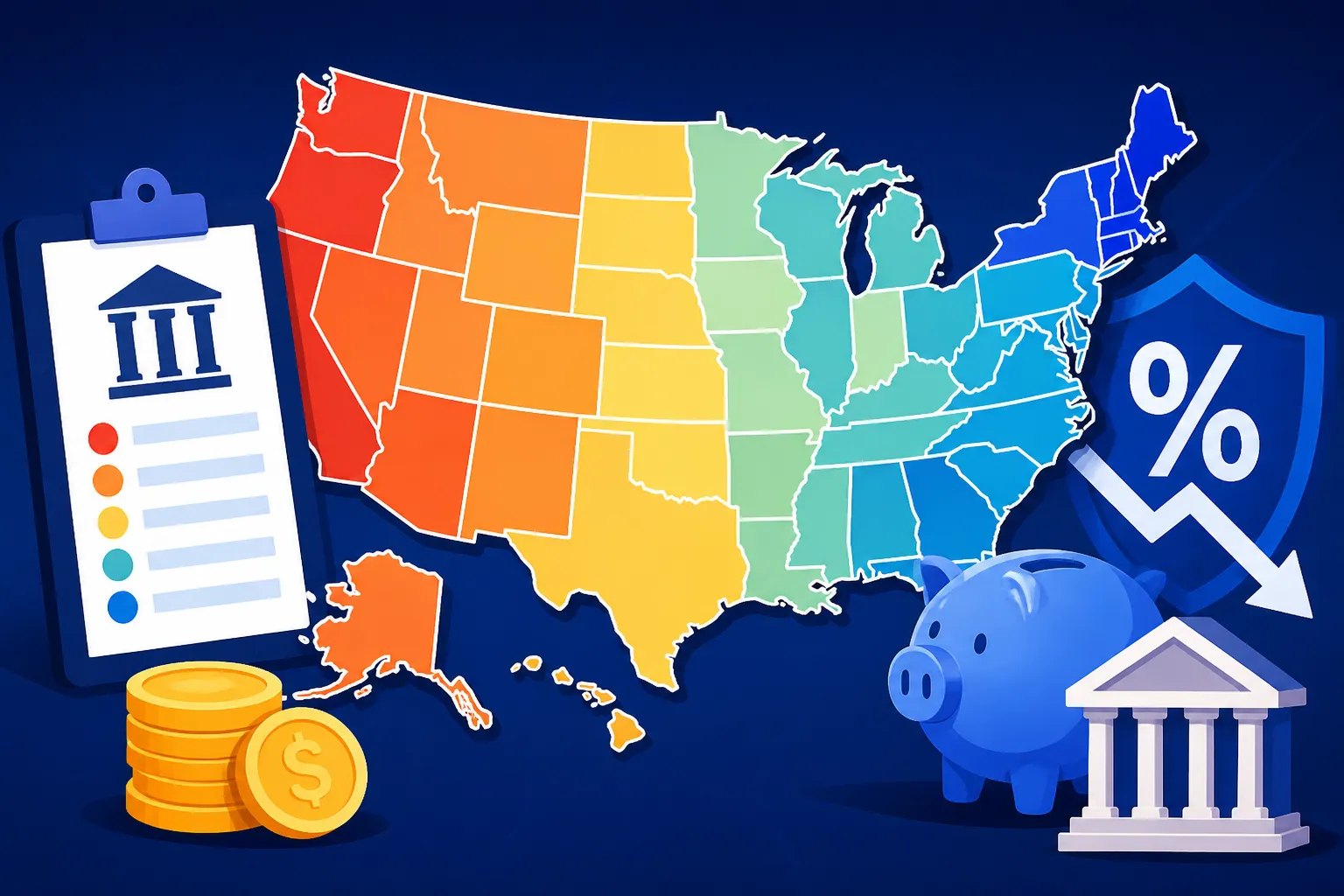
To see where your current or prospective state falls in the hierarchy, check out the comparison table below. It highlights the top marginal rates and the type of tax system each state uses for 2026.
| State | Top Marginal Rate (2026) | Tax System Type |
|---|---|---|
| California | 13.3% | Progressive |
| New York | 10.9% | Progressive |
| New Jersey | 10.75% | Progressive |
| Oregon | 9.9% | Progressive |
| Minnesota | 9.85% | Progressive |
| Massachusetts | 5.0% / 9.0% | Flat / Multi-Tier |
| Pennsylvania | 3.07% | Flat |
| Indiana | 2.9% | Flat |
| Florida | 0% | No Income Tax |
| Texas | 0% | No Income Tax |
Regional Deep Dives: Where You Live Matters
The geography of taxes is a real phenomenon. You’ll often find that states in the same region tend to copy each other's tax policies to avoid losing residents to their neighbors. This creates "tax clusters" across the United States. If you're a remote worker with the flexibility to live anywhere, understanding these regional trends can save you thousands of dollars a year.
The Northeast Corridor and the High Tax Burden
The Northeast is historically the most expensive region for income taxes. From Maine down to Maryland, the trend is high progressive rates and, in many cases, additional local taxes. Connecticut and Massachusetts have both grappled with "millionaire taxes" to fund education and transportation, creating a high-cost environment for residents. If you are working in this region, you are likely feeling the weight of these contributions every single month.
One of the most confusing aspects of living in the Northeast is the prevalence of local and city-level taxes. Beyond just the state, cities like Philadelphia and Wilmington have their own wage taxes that apply to anyone living or working there. This can be a shock if you move from a rural area where these don't exist. You can learn more about these hidden costs in our guide to Local & City Income Taxes in the US.
Furthermore, the "commuter struggle" is real in this region. Many people live in New Jersey or Connecticut and commute into New York City. This creates a complex tax situation where you might owe money to two different states, though most have credits to prevent double taxation. Navigating this requires a tool like SmartAsset to ensure you're withholding the right amount from your checks. We dive deep into this scenario in Live in NJ Work in NY: Tax Guide.
The Midwest Tax Revolution
The Midwest is currently the most exciting region to watch for tax nerds. States that were once high-tax strongholds are pivoting toward flat taxes and significant exemptions. Michigan and Ohio have both undergone major reforms to make their states more attractive to businesses and families. In Michigan, the rate is tied to the state's general fund revenue, meaning if the state does well, your taxes actually go down automatically.
Ohio has also simplified its system, collapsing multiple brackets into just a few. This has made the Buckeye State much more competitive with its neighbor, Indiana, which has long boasted one of the lowest flat taxes in the country. If you're looking for a low cost of living combined with a manageable tax bill, the Midwest is increasingly the place to be. It’s a complete 180 from the "Rust Belt" reputation of the past.
However, you still have to watch out for local "RITA" taxes in Ohio cities, which can add a layer of complexity to your filing. These local collections are separate from the state and require their own paperwork. If you’re feeling overwhelmed by the paperwork, you aren't alone; thousands of Midwesterners struggle with this every year. You can find help in our guide to Which Ohio Cities Have Income Tax?.
The West Coast Divide: Washington vs. Oregon
The border between Washington and Oregon is one of the most famous "tax arbitrage" spots in the country. Washington has no state income tax, while Oregon has no state sales tax. For decades, people have tried to live on the Washington side of the Columbia River and shop on the Oregon side to avoid both taxes. It sounds like a dream, but the states have become very savvy at closing these loopholes.
Oregon's income tax rates are among the highest in the nation, often hitting 9% even for middle-class earners. This can be a bitter pill to swallow if you’re moving from a lower-tax state. Meanwhile, Washington has introduced a 7% tax on long-term capital gains for high earners, signaling that even "no tax" states are looking for new ways to generate revenue. You can see how this affects your investments in our breakdown of Washington Capital Gains Tax Explained (7% / 9.9%).
This regional rivalry shows that no matter where you go, the government is going to find a way to fund its operations. Whether it's through your paycheck, your property, or your shopping cart, the "tax-free" dream is usually more about how you pay rather than if you pay. If you're choosing between these two Pacific Northwest giants, our Oregon vs Washington Taxes Compared article is a must-read.
How to Calculate Your Real Tax Burden
Looking at a "top rate" is only half the story. To truly understand your financial situation, you need to look at your effective tax rate—the percentage of your total income that actually goes to the state after deductions and credits. This is where most people get confused, and honestly, it’s where the most "magic" happens in tax planning.
Starting With Your Adjusted Gross Income (AGI)
Most states start their tax calculation with your federal Adjusted Gross Income (AGI). This means that any "above-the-line" deductions you take on your federal return—like student loan interest or traditional IRA contributions—will likely lower your state tax bill too. It’s the foundation of your tax return. If you can lower your AGI, you win at both the federal and state levels.
However, some states have "add-backs" where they make you add certain income back into the total that the federal government ignored. This can be incredibly frustrating. For example, some states tax municipal bond interest from other states, even though it’s tax-free federally. This is why a simple "1040" doesn't always tell the whole story for your state return.
To get an accurate picture, you should use a calculator like SmartAsset's state tax tool. It allows you to input your specific zip code and income to see exactly what will be left over. This is especially helpful if you live in a state with local taxes. Understanding this process is the first step in taking control of your finances. For more detail, check out our How Do I Calculate My State Income Tax? guide.
The Role of Deductions and Credits
This is where you can actually fight back against a high tax bill. Most states offer a standard deduction, just like the federal government. In 2026, some states have significantly increased these amounts to help lower-income families. For instance, the California Standard Deduction 2026 is much higher than in many other states, which helps offset their high rates for people earning less.
Beyond deductions, you should look for "refundable" tax credits. These are the holy grail of tax season because they can actually result in the state sending you a check for more than you paid in. The Earned Income Tax Credit (EITC) and Child Tax Credits are the most common examples. Many states have expanded these for 2026 to support families. You can see if your state offers these in our guide on State Earned Income Tax Credits (EITC) Guide.
Don't forget about specific credits for things like installing solar panels, contributing to a 529 college savings plan, or even renting your home. In states like Minnesota and California, renters can get a modest credit to help with high housing costs. These little "wins" can add up to thousands of dollars over time. To see the full list of what you might be missing, take a look at our State Tax Credits: Solar, College & Dependent Care pillar.
Factoring in Reciprocity and Multi-State Filing
In our modern, remote-work world, it's common to live in one state and work for a company in another. This is where the 183-day rule and reciprocity agreements come into play. If your state has a reciprocity agreement with a neighboring state, you generally only pay taxes to the state where you live. This is a huge relief for people in the DC-Maryland-Virginia area or the Illinois-Wisconsin border.
Without these agreements, you have to file as a "non-resident" in the state where you work and a "resident" in the state where you live. You'll usually get a credit on your home state return for taxes paid to the other state, but the paperwork is a nightmare. It feels like you're paying twice, even if the math eventually works out. You can learn how to navigate this in State Reciprocity Agreements Explained.
If you are a "digital nomad" or a remote worker, you also have to worry about "convenience of the employer" rules. Some states, notably New York, will try to tax your income even if you never set foot in the state, as long as your office is located there. This is a highly contested area of tax law in 2026, and it’s something you must stay on top of if you want to avoid a massive audit. See our Remote Work State Taxes & Convenience of the Employer guide for the latest updates.
Strategies for Reducing Your State Tax Bill
Now that you know how the system works and how you rank, let's talk about how to keep more of your money. You don't have to just accept the number on your W-2. There are proactive steps you can take throughout the year to minimize the impact of state income taxes on your lifestyle.
Maximizing 529 Plans and Retirement Contributions
One of the most effective ways to lower your state tax bill is to invest in your future. Most states that have an income tax offer a deduction or credit for contributions to a 529 college savings plan. This is a "double win": you save for your child's education (or your own!) and you get an immediate tax break. In 2026, some states have even added "tax parity," meaning you can get a deduction for contributing to any state's 529 plan. Check out the 529 Plan Tax Deductions by State to see how much you can save.
Retirement contributions are another powerful tool. While the federal government allows you to deduct 401(k) and IRA contributions, most states follow suit. If you're in a high-tax state like New Jersey or Hawaii, every dollar you put into your 401(k) is effectively "saving" you an additional 5% to 10% in state taxes. It’s an immediate return on investment that most people ignore.
As you approach retirement, you should also consider where you want to live. Some states are incredibly friendly to seniors, exempting Social Security or even private pensions from taxation entirely. If you're planning your "golden years," you'll want to read States That Don't Tax Social Security (2027) and States That Don't Tax Pensions (2027). Moving just one state over could save you $5,000 a year in retirement.
Domicile vs. Residency: Avoiding the Audit
If you are planning to move to a lower-tax state like Florida or Nevada to save money, you can't just buy a condo and call it a day. States like California and New York are notorious for auditing people who claim to have moved but still maintain significant ties to their old home. They will look at your cell phone records, your "pattern of life," and even where you keep your most sentimental items (the "teddy bear test").
Establishing a new "domicile" requires a clean break. You need to register to vote, get a new driver's license, and spend more than half the year in your new state. If you get it wrong, you could end up owing back taxes, interest, and penalties to your old state for years. It's a high-stakes game that requires careful documentation. We explain the difference in Domicile vs Statutory Residency.
For those who spend half their time in a "warm" state and half in a "cool" state—the classic snowbirds—the 183-day rule is your best friend and your worst enemy. If you spend 184 days in a high-tax state, they will claim you as a resident and tax your entire worldwide income. Keeping a meticulous calendar is the only way to protect yourself. Learn more in our Snowbird & Dual-Residency Taxes guide.
Leveraging Business and Self-Employed Deductions
If you are a freelancer or a small business owner, you have even more options. Many states have implemented "Pass-Through Entity" (PTE) taxes, which allow you to pay your state income tax at the business level. This is a workaround for the federal $10,000 cap on state and local tax (SALT) deductions. It can save business owners tens of thousands of dollars in federal taxes.
You can also deduct specific business expenses on your state return that might not be as impactful on your federal return. From home office deductions to mileage, every expense lowers your taxable income. Since every state has slightly different rules for what counts as a legitimate business expense, using a tool like SmartAsset to track your obligations is a smart move.
Finally, don't forget to look into "location-based" credits. Some states offer huge tax breaks for businesses located in "enterprise zones" or rural areas. If you have the flexibility to choose where your office is located, you could practically wipe out your state tax bill while helping to revitalize a local community. It’s a win-win that many entrepreneurs overlook in the hustle of daily operations.
State Income Tax Disclaimer
The information provided in this guide is for educational and informational purposes only and does not constitute professional tax, legal, or financial advice. Tax laws, rates, and regulations are subject to frequent change by state legislatures and may vary significantly based on individual circumstances. We strongly recommend consulting with a qualified Certified Public Accountant (CPA) or tax professional before making any financial decisions or filing your state income tax return. While we strive to provide the most current data for 2026, always verify specific rules with your state’s Department of Revenue.